The survival of a pedestrian struck by a fixed-wing aircraft during takeoff or landing is dictated by a brutal intersection of kinetic energy distribution and the structural geometry of the airframe. When an individual enters the active runway environment—a breach of the sterile area protocol—the margin for error collapses into a series of milliseconds where pilot reaction time is functionally irrelevant. Analysis of recent runway incursions reveals that most "accidents" are actually the predictable outcome of specific failures in perimeter integrity and ground-based situational awareness systems.
The Kinetic Equation of Ground-to-Air Impact
To understand why a human body reacts as it does when struck by an aircraft, one must evaluate the Energy Transfer Model. In a standard vehicular collision, the point of impact is often cushioned by crumple zones designed to absorb Joules. In contrast, an aircraft is a rigid structure optimized for aerodynamic lift and structural tension.
The kinetic energy ($K_e$) involved is calculated by the formula:
$$K_e = \frac{1}{2} mv^2$$
Where $m$ is the mass of the aircraft and $v$ is the velocity at the moment of impact. Because velocity is squared, even a light sport aircraft weighing 1,320 lbs (approximately 600 kg) traveling at a modest taxi or rotation speed of 40 knots (approx. 20 m/s) carries significant force. The primary variables determining the lethality of a runway strike include:
- Point of Contact: Striking the landing gear (heavy, unyielding steel or aluminum) vs. the leading edge of a wing (hollow but high-velocity) vs. the propeller (rotational energy).
- Angle of Deflection: Whether the body is "thrown" clear or pulled under the fuselage into the path of trailing gear or engine intakes.
- Surface Friction: The runway environment is engineered for high-grip (friction) to assist braking. This surface acts as an abrasive at high speeds, compounding blunt force trauma with severe friction burns and degloving injuries.
The Three Pillars of Perimeter Failure
A man standing on a runway represents a systemic collapse of Aviation Security and Safety Layers. No single error allows a non-authorized person to reach an active takeoff strip. Instead, it is a cascading failure across three distinct domains.
Physical Barrier Integrity
The first failure occurs at the physical boundary. Airport perimeters are often miles long, frequently bordering public lands or dense urban centers. High-security fencing (typically 8 to 10 feet with outriggers) is a deterrent, not a solution. The failure modes here involve "blind spots" in vibration sensors or optical cameras where terrain allows for unmonitored breaching.
Surveillance and Detection Latency
Modern airports utilize Surface Movement Guidance and Control Systems (SMGCS). However, many smaller or regional fields rely on human sight and standard radar. Primary radar is designed to detect large metal objects, not a 180-pound human moving at 3 mph. This creates a Detection Gap: the system is blind to "soft targets" until they interact with "hard targets" (the aircraft).
Operational Communication Breakdown
Once a breach occurs, the time it takes for a ground observer to notify the tower, and for the tower to issue an emergency "Abort" or "Go-Around" instruction, usually exceeds the time remaining before impact. If an aircraft is in the "high-speed" portion of a takeoff roll (above 80–100 knots), the pilot is committed to the air; attempting to brake for a pedestrian could result in a runway excursion or a catastrophic fire, endangering everyone on board.
The Psychology of the Unauthorized Entrant
Identifying why individuals enter these zones is critical for preventative engineering. Incursions typically fall into three behavioral categories:
- Spatial Disorientation: Often seen in vehicle-based incursions where a driver takes a wrong turn from a taxiway onto a runway.
- Malicious Intent or Crisis: Intentional breaches for the purpose of self-harm or protest, which are almost impossible to stop with standard signage.
- Operational Complacency: Maintenance workers or ground crew who "normalized" the risk of crossing a line without specific clearance, leading to a momentary lapse in situational awareness.
Mechanical Risks to the Airframe
The narrative often focuses exclusively on the pedestrian, but the engineering implications for the aircraft are severe. An impact with a human body can cause:
- Foreign Object Debris (FOD) Ingestion: If the strike occurs near an engine intake, the biological and structural mass can cause a compressor stall or catastrophic engine failure.
- Control Surface Impairment: Damage to the leading edge of a wing or a stabilizer can disrupt laminar flow, potentially causing a stall during the most vulnerable phase of flight (initial climb).
- Landing Gear Malfunction: If the impact occurs against the nose gear, it can damage hydraulic lines or sensors, leading to a gear collapse upon the next landing.
Modernizing the "Sterile Runway" Concept
The current industry standard for runway safety is the Runway Status Lights (RWSL) system. This technology integrates surface radar with airfield lighting to automatically turn runway entrance lights red when an aircraft is moving at high speed nearby. This removes the "human middleman" from the safety equation.
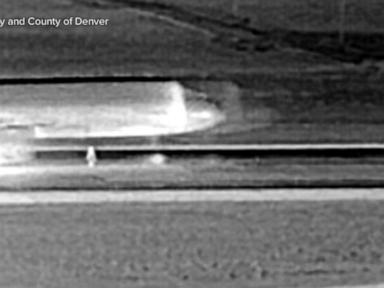
However, the RWSL system is largely focused on preventing aircraft-to-aircraft collisions. To address the "human on the runway" variable, airports must transition toward AI-Integrated Thermal Analytics. These systems use infrared cameras to distinguish the heat signature of a human from the ambient heat of the tarmac. When a signature is detected within the "sterile zone" of the runway, an automated alert can be triggered directly to the cockpit via the Electronic Flight Bag (EFB), bypassing the voice-lag of Air Traffic Control.
Strategic Operational Shift
Airports cannot rely on the hope that pilots will see a person in time to react. The visual profile of a human against a gray runway in low-light or high-glare conditions is nearly nonexistent. The strategic priority must move from Reactionary Reporting (seeing and saying) to Automated Inhibition (detecting and stopping).
The path forward requires a transition to "smart" perimeters where the fence is not just a wire mesh but a continuous sensor loop. Until every Tier 1 and Tier 2 airport integrates automated pedestrian detection into their Ground Radar systems, the runway remains a high-kinetic environment where the laws of physics will always outpace the speed of human intervention. Ground operations must treat the runway not as a road, but as a high-energy engine component where any foreign presence is a critical failure.