The Desk and the Ocean
Picture a desk in New Delhi. It is stacked with manila folders, tied with faded red string. The room is hot, the ceiling fan hums a low, hypnotic drone, and a bureaucrat is unscrewing the cap of a fountain pen.
Now, fly seven thousand kilometers away. Imagine the North Sea. The air tastes of salt and ice. Gale-force winds whip across a dark, churning ocean, spinning massive wind turbines that slice through the fog. Here, engineers are wrestling with the future of global energy, capturing kinetic power from the harshest environments on Earth.
These two worlds—the quiet, paper-laden office and the roaring, high-tech maritime frontier—are supposed to be building a bridge together.
Norway wants to invest billions of dollars into India’s green energy transition. India desperately needs that capital to power its soaring economy without choking its cities in smog. It looks like a perfect match on paper. But between the cold Nordic waters and the warm Indian plains lies a vast, invisible swamp.
Regulatory friction.
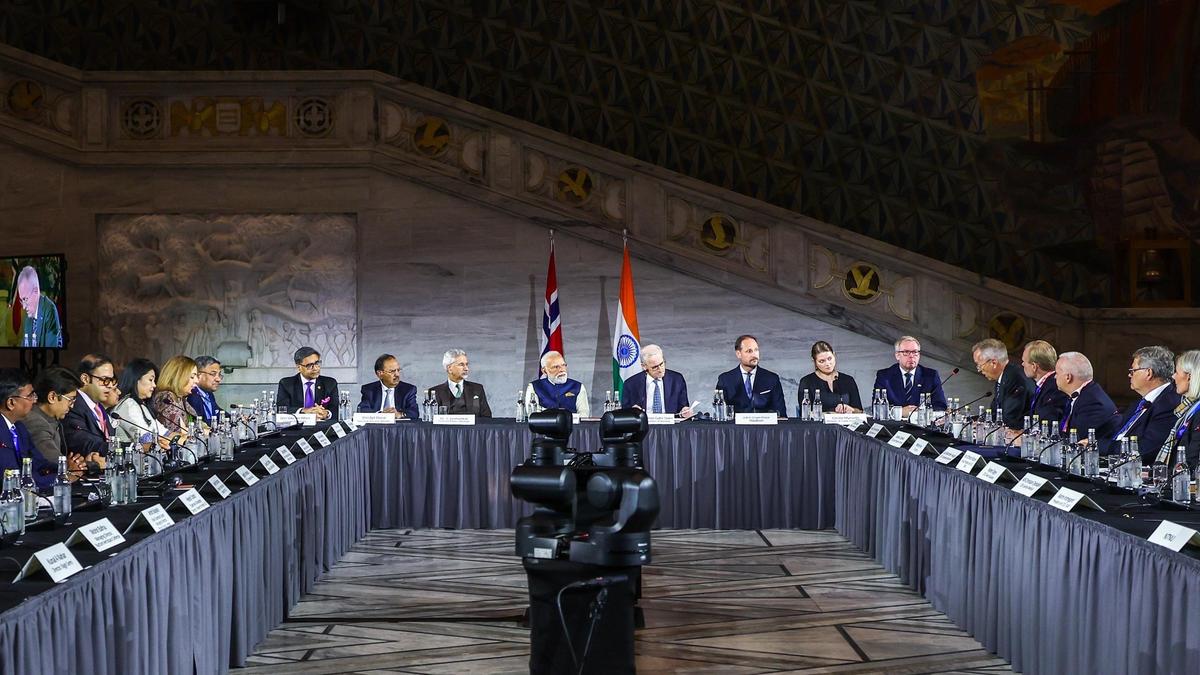
When Norwegian business leaders recently met with Indian Prime Minister Narendra Modi, they did not bring grand, philosophical complaints. They brought a map of the swamp. They spoke of "ground-level challenges"—a polite, corporate euphemism for the excruciating, day-to-day agony of trying to build complex infrastructure when the rules keep shifting beneath your feet.
The Phantom Factory
To understand what these executives are whispering behind closed doors, we have to look past the press releases. Let us use a hypothetical example to illustrate the friction.
Meet Vidar. He is a senior project manager for a Nordic maritime firm. Vidar does not hate bureaucracy; he understands that rules keep workers safe and prevent corruption. He arrived in Mumbai with a suitcase full of blueprints, a bank account backed by European pension funds, and a mandate to build a state-of-the-art offshore logistics hub.
For the first six months, everything is electric. The political speeches are warm. Handshakes are photographed.
Then, the ground shifts.
Vidar’s team applies for a standard maritime permit. The agency in charge says the form requires a stamp from a different ministry. Vidar goes to the second ministry. They inform him that because his technology uses a specific type of deep-water anchor, he actually needs clearance from a third, newly formed environmental committee.
Months bleed into quarters. The pension fund managers back in Oslo start looking at the calendar. They are paying interest on capital that is sitting idle in a bank account.
Suddenly, the local state government announces a retroactive change to its land-use policy. The site Vidar spent a year surveying is now subject to a different tax bracket. The economic model that justified the entire project dissolves overnight.
Vidar sits in his hotel room, staring at a spreadsheet. The project isn't dying because of a lack of money, engineering talent, or political will. It is dying from a thousand paper cuts.
This is the reality of doing business across borders when local implementation fails to match global rhetoric. When Norwegian business leaders spoke to Modi, they were pleading for Vidar. They were telling the Prime Minister that the big vision is beautiful, but the plumbing is broken.
The Weight of Changing the Rules
Money is a coward.
Capital does not seek out adventure; it seeks out predictability. If an investor knows they will face a 15% tax rate for the next twenty years, they can build a business model around that. If they think the tax rate might be 10% or 20% depending on who wins an election or who gets promoted to a senior bureaucratic post next Tuesday, they pack up and go to Vietnam. Or Brazil. Or Poland.
Norway's sovereign wealth fund is the largest in the world. It holds over one and a half trillion dollars, fueled by decades of North Sea oil revenue. The country is trying to pivot that immense wealth away from fossil fuels and into the green future. India, with its massive population and aggressive renewable energy targets, is the logical destination.
But the corporate leaders who accompanied the Norwegian delegation are frustrated by a specific type of institutional whiplash known as policy instability.
Consider what happens next when a policy is altered mid-stream. A company wins a bid to supply wind turbines based on a specific tariff structure. They order the steel. They hire local engineers. Then, a regulatory body decides to renegotiate the tariff because market conditions changed.
To a regulator, this looks like protecting the consumer. To an international investor, it looks like a breach of faith. It breaks the mathematical equations that allow a bank to lend money for a thirty-year project.
The stakes are not abstract. If India cannot smooth out these wrinkles, the capital will simply flow elsewhere. The turbines will be built in other waters. The jobs will go to other shores.
The View from the Top Versus the Mud at the Bottom
There is a profound disconnect between the view from a prime minister's office and the view from a municipal port authority.
Prime Minister Modi has championed the "Ease of Doing Business" initiative for years. Nationally, India has leaped forward in global rankings. Digitization has streamlined passport applications, tax filings, and company registrations. At the macro level, the machine looks sleek.
But when a Norwegian shipping company tries to clear a specialized vessel through an Indian port, they aren't dealing with the macro machine. They are dealing with a local customs official who has a different interpretation of a maritime law written in 1958.
The business leaders raised these exact pain points. They pointed out that while the overarching legal frameworks are improving, the "ground-level challenges" remain stubbornly entrenched.
- Customs delays for specialized maritime equipment that doesn't fit standard import categories.
- Overlapping jurisdictions between coastal state governments and the federal administration in New Delhi.
- Retroactive tax assessments that create sudden, unplannable liabilities for foreign entities.
It is a classic case of operational friction. You can design the fastest car in the world, but if the road is covered in gravel, the car cannot perform. Right now, international investors feel like they are driving an expensive electric vehicle over a mountain path littered with sharp rocks.
Why This Matters to Someone Who Doesn't Care About Corporate Profits
It is easy to watch a meeting between international billionaires and politicians and feel completely detached. Why should the average citizen care if a Norwegian executive has to fill out three extra forms to build a dock?
Because those forms dictate the speed at which the world cools down.
The transition away from coal and gas is the most massive engineering challenge in human history. It requires moving trillions of dollars from countries that have cash to countries that have scale. India has the scale. It has the sun, the coastlines, and the brilliant engineering minds. What it lacks is the sheer volume of domestic capital required to build out infrastructure at the necessary speed.
Every month a project is delayed by an unresolved permit is another month a coal-fired power plant runs at full capacity to keep the lights on in New Delhi or Chennai. The red tape isn't just slowing down profits; it is slowing down the decarbonization of the planet.
When we talk about easing regulatory frameworks, we aren't talking about letting corporations pollute or exploit workers. True ease of doing business means clarity. It means that a "yes" remains a "yes" a year later, and a "no" is delivered in three weeks rather than three years.
The High Cost of Waiting
The meeting in New Delhi ended with the usual polite statements of mutual cooperation. Hands were shaken. Commitments to clean energy were reaffirmed.
But the tension remains. The Norwegian business community has made its move. They have laid their cards on the table, showing exactly where the friction points are, where the gears are grinding, and where the money is getting stuck.
The ball is now in the court of the Indian bureaucracy. The challenge is no longer about passing grand laws or signing international treaties. It is about the gritty, unglamorous work of cleaning up the administrative machinery, training local officials, and ensuring that the vision created at the highest levels of government actually survives the journey down to the docks.
Down on the Mumbai coast, the tide is coming in. The water is gray, restless, and packed with energy. The wind is blowing, hard and steady, carrying enough power to light up millions of homes, waiting for someone to build the structures that can catch it.


