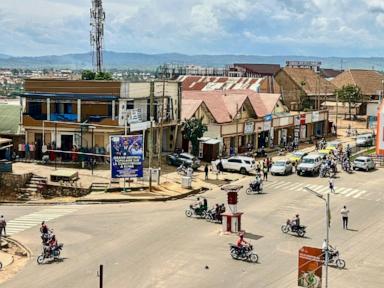
The sound of a shovel hitting the earth is distinct. It is a sharp, metallic thud, followed by the heavy sigh of displaced soil. In the Equateur province of the Democratic Republic of Congo, this sound has become a daily rhythm. A metronome of grief.
Lwamba stands at the edge of a fresh clearing, wiping sweat from his brow. His hands are calloused, not from farming cassava or hauling fish from the Congo River, but from digging graves. He is a hypothetical composite of the dozens of young men currently tasked with burying their neighbors, but his reality is entirely accurate. The soil here is a deep, oxidized red. Lately, it does not stay undisturbed for long.
The headlines from the wire services are predictably sterile. They report that the death toll in this latest Ebola outbreak has quietly crept past 80. They use phrases like "localized transmission" and "containment protocols." But numbers have a way of flattening human suffering. Eighty is not just a statistic. It is eighty empty chairs. It is eighty families shattered, eighty names spoken in the quiet, terrified whispers of the night.
To truly understand what is happening along the banks of the river, one must look past the spreadsheets of the World Health Organization. You have to look at the mud.
The Ghost in the Blood
Ebola is not a gentle killer. It is efficient, brutal, and deeply intimate. It exploits the very thing that makes us human: our desire to touch, to comfort, to care for the sick, and to honor the dead.
When the virus enters a body, it does not immediately sound an alarm. It hides. For days, a person might feel a slight fatigue, a mild headache—the kind of mundane ailments easily blamed on a long day under the equatorial sun or a bout of malaria. But inside, the virus is replicating with terrifying speed. It attacks the endothelial cells that line the blood vessels.
Consider a riverbank during a torrential downpour. If the earth is strong, the river stays within its channels. But if the soil turns to liquid mud, the banks collapse, and water floods the plains. That is what Ebola does to the human vascular system. It dissolves the integrity of the vessels.
By the time the fever spikes, the battle is already turning. The vomiting begins, followed by severe diarrhea. In the final, most catastrophic stages, the virus causes internal and external bleeding. It is a visceral, agonizing progression.
But the real cruelty of Ebola lies in its aftermath.
In many Congolese communities, a funeral is not a detached, somber viewing behind glass. It is an active, communal act of love. Family members wash the body of the deceased. They embrace them one last time, preparing them for the journey into the ancestral world. However, a body killed by Ebola is essentially a biological landmine. The viral load is at its absolute peak at the moment of death. The very fluids that a grieving mother wipes from her child’s face carry millions of microscopic invaders.
One touch is all it takes. One final kiss on a fevered brow can sentence an entire family to the same red earth.
The Invisible Stakes
Public health officials often talk about "breaking the chain of transmission" as if it were a simple mechanical task. You find the sick, you isolate them, you vaccinate the contacts. It sounds logical on paper.
The reality on the ground is a labyrinth of fear and deep-seated suspicion.
Put yourself in the shoes of a father in a remote village hours outside Mbandaka. Your eldest daughter wakes up shivering. Within two days, she cannot keep food down. You have heard rumors of a sickness. You have also heard that when the men in white plastic suits arrive, they take people away to tents where no one is allowed to enter. You hear that those who go into the tents rarely come back alive.
Then come the rumors. In a region that has endured decades of political neglect, armed conflict, and exploitation by foreign entities, trust is a rare commodity. Why should a villager trust a sudden influx of international workers carrying strange equipment? Some believe the white suits themselves are bringing the disease. Others think it is a curse, or a political plot to depose local leaders.
Fear is a powerful narcotic. It makes people run.
When a family suspects Ebola, their first instinct is often not to call a hotline, but to hide. They slip into the dense canopy of the rainforest. They travel by night on wooden pirogues along the labyrinthine tributaries of the Congo River. But they cannot outrun the biology inside them. They carry the spark to the next village. Then the next.
This is how an outbreak grows from a spark into a forest fire. The 80 deaths reported this week are not a static total; they are a snapshot of a moving target.
The Weight of the Suit
The response teams face a different kind of horror. To enter a hot zone, a health worker must don Personal Protective Equipment (PPE). It is a multi-layered ritual of rubber, plastic, and heavy-duty tape.
Inside that suit, the heat is immediate. The humidity of the Congo basin is oppressive on a normal day, but inside a layer of impermeable plastic, it becomes a furnace. Within minutes, sweat pools in your boots. The goggles fog. Your breath echoes loudly in your ears, a constant, rhythmic reminder of your own isolation.
You cannot touch your face to wipe away the stinging sweat. You cannot drink water. You have roughly 40 minutes to an hour of operational time before exhaustion and dehydration threaten to impair your judgment. And in this environment, a single lapse in judgment—a torn glove, an accidental touch of the face while undressing—can be fatal.
The suits also create a profound psychological barrier. To a sick child, the doctor does not look like a savior. They look like an alien. A creature without a face, without eyes, speaking through a muffled mask. The comfort of human touch, the soothing expression of empathy that is so vital to healing, is entirely stripped away.
Medical teams must navigate this emotional landscape while carrying the immense weight of historical context. This is not the first time Equateur has faced this enemy. The region has battled multiple outbreaks over the last decade alone. There is a profound weariness in the bones of the local health workers. They are tired of fighting the same ghost.
Beyond the Numbers
There is a temptation from afar to view these recurring outbreaks with a sense of fatalism. To look at the map of Central Africa and see it as a permanent zone of crisis, a place where tragedy is simply part of the geography.
That view is a luxury of distance.
The people of Mbandaka are not passive victims in a tragic play. They are mothers, teachers, fishermen, and innovators. Local community leaders are risking their lives daily to change the narrative. They are riding motorbikes down rutted dirt tracks, megaphone in hand, to counter misinformation with facts. They are designing handwashing stations out of plastic buckets and foot pedals to allow for sanitation without contact.
Progress is agonizingly slow, measured not in grand announcements but in small, quiet victories. A family agrees to a safe and dignified burial. A contact allows themselves to be monitored for 21 days. A survivor steps out of an isolation unit, their blood now carrying the rare antibodies that make them immune, ready to care for the children whose parents are gone.
The fight against Ebola is not won in laboratory boardrooms in Geneva or Atlanta. It is won or lost in the dirt. It is won when trust is painstakingly built, person by person, village by village, through the sheer force of human empathy.
The sun begins to dip below the tree line, casting long, dramatic shadows across the clearing where Lwamba works. He rests his weight against the wooden handle of his shovel. The air is thick with the scent of woodsmoke and damp earth. Another grave is finished. He looks down at his hands, then turns his gaze toward the river, where the water flows wide and dark into the gathering dusk. He knows that tomorrow, he will likely have to dig again.