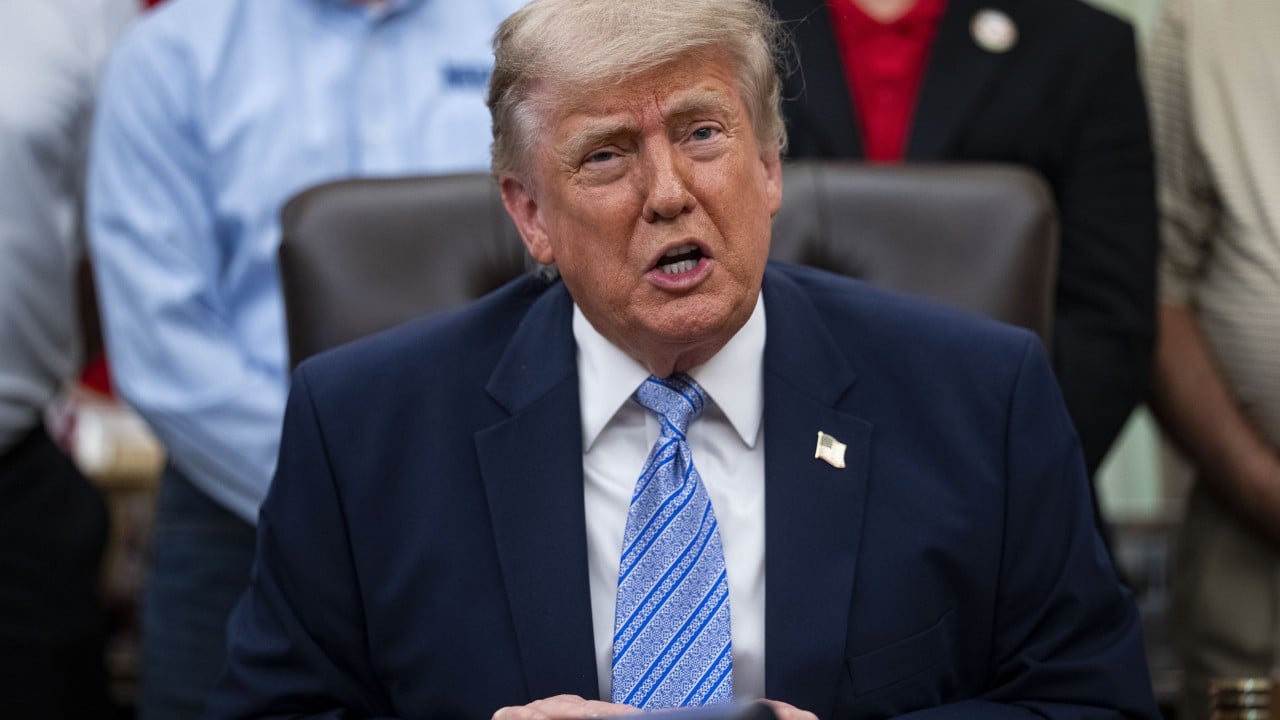
The white-hot race for global artificial intelligence supremacy took a raw political turn this week when President Donald Trump abruptly canceled a high-profile White House signing ceremony for a highly anticipated executive order on AI safety. The decision directly reflects an aggressive administrative doctrine that views any domestic regulatory speed limit as an act of economic surrender to China.
By pulling the plug on the ceremony at the absolute last minute, the administration sent an unmistakable message to Silicon Valley and Beijing. Washington will prioritize raw computing power and corporate velocity over precautionary guardrails, gambling that unhindered commercial deployment is America's best defense against foreign technological rivalry.
This sudden pivot exposes the deep rift between traditional national security hawks, who favor strict oversight of highly capable software models, and a dominant wing of tech-aligned policymakers who believe that a heavy regulatory hand will cripple American industry. The canceled directive was slated to instruct federal agencies to utilize advanced AI systems to harden the cybersecurity defenses of critical national infrastructure, including banking networks and hospitals. More critically, it aimed to establish federal reviews to monitor whether the latest generation of frontier models—such as Anthropic’s newly revealed Mythos architecture—could be weaponized to launch complex, automated cyberattacks.
Tech executives and investor groups lobbied fiercely against the order behind the scenes. They argued that even minor compliance hurdles or mandatory security reviews would dent corporate earnings, bottleneck the commercial rollout of software updates, and force engineering teams to alter model architectures to satisfy government bureaucrats. In a hyper-competitive global market, a delay of even a few weeks is framed as a strategic defeat.
The administration chose to listen to the builders rather than the overseers. This is not an isolated incident of regulatory cold feet. It is the logical progression of an aggressive, deliberate strategy to strip away oversight structures built by the previous administration.
The Strategy of Growth Over Guardrails
Over the past year, the White House has systematically dismantled the framework of AI governance. This agenda is driven largely by a dedicated policy apparatus co-led by figures like David Sacks, the administration's special advisor for AI and crypto. The foundational thesis is simple. The nation that builds the largest, most pervasive digital ecosystem will dictate global technical standards, command the underlying supply chains, and secure an insurmountable economic lead.
To achieve this, the federal government is shifting from an oversight body to an active industrial accelerator. The policy toolkit relies heavily on three specific mechanisms designed to maximize the speed of domestic tech firms.
- Aggressive Preemption of State Rules: Federal agencies are actively weaponizing funding to stop individual states from passing localized AI safety bills. Under a directive issued late last year, the Department of Commerce has threatened to withhold vital federal broadband expansion grants from states that enact restrictive AI rules. The administration explicitly targeted localized statutes, such as Colorado's landmark algorithmic discrimination law, claiming that patchwork state regulations create compliance nightmares that stifle corporate agility.
- A Light-Touch Federal Blueprint: Rather than proposing a centralized regulatory agency akin to the Federal Communications Commission or the SEC to govern machine learning, the White House released a legislative framework recommending that oversight remain diffuse. Under this model, sector-specific agencies handle isolated incidents of fraud or consumer harm using existing laws, leaving the core development of foundational models entirely unbothered.
- The Pro-Innovation Sandbox: The administration is establishing massive, federal data sandboxes, opening up previously restricted government datasets to private firms to train larger, more sophisticated neural networks.
This hyper-growth strategy treats the deployment of software as an economic numbers game. If American companies can train and deploy models faster than their overseas counterparts, domestic technology becomes the default global infrastructure.
The Core Conflict of the Capitalist Cold War
The logic behind stripping away domestic regulations relies on a highly specific interpretation of the tech race with China. Tech executives frequently pitch a zero-sum scenario to Washington lawmakers. If a US company is legally required to pause a model release for a month to run safety evaluations, a Chinese competitor operating without Western ethical constraints will capture the market.
Yet, this narrative oversimplifies a messy reality. Washington’s current hands-off domestic policy sits in direct contrast with its volatile, highly interventionist trade policies. The administration has created a confusing web of market restrictions by constantly shifting its stance on advanced hardware exports.
| Timeline | Policy Action | Strategic Intent |
|---|---|---|
| April 2025 | Total halt on advanced AI chip exports to Chinese markets. | Starve foreign adversaries of the physical compute needed for frontier training. |
| July 2025 | Sudden reversal; Nvidia cleared to ship custom H20 processors to China. | Protect American semiconductor revenue and maintain market dominance. |
| January 2026 | 25 percent tariff slapped on advanced computing chips transiting through the US. | Force chip packaging and supply chain steps to relocate permanently to US soil. |
| May 2026 | Commerce Department clears Nvidia H200 sales to major Chinese internet firms. | Allow American tech firms to monetize hardware before foreign alternatives catch up. |
This frantic oscillation between total containment and commercial permissiveness reveals the central paradox of current tech diplomacy. The administration wants to starve Beijing of raw computing capability while simultaneously ensuring that Silicon Valley giants like Nvidia, AMD, and Microsoft can maximize their international revenues.
The Dangerous Myth of the Clear Lead
The decision to scrap the executive order assumes that regulation is inherently a drag on performance. This view is short-sighted. By treating safety and capability as opposite ends of a seesaw, policymakers risk creating structural vulnerabilities that could backfire catastrophically.
Consider the technical mechanics of a modern frontier model. When a company builds an enterprise-grade system, safety is not merely an ethical layer added to the software after it is trained. It is fundamentally tied to predictable performance. A model that hallucinating data, leaks proprietary enterprise training inputs, or proves highly vulnerable to adversarial prompt injection is a defective commercial product.
Furthermore, the threat of automated cyber warfare is not a speculative scenario for the distant future. Security researchers have repeatedly demonstrated that advanced LLMs can be repurposed to discover zero-day vulnerabilities in critical infrastructure software at speeds human analysts cannot match. By refusing to establish basic, unified federal testing standards for these dual-use technologies, Washington is essentially outsourcing national biosecurity and cyber-defense readiness to private boardrooms.
The corporate sector operates on a quarterly timeline. CEOs face immense pressure to beat Wall Street expectations and roll out features ahead of their immediate venture-backed rivals. They are structurally incentivized to externalize systemic risks, leaving the public to deal with the fallout if a poorly vetted system causes a major network outage or an autonomous logistics failure.
The Cost of Unchecked Speed
Relying entirely on market forces to win a geopolitical technology race ignores the structural realities of the industry. The current boom requires staggering amounts of capital, electrical grid capacity, and data centers. By focusing purely on deregulation, the administration is ignoring the real structural bottlenecks facing American tech firms, such as permitting delays for power plants and a severely strained domestic energy grid.
A hands-off approach also strips the United States of its moral authority to shape international norms. If the world's leading tech power refuses to enforce basic safety standards on its own corporate champions, it cannot realistically convince international allies or rivals to adopt responsible deployment practices. This leaves global standards to be written by default, driven by whoever is willing to take the biggest risks with deployment.
The cancellation of this week's signing ceremony was not a sudden burst of strategic brilliance. It was a victory for corporate lobbying over long-term technological resilience. Washington has chosen to run as fast as possible, ignoring the fact that sprinting blind makes a catastrophic trip far more likely.