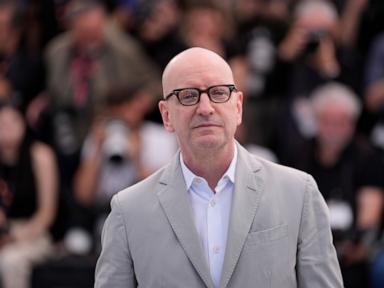
Steven Soderbergh has built a legendary career by executing sharp creative pivots before the rest of Hollywood even notices the floor shifting, but his latest tactical maneuver has landed him in uncharted territory. At the Cannes Film Festival, the veteran director debuted John Lennon: The Last Interview, a 90-minute documentary centered on the harrowing, deeply candid RKO Radio conversation recorded just hours before Lennon was murdered outside the Dakota on December 8, 1980. The film itself is a remarkable historical document, yet the immediate conversation surrounding it has been hijacked by a stark production detail: roughly ten percent of the runtime consists of surreal, generative artificial intelligence imagery. Rather than attempting a seamless digital resurrection of a dead icon, Soderbergh openly admits he deployed the tech to stretch a dwindling budget and bridge the abstract, philosophical gaps in the audio where archival footage simply did not exist.
The cinematic establishment reacted to the revelation with immediate skepticism. Early reviews from Cannes have labeled the synthetic sequences as generic, distracting, and aesthetically inferior to the historic material flanking them. Yet dismissed as a mere creative misfire, this experiment signals a far more calculated reality facing independent cinema. Soderbergh did not use these tools out of a starry-eyed belief that algorithms can replace human artistry. He did it because he ran out of money, and a tech giant stepped in to foot the bill in exchange for an elite Hollywood case study.
The Corporate Compromise Behind the Frame
The narrative spun on the festival circuit emphasizes creative exploration, with Soderbergh noting that Lennon’s son, Sean Ono Lennon, gave the project his blessing by suggesting his father would have eagerly engaged with new technology. This framing obscures the economic reality of modern film production. Independent documentary filmmaking has become an increasingly hostile financial ecosystem, where archival licensing fees are astronomical and completion funding is notoriously scarce.
During post-production, Soderbergh hit a wall. The documentary had plenty of archival photos and film reels to cover concrete references to specific songs, people, or events. However, when Lennon and Yoko Ono drifted into abstract philosophies about peace, love, and the shifting dynamics of the counterculture as the 1980s dawned, the screen went black.
Instead of traditional, labor-intensive visual effects or costly animation houses, the production partnered with Meta. The Silicon Valley giant was actively hunting for a prominent filmmaker to stress-test its emerging generative video tools. The arrangement was transactional: Meta provided the tech and the financial backing required to finish the movie, and Soderbergh provided a high-profile, prestige-stamped platform at Cannes to validate their software.
This model changes the relationship between Silicon Valley and the arts. When a tech corporation funds a cash-strapped auteur to utilize its proprietary software, the resulting film functions simultaneously as art and as an active product demonstration.
The Aesthetic Friction of Synthetic Surrealism
Soderbergh has defended his choice by drawing a definitive line between malicious manipulation and stylized visual effects. He argues that the film uses AI openly, occupying a dream space rather than pretending to be an authentic historical record.
"There's a way of using AI in which your intention is to fool somebody or manipulate them," Soderbergh stated during his press run. "And then there's a use where it's obvious that it is AI and that it is being used essentially in the way that you would use VFX or CGI."
While the ethical intent may be clean, the cinematic execution exposes the current limitations of generative video. The ten minutes of synthetic footage scattered across The Last Interview are designed to evoke a psychedelic, Lennonesque atmosphere. Instead, they frequently land as hollow imitation. Critics have likened the sequences to cheap, second-rate animated album covers—visuals marked by a glossy, unnatural sheen and the floating object permanence errors that continue to plague AI video generators.
The friction is not just aesthetic; it is narrative. The RKO interview is a monumental piece of audio tape, capturing a hopeful 40-year-old man reflecting on his past and looking forward to an expansive future, completely unaware of the tragedy waiting outside his door. To interrupt that raw, chilling human clarity with algorithmic approximations of a "psychedelic dreamscape" creates a jarring tonal disconnect. It pulls the audience out of the historical weight of the moment and forces them to evaluate the rendering quality of a software update.
The Indie Maverick as Tech Agnostic
To understand why Soderbergh became the first major Hollywood director to cross this line, one has to examine his historical track record. He has never been a romantic traditionalist about the medium of film. When digital cameras were in their infancy, he adopted them. He famously shot Unsane and High Flying Bird entirely on iPhones to prove that distribution-ready features could bypass traditional, bloated studio camera packages.
For Soderbergh, tools are entirely utilitarian. He is not precious about the celluloid past, nor is he blind to the flaws of the digital present. He has openly acknowledged that generative video might turn out to be a passing industry fad, suggesting that half a decade from now, Hollywood might look back on this era as an eccentric, experimental phase.
Soderbergh's Practical Tech Timeline:
├── 2002: Early adoption of high-definition digital video (Full Frontal)
├── 2018: Shoots mainstream features entirely on iPhones (Unsane)
└── 2026: Integrates corporate-backed generative AI into a documentary (The Last Interview)
This pragmatic agility explains how he can absorb the fierce blowback from his peers without blinking. While organizations like the Academy of Motion Picture Arts and Sciences tighten their rules to ensure only human performances remain eligible for major awards, Soderbergh views the technological shift through a cold, macroeconomic lens. To him, ignoring the existence of these automated pipelines is a luxury reserved for filmmakers who do not have to worry about balancing a ledger.
The Precedent for a Fragmented Archive
The estate of John Lennon is no stranger to this specific technological crossroads. The Beatles famously utilized advanced machine-learning audio isolation tools developed by Peter Jackson's team to extract Lennon’s vocals from an old cassette tape, resulting in the release of their final track, Now and Then. That project was widely celebrated because it used software to unearth a hidden human performance, cleaning away decades of tape hiss to reveal a genuine piece of history.
What Soderbergh has done in The Last Interview is fundamentally different, reversing that dynamic. He took a pristine, clear human audio performance and smothered it in synthetic visuals. It sets a complicated precedent for how history is preserved and presented. If a documentary filmmaker can replace missing visual history with corporate-sponsored algorithmic generations, the line between historical curation and digital illustration becomes permanently blurred.
The true value of The Last Interview rests entirely on the raw, unfiltered voices of Lennon and Ono talking through the quiet apartment air in 1980. The tragedy is that a film dedicated to preserving the final words of an iconic human life will instead be remembered as the moment a legendary director traded visual authenticity for a tech company's completion fund.