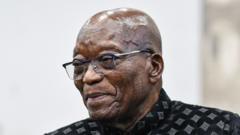
Former South African President Jacob Zuma’s shocking reunion with fugitive businessman Ajay Gupta in India is a calculated financial and political play. Facing a R29 million personal legal debt and funding pressures for his Umkhonto we Sizwe party, Zuma went back to his original financiers. The meeting at a temple in Haridwar exposes the total collapse of South Africa’s efforts to hold the architects of state capture accountable. It proves that despite years of judicial inquiries, the networks that plundered billions remain active, well-funded, and completely untouchable.
The images that emerged from the Sidipeeth Shri Dakshin Kali Temple in Haridwar were not merely a display of personal piety. They represented a profound betrayal of the South African public. Standing alongside the 84-year-old former president was Ajay Gupta, the suspected mastermind behind a corrupt enterprise that drained an estimated R15 billion from state coffers during Zuma’s presidency. In a video recorded at the banks of the Ganges, a garlanded Zuma smiled broadly, calling Gupta a "brother and friend" and declaring his intention to retake control of the country.
The response from Pretoria was immediate and fierce, yet it carried an underlying note of helplessness. Minister in the Presidency Khumbudzo Ntshavheni accused Zuma of openly and unapologetically showing the "middle finger" to South Africans who lost their livelihoods to the family's financial machinations. But behind the fiery rhetoric lies a sobering reality. The South African state has failed to secure the extradition of the Gupta brothers, and its own institutions are now being used to validate the very fugitives they claim to pursue.
A Temple Reunion and a National Insult
The meeting in northern India was carefully staged. Ajay Gupta has long maintained deep ties to the Haridwar region, using his vast wealth to establish himself as a prominent religious benefactor. For Zuma, the trip served a dual purpose. It provided an opportunity to reconnect with his most reliable source of historical patronage while projecting an aura of international statesman status to his domestic base.
What transformed a private meeting into a national scandal was the presence of Anil Sooklal, South Africa’s High Commissioner to India. A diplomat paid by the taxpayers was filmed standing side-by-side with a man whose name is synonymous with the destruction of South Africa's state-owned enterprises. The sight of a state representative hobnobbing with a state capture suspect triggered an immediate crisis within the Department of International Relations and Cooperation.
The government’s official explanation was a masterclass in bureaucratic damage control. Sources within the diplomatic corps claimed that Sooklal was merely following standard protocol by extending standard courtesies to a former head of state. They argued that the High Commissioner had no prior knowledge that Ajay Gupta would be present at the prayer meeting. This explanation stretches credulity. An experienced diplomat does not walk blindly into a highly publicized event featuring one of the most wanted men in South African history without someone noticing.
Minister Ntshavheni did not accept the diplomatic defense. She branded the ambassador's conduct an absolute disgrace, stating that he had directly undermined the criminal justice system of the country. International Relations Minister Ronald Lamola ordered an urgent internal investigation, promising drastic steps against any official who compromises the laws of the republic. Yet, the damage was already done. The image of the High Commissioner, the former president, and the fugitive businessman standing together sent a clear signal to the world that South Africa's fight against corruption is largely a performative exercise.
The Legal Vacuum Protecting Ajay Gupta
To understand how this situation occurred, one must look closely at the glaring failures of South Africa's National Prosecuting Authority. While the public views all three Gupta brothers as fleeing fugitives who belong in a maximum-security prison, the legal reality is far more complicated.
The prosecuting authority confirmed a startling fact following the India meeting. There is currently no active warrant of arrest against Ajay Gupta in South Africa.
Charges against him were quietly dropped in 2019. Furthermore, while the Zondo Commission spent years investigating the systemic looting of state organs, its final recommendations did not single out Ajay Gupta for individual prosecution. Instead, the commission issued broad guidelines targeting generic members of the family for their involvement in specific corruption scandals, such as the Vrede Dairy project and the Optimum Coal Mine disaster.
This legal distinction has allowed Ajay Gupta to move through international society with relative freedom. He does not face the same immediate legal pressures as his younger brothers, Atul and Rajesh, who were arrested in the United Arab Emirates in 2022. Even in that case, the South African state bungled the process. A Dubai court rejected the extradition request for the younger brothers on a technicality in 2023, leaving the prosecuting authority empty-handed and deeply embarrassed.
The lack of an active warrant for Ajay Gupta means that, on paper, he is a free man. He can host former presidents, fund political organizations, and build religious networks without fear of international arrest notices. The state’s inability to build a concrete, lasting criminal case against the eldest Gupta brother highlights the deep institutional weakness that continues to plague South Africa's legal system. Years after the state capture report was handed over, the primary actors remain entirely beyond the reach of the law.
Funding an Insurgency
The timing of Zuma’s pilgrimage to India is not accidental. The former president is currently fighting on multiple fronts, and his resources are dangerously depleted. The courts have ruled that Zuma is personally liable for a staggering R29 million in legal fees accumulated during his endless attempts to avoid prosecution. This is money he simply does not have.
At the same time, Zuma is leading a political insurgency through the Umkhonto we Sizwe party. Operating an aggressive political campaign requires immense financial capital. Rallies must be funded, transport must be secured, and marketing material must be produced. With traditional corporate donors avoiding his new party due to its radical rhetoric, Zuma has been forced to look outside the borders of South Africa for financial survival.
The Guptas have a long history of providing the necessary capital to sustain Zuma's ambitions. During his presidency, their financial relationship allowed them to dictate cabinet appointments and control multibillion-rand state contracts. Now, with Zuma acting as the disruptive head of a powerful opposition faction, the relationship has evolved. A destabilized South African political environment benefits the Guptas, creating potential openings for them to negotiate a return or protect their remaining assets from future asset forfeiture units.
In the video shared from India, Zuma made his intentions clear. He explicitly stated that he is contesting and intends to take the country forward. This is a direct challenge to the current administration. By standing next to Ajay Gupta while making this declaration, Zuma is letting the ruling party know that he still has access to the unlimited financial networks that built his initial empire. It is a show of strength designed to unnerve his political opponents and reassure his loyal followers that his movement is well-funded.
The Diplomatic Breakdown and Parallel Foreign Policy
The executive branch is now facing a terrifying reality. A former head of state is effectively running an independent, parallel foreign policy that directly contradicts the official stance of the government. Zuma travels the world, meets with controversial figures, and utilizes state-funded privileges to undermine the country’s global standing.
Former presidents in South Africa enjoy substantial lifetime benefits. These include state-funded security details, travel allowances, and administrative support. The government has admitted that it does not receive the international travel itineraries of former presidents before they depart. This lack of oversight allowed Zuma to land in New Delhi, receive a formal escort from the High Commission, and travel to a remote temple to meet a state capture suspect without the presidency knowing until the images leaked online.
Minister Ntshavheni indicated that the government is now reviewing these privileges. The state is entitled to withdraw benefits if they are used to break the laws of the republic or damage national interests. Stripping Zuma of his presidential privileges would be a major political step, one that his supporters would instantly label as a political witch hunt. It is a risk the current administration has previously avoided, but the blatant nature of the Haridwar meeting has pushed the government into a corner.
The structural flaw in South Africa's transition away from the state capture era is that it assumed the old networks would dissipate once Zuma left office. The meeting in India proves the opposite. The networks did not disappear. They merely relocated, adapted, and waited for the right moment to reassert their influence. The South African state remains trapped in a cycle of writing reports, launching internal inquiries, and expressing public outrage, while the individuals who compromised the nation's democracy continue to operate with total impunity.
South Africans looking at the photos from Haridwar are not just seeing a former leader visiting a friend. They are witnessing the stark reality of institutional failure. The system designed to punish high-level corruption has proven entirely inadequate, leaving the public to watch as the figures who compromised their economy plan their next political moves from the safety of international sanctuaries.