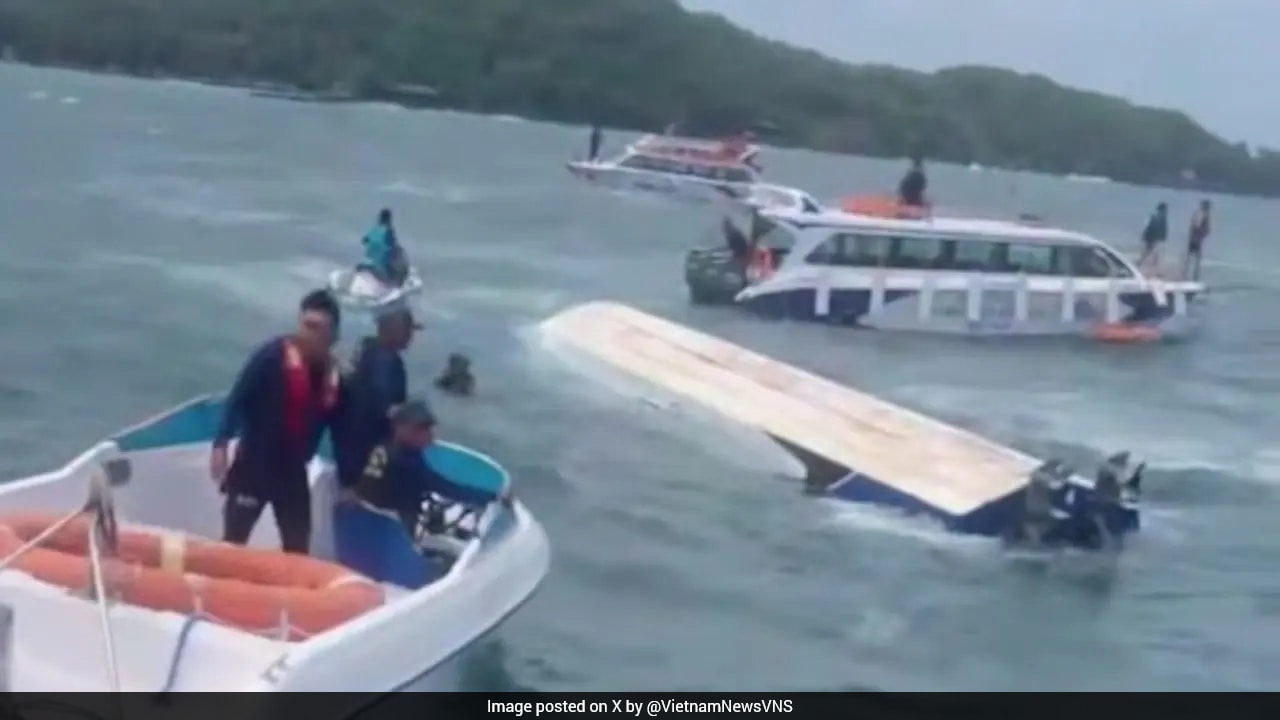
The standard media script for a maritime accident is entirely predictable. A boat capsizes in a popular international destination. Headlines flash words like "tragedy" and "rescue efforts." Politicians express deep concern. The public demands immediate regulatory crackdowns, better safety gear, and stricter oversight from local governments.
It is a comfortable, reactive narrative. It is also completely wrong.
When a tourist boat capsizes in Vietnam or any other rapidly growing Southeast Asian hub, mainstream outlets treat it as an isolated failure of local enforcement. They blame the boat captain. They blame the regional coast guard. They focus on the immediate mechanics of the accident while ignoring the structural economic incentives that made the disaster inevitable.
The harsh reality is that these incidents are not regulatory failures. They are the logical end product of mass tourism ecosystems built entirely on razor-thin margins and the consumer demand for unsustainably cheap travel experiences. Until we confront the economics of the "budget excursion," no amount of paperwork or government policing will keep travelers safe.
The Illusion of the Low-Cost Excursion
I have spent over fifteen years auditing supply chains and operations within the global hospitality and travel sectors. I have seen exactly how the sausage gets made in emerging markets. When you buy a cut-rate day cruise or a cheap island-hopping package, you are not outsmarting the system. You are participating in a high-stakes financial compromise where safety is always the first variable to be optimized out of the ledger.
Consider the basic math of a budget tourist boat operation.
- Fuel and Maintenance: Fixed overhead costs that cannot be easily reduced without grounding the vessel.
- Labor: Already pushed to the absolute minimum in developing economies.
- Volume: The only remaining lever to achieve profitability.
To make a profit on a $20 or $30 day trip, an operator must maximize passenger volume while minimizing time spent at the dock. This creates an environment where overloading vessels is not an accident—it is the business model.
When mainstream news outlets cry out for stricter enforcement of passenger limits, they assume the operators are simply unaware of the rules. They are not. The operators know the limits perfectly well. They also know that complying with those limits means shutting down their businesses because the price point demanded by the modern mass tourist does not cover the cost of a half-empty boat.
Why Local Regulations Always Fail
Whenever a high-profile accident occurs, the immediate response from industry commentators is to demand that local governments "step up" and enforce international safety standards. This demand ignores the fundamental governance realities of developing tourism economies.
In many rapidly developing coastal regions, the maritime authority is underfunded, understaffed, and completely overwhelmed by the sheer volume of informal tourist traffic. Expecting a provincial maritime office to effectively police hundreds of independent, small-scale boat operators across thousands of miles of coastline is a fantasy.
[Global Tourist Influx] ──> [Overwhelmed Local Infrastructure] ──> [Enforcement Gaps] ──> [Market-Driven Corner Cutting]
More importantly, top-down regulation fails because it creates a cat-and-mouse game that operators are financially incentivized to win. If a local government mandates expensive lifejacket upgrades or sophisticated GPS tracking systems without addressing the underlying economics of the tour pricing, one of two things happens:
- The Shadow Market Thickens: Operators bypass official docks entirely, launching from unmonitored beaches to evade inspectors.
- Performative Compliance: Bureaucrats check boxes while operators buy the cheapest, non-certified safety gear available just to pass visual inspections.
We see this pattern globally. When Egypt faced scrutiny over diving safety in the Red Sea, or when Thailand dealt with the aftermath of the Phuket boat disaster, the initial wave of heavy-handed crackdowns did not create a permanent culture of safety. It simply drove the risk further underground until the media attention faded and the economic realities reasserted themselves.
The Entitled Tourist and the Safety Double Standard
There is an uncomfortable hypocrisy at the heart of Western and middle-class Westernized tourism. Travelers from developed nations expect the rock-bottom pricing of an unregulated market alongside the ironclad safety guarantees of a heavily socialized European or North American transit system.
You cannot have both.
When you pay pennies for a service in an emerging economy, you are explicitly opting out of the institutional safety net that exists in your home country. You are trading institutional oversight for a discount.
The "People Also Ask" columns on search engines are filled with variations of: Is it safe to take budget boat tours in Southeast Asia?
The honest answer is no, it is inherently risky. But travelers do not want honesty; they want reassurance. They want to be told that a $15 sunset cruise has undergone the same rigorous hull stress testing as a cross-channel ferry in the UK.
This consumer entitlement drives a dangerous cycle. Tour operators realize that tourists select trips based almost entirely on price and aesthetic appeal (how good the boat looks on social media) rather than verifiable safety credentials. Consequently, investment goes into paint, sound systems, and open bars rather than fire suppression systems, life raft maintenance, and marine band radios.
Dismantling the Tourism Supply Chain
If we want to actually prevent these incidents rather than just writing solemn post-mortems about them, we have to shift the accountability away from the local captains and onto the global distributors who monetize them.
The vast majority of tourists do not book directly with a local boat captain. They book through third-party aggregators, international travel agencies, or digital booking platforms. These platforms take a massive cut of the booking fee—often up to 30% to 40%—further squeezing the margins of the actual operator on the water.
Yet, when a boat goes under, these international aggregators hide behind liability disclaimers in their terms of service. They claim they are merely "platforms" connecting willing buyers with independent local contractors.
This is where the real intervention needs to happen.
- Platform Liability: If an international booking platform profits from listing an excursion, they must be held legally and financially liable for the safety audits of that excursion.
- Margin Redistribution: Forcing platforms to ensure that a realistic percentage of the ticket price goes directly toward vessel maintenance and crew training, rather than corporate marketing budgets.
Admittedly, this approach has a massive downside that most travelers will hate: it will destroy the ultra-budget travel market. If booking platforms are forced to verify the safety compliance of every vessel they list, the price of a day cruise will double or triple. The era of the $20 all-inclusive island excursion will end.
But that is precisely the point. Safety is an expensive asset. If you are not paying for it at the ticket counter, you are paying for it with your life expectancy on the water.
Stop Blaming the Weather
Every time a vessel capsizes, the initial press releases cite "sudden adverse weather conditions" or "unexpected rogue waves." This is a convenient excuse that absolves everyone of responsibility. It reframes a systemic failure as an act of God.
In the maritime industry, there is rarely such a thing as unexpected weather in coastal tour zones. There are only captains who chose to ignore a forecast because turning back meant refunding fifty passengers and losing a week's worth of profit. There are only operators who pushed a vessel past its displacement limits because they needed to hit a volume target to service their debt on the boat.
The weather is a constant variable. The human decision to sail into it under financial duress is the actual cause of the disaster.
Stop reading the sanitised accounts of travel mishaps that treat these events as unpredictable tragedies. They are entirely predictable financial calculations. If you choose to buy into a race-to-the-bottom market, stop acting surprised when you hit the bottom.