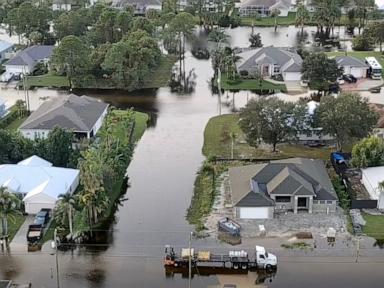
Two people are dead. Hundreds more spent the night clinging to roof trusses, floating inside their own living rooms, or watching strangers in jon boats glide past their mailbox posts.
Listen to the news reports and those numbers slide right off the tongue. Two fatalities. Hundreds of rescues. A stalled storm system dumping double-digit inches of rain across Florida. By tomorrow morning, the headlines will move on to a Senate vote or a celebrity divorce, leaving behind a tidy, sanitized summary of an event that feels anything but tidy to the people scraping black mud off their baseboards.
Statistics have a way of numbing us. They turn a drowned living room into a data point. They turn a neighbor’s last panicked breath into a footnote at the bottom of a county press release.
To understand what actually happened during these severe Florida floods, you have to stop looking at the radar maps and step onto the soggy carpet of a ground-floor apartment at three in the morning.
The Sound of Water Where Water Should Not Be
If you have never lived through a serious flood, you probably imagine a dramatic, cinematic wall of water crashing through a front door. Hollywood loves a tidal wave. Reality is much quieter, and infinitely more insidious.
Consider a hypothetical scenario, built from the exact patterns emergency dispatchers across Florida have documented over the last several days. Picture a retired couple—let’s call them Arthur and Elena—living in a single-story ranch home three miles inland from the coast. They aren't in a mandatory evacuation zone. They didn't board up their windows because there was no hurricane warning, no screaming cone of uncertainty on the evening news, no 130-mile-per-hour winds tearing shingles off the roof. Just rain. Heavy, relentless, monotonous rain that started Tuesday afternoon and simply forgot to stop.
At midnight, Arthur wakes up to use the bathroom. His bare feet hit the hallway rug, and the rug squishes.
That is how it begins. Not with a roar, but with a squish.
Water doesn't break down your door; it seeps under the threshold like a dark stain spreading across a tablecloth. It bubbles up through the shower drain because the municipal storm sewers have surrendered. Within forty minutes, the water in Arthur and Elena’s hallway is ankle-deep. Twenty minutes after that, it is lapping against the bottom of their mattress. The power flickers and dies, plunging the house into a thick, humid dark where the only sound is the steady drumming on the roof and the eerie, metallic clanking of the refrigerator floating off its feet in the kitchen.
When people ask why anyone would ever drown in a rainstorm without hurricane winds, this is the answer. Floodwater is deceptive. It looks flat, calm, almost harmless—until you open the front door to wade to your car and realize the current sweeping down your cul-de-sac is moving at six miles an hour, carrying submerged lawn furniture, downed power lines, and raw sewage.
Why Florida’s Sponge Is Full
We tend to think of Florida as a place built to handle water. It is a peninsula surrounded by warm seas, blessed with afternoon thunderstorms and dotted with retention ponds. Surely, the state knows how to drain a heavy rain.
Think of Florida’s ground like a kitchen sponge sitting on a countertop. For decades, that sponge was thick, porous, and sprawling—millions of acres of cypress swamps, pine flatwoods, and sawgrass marshes that drank up tropical deluges and slowly filtered them down into the aquifer. When a storm stalled overhead, the land absorbed the blow.
Over the last fifty years, we paved over massive sections of that sponge. We laid down asphalt highways, sprawling strip malls, and master-planned subdivisions elevated on trucked-in fill dirt. Now, imagine pouring a pitcher of water onto a granite countertop instead of a sponge. The water has nowhere to go except sideways—straight into the older, lower-lying neighborhoods that were built before modern elevation codes existed.
Add a high tide pushing seawater back up into the drainage canals, and the plumbing locks up completely. The storm drains stop draining. Instead, they become geysers, pumping brackish bay water up into residential streets while the sky continues to dump two to three inches of rain an hour from above.
Meteorologists call this a stalled frontal boundary or a tropical disturbance, terms that sound entirely too polite for what happens on the ground. You don't need a named Category 4 hurricane to ruin a city. A nameless, slow-moving rainmaker sitting over a saturated watershed for thirty-six hours will quietly destroy more homes than a brief, violent windstorm ever could.
The Invisible Stakes After the Helicopters Leave
By the time the Coast Guard helicopters and local fire-rescue airboats arrive, the rescue phase becomes a dramatic spectacle. Cameras capture firefighters wading chest-deep through brown water, carrying toddlers on their shoulders and lifting elderly residents out of second-story windows. Those hundreds of rescues are small miracles of coordination, courage, and sheer physical grit.
Yet the true crisis begins the exact moment the water recedes.
Walk through a flooded Florida neighborhood forty-eight hours after the rain stops, and the air hits you first. It smells like wet drywall, rotting grass, gasoline, and sewage. Piles of ruined possessions—soaked mattresses, warped family photo albums, bloated particle-board dressers—begin lining the curbs like barricades.
Here is what the breaking news alerts rarely mention:
- The Insurance Trap: Standard homeowners insurance policies in Florida do not cover flood damage. Unless a family carries a separate policy through the National Flood Insurance Program or a private flood insurer—and many outside designated high-risk zones do not—every dollar required to gut and rebuild their home comes straight out of their own pockets.
- The Toxic Soup: Floodwater is never just rainwater. It is a chemical cocktail of motor oil leaked from submerged cars, fertilizers washed off suburban lawns, industrial runoff, and overflowing septic tanks. Every piece of porous furniture it touches becomes a biohazard.
- The Mold Clock: In Florida’s heat and humidity, black mold begins colonizing wet drywall within twenty-four to forty-eight hours. If a family cannot afford a remediation crew immediately, the walls themselves become unbreathable.
I have stood inside a gutted house three weeks after a flood, watching a grown man stare at the bare wooden studs where his daughter’s bedroom used to be. There is a specific kind of grief that comes with water damage. A fire leaves ashes; you know immediately what is gone. A flood leaves your things right in front of you—your wedding dress, your grandfather’s toolbox, your kid’s stuffed bear—intact in shape, yet completely poisoned by brown silt and bacteria. You have to throw them away yourself, piece by heavy, dripping piece.
What We Keep Getting Wrong About Safety
Whenever deadly flooding strikes, the public conversation inevitably circles back to personal responsibility. Why didn't they leave? Why did someone drive into a flooded intersection?
It is easy to judge from a dry living room. When you are inside the storm, confusion is the dominant emotion.
Water changes the geometry of familiar places. A road you have driven ten thousand times disappears beneath a smooth, glassy surface. In the dark, or through a windshield blurred by heavy rain, six inches of water looks identical to four feet of water. It takes just twelve inches of rushing water to float a standard passenger sedan, and two feet to sweep away a heavy SUV or pickup truck. Most flood fatalities across the country happen inside vehicles, often within a mile of the driver's own home, when a sudden drop-off or a washed-out culvert turns a routine commute into an underwater trap.
And what about staying home? People stay because leaving feels like an overreaction—until the exact second it becomes impossible. By the time water is cresting over your front porch, the roads are already impassable. Calling 911 doesn't summon an immediate ambulance; it puts you in a queue behind four hundred other terrified callers while rescue crews navigate submerged street signs, floating debris, and live electrical wires hidden beneath the surface.
Preparing Before the Sky Turns Grey
We cannot stop tropical moisture from stalling over the Florida peninsula, and we cannot undo decades of coastal overdevelopment before the next storm cell forms off the Gulf. What we can do is abandon the dangerous myth that only hurricanes deserve our respect.
If you live anywhere in Florida—or anywhere near a coastline, river, or low-lying urban basin—survival depends on treating heavy rain with the same seriousness you reserve for a named storm:
- Check your flood risk beyond the FEMA maps. Roughly a quarter to a third of all flood insurance claims come from outside high-risk flood zones. If it rains where you live, it can flood where you live.
- Never test standing water. Turn around, find another route, or wait it out. No meeting, grocery run, or trip home is worth betting your life against an invisible current.
- Elevate what cannot be replaced. Keep birth certificates, insurance policies, passports, and irreplaceable family keepsakes in waterproof containers on high shelves—not in bottom dresser drawers or plastic bins on the garage floor.
- Know your shutoffs. Learn where your main electrical breaker and water shutoff valves are located before an emergency hits, and never wade into standing water inside your home if the power is still on.
The Quiet After the Rain
Tonight, across the hardest-hit counties in Florida, the emergency shelters are full of people sleeping on canvas cots under harsh fluorescent lights. They are checking their phones for updates on road closures, waiting for daylight so they can go back and see what is left of their floors, their cars, and their routines.
Meanwhile, two families are making phone calls to funeral homes instead of insurance adjusters.
The rain has moved off the coast, leaving behind a sky that looks impossibly blue and indifferent. Down on the ground, the water is slowly draining back toward the sea, leaving a faint, muddy waterline two feet up the stucco walls of hundreds of homes—a quiet scar marking exactly how close everyone came to losing everything.