The fluorescent lights of a suburban community center in Westerville, Ohio, hum with a specific kind of midwestern static. Outside, November wind strips the last stubborn leaves from pin oaks. Inside, the air smells faintly of burnt coffee, damp wool coats, and fried samosas cooling in aluminum trays.
Consider a hypothetical evening here, just days after the 2026 midterm elections. Let us call the host Rajesh—a fifty-four-year-old cardiologist who emigrated from Chennai in 1998, built a practice in Columbus, and spent twenty years voting quietly for lower capital gains taxes and stronger school boards. Across from him stands Megan, a third-generation union machinist from Akron whose grandfather helped build the tires that rolled America into the twentieth century.
For the last two years, both Rajesh and Megan have been watching the same man on their television screens.
Vivek Ramaswamy.
Born in Cincinnati to Indian immigrant parents, educated at Harvard and Yale, enriched by biotech ventures, and hardened in the crucible of populist media, Ramaswamy stepped onto the Ohio political stage not merely as a candidate, but as a living stress test. When he launched his bid for the Ohio governorship—positioning himself as the heir apparent to an America First movement that had transformed the Buckeye State from a perennial swing state into a crimson fortress—the pundits in Washington saw a straightforward horse race.
They missed the point entirely.
The 2026 Ohio election was never just about who gets to sit behind the desk in Columbus. It was an intimate, high-stakes referendum on belonging. It asked a question that has haunted immigrant communities in America since the first ships docked at Ellis Island, dressed up now in the red-and-blue armor of modern partisan warfare: Can you ever truly be one of us if you do not look like us, pray like us, or share our bloodline?
The Architecture of a Gamble
To understand why Ohio became the proving ground for Indian-origin Republicans, you have to understand the math of modern American politics—and the human pulse beating underneath it.
According to U.S. Census data, Indian Americans represent roughly 1.5 percent of the national population, numbering over five million people. In Ohio, that share is smaller—hovering just under one percent, concentrated heavily in the suburban corridors around Columbus, Cincinnati, and Cleveland. On paper, that is a rounding error. In an election decided by thin margins, or in a Republican primary where ideological purity is weighed on a jeweler’s scale, a rounding error becomes a lightning rod.
Historically, Indian Americans voted reliably Democratic. The reasons were intuitive: civil rights protections, immigration pathways, and a social safety net that welcomed newcomers. Yet over the past decade, a quiet migration began. Driven by frustration over progressive education policies, concerns about affirmative action in university admissions, small-business taxation, and a deeply ingrained cultural conservatism around family structure, a growing slice of the diaspora began looking right. By the 2024 presidential cycle, post-election surveys showed Republican support among Indian Americans creeping upward, particularly among younger men and first-generation entrepreneurs.
Enter Ramaswamy.
He did not tiptoe into the Republican tent asking for permission. He kicked the doors off the hinges. During his 2024 presidential run and his subsequent campaign for the Ohio governorship in 2026, Ramaswamy adopted a rhetoric that was sharper, louder, and more uncompromisingly nationalist than many of his native-born peers. He spoke of meritocracy as a sacred covenant. He attacked diversity initiatives with the zeal of a convert. He stood on stages across rural Appalachia, from Scioto County to Ashtabula, telling crowds of predominantly white working-class voters that he understood their forgotten towns better than the coastal elites ever could.
And for a while, the magic seemed to work.
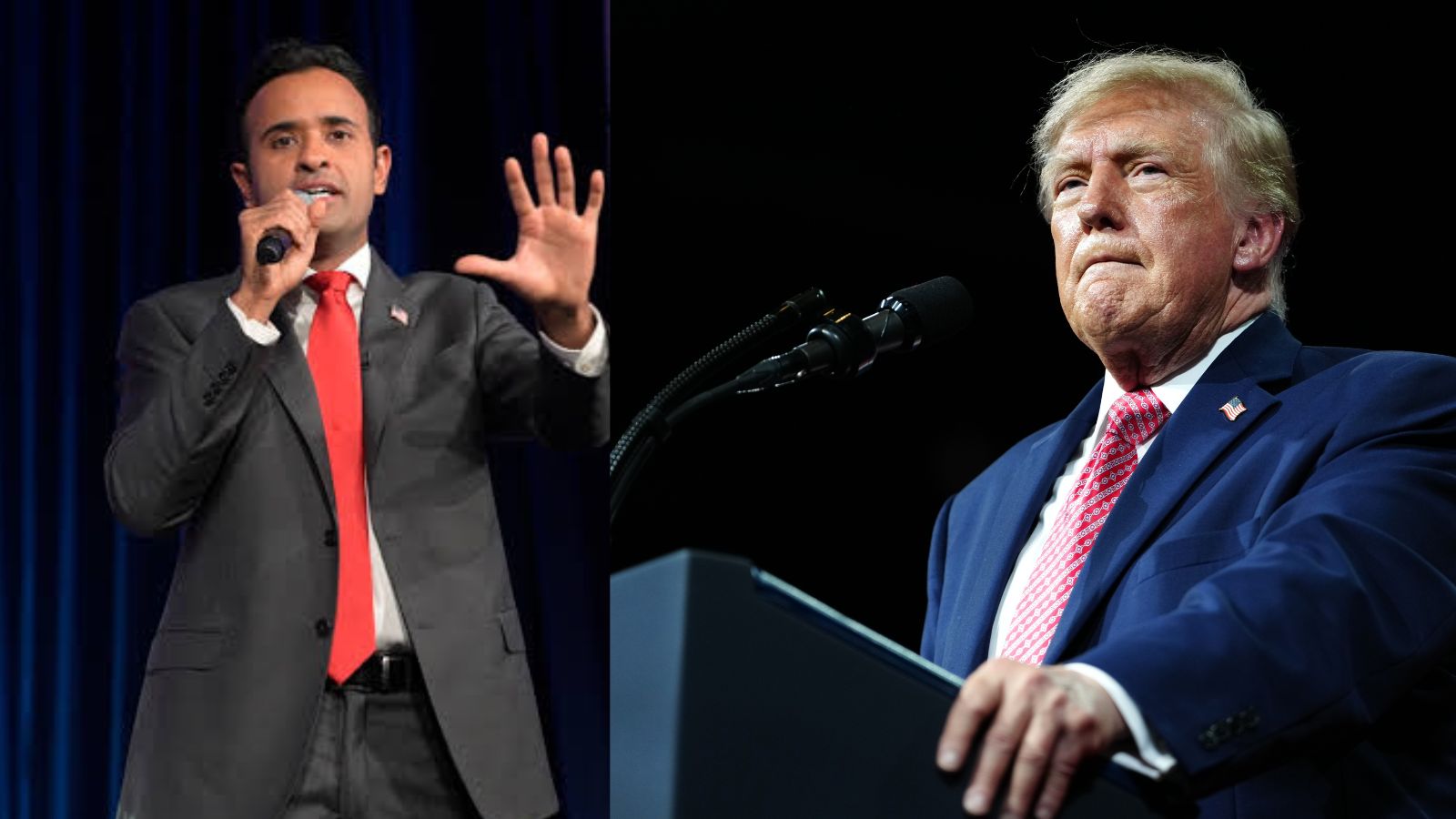
Watching him work a room in rural Ohio is like watching a high-wire act without a net. He speaks at a breathless cadence, hands slicing the air, absorbing the hostility of skeptics and reflecting it back as shared grievance. In places where an Indian last name used to draw blank stares, crowds chanted his first name.
But politics is rarely won on applause lines alone. Beneath the surface of those rallies, a quieter, far more complicated friction was building.
The Invisible Friction
I remember sitting in a diner off Interstate 71 outside Mansfield a few years ago, listening to two retired factory workers argue over breakfast. One loved Ramaswamy’s fire; he liked that a billionaire’s son was willing to take on federal agencies and speak plainly about manufacturing decline. The other stirred his coffee slowly, staring out at the rain-slicked parking lot, before muttering a single sentence that still echoes in my ears: "He talks good, sure. Just don't know if a guy like that really knows what it feels like when the plant closes."
That hesitation—wordless, instinctive, rarely spoken into a pollster’s microphone—is the invisible wall every minority conservative eventually hits.
Think of the Republican coalition in a state like Ohio as an old, hand-built stone bridge. For decades, the stones were held together by a shared cultural mortar: small-town heritage, evangelical Christianity, military service, and generational continuity. When Indian-origin conservatives step onto that bridge, they bring formidable stones of their own—economic ambition, educational rigor, fierce self-reliance. On policy, the fit looks seamless.
Yet the mortar is different.
During his campaigns, Ramaswamy faced moments where that difference broke through the surface with jarring clarity. Whether it was answering questions about his Hindu faith in front of evangelical audiences, or watching far-right commentators online question his loyalty to Western civilization based solely on his ancestry, the subtext was impossible to ignore. Even when he embraced the most hardline positions on immigration—calling for the end of birthright citizenship and sweeping reductions in legal visa programs like the H-1B system that brought his own parents to America—critics from the populist right still eyed him with suspicion.
Wait. Pause and consider the sheer psychological weight of that position.
To win the trust of the populist base, an Indian-origin Republican often feels compelled to pull up the very ladder their own family climbed. They must prove, louder than anyone else in the room, that they are not beholden to their heritage. They must out-nationalize the nationalists.
For our hypothetical cardiologist in Westerville, Rajesh, watching this unfold triggered a quiet, gnawing vertigo. Rajesh came to Ohio on an H-1B visa. He spent seven years in immigration limbo, checking mailbox slot after mailbox slot for green card updates while working eighty-hour weeks in hospital wards. He agrees with Ramaswamy on tax cuts. He applauds Ramaswamy’s critique of bureaucratic bloat. Yet when he hears populist rhetoric painting legal immigration programs as a scam designed to replace American workers, Rajesh feels a cold chill settle in his chest.
He looks at his teenage daughter, born at Riverside Methodist Hospital in Columbus, and wonders which version of America is actually being built for her.
What the Numbers Actually Tell Us
Let us strip away the campaign posters and look at the cold anatomy of the 2026 midterm landscape in Ohio.
Ohio is no longer the bellwether it once was. Over the last ten years, the state has shifted steadily rightward, driven by the realignment of non-college-educated white voters in the Mahoning Valley and the rural counties bordering West Virginia and Indiana. In a statewide general election, a Republican nominee starts with a structural advantage built on voter registration trends and geographic distribution.
However, winning a Republican primary in Ohio requires navigating an entirely different terrain than winning a general election.
In a primary, turnout is smaller, older, and fiercely ideological. Voters in the western agricultural belt—places like Mercer and Darke counties—carry immense sway. Here, cultural familiarity is currency. When previous candidates like J.D. Vance ran in Ohio, they leaned heavily on memoir and blood-and-soil storytelling—grandmothers from Kentucky, rusted steel mills, shared generational trauma.
Ramaswamy could not tell that story. His origin story was one of upward velocity: St. Xavier High School in Cincinnati, biology degrees, hedge funds, patent acquisitions. In a state that prides itself on grit over polish, brilliance can sometimes look like distance.
This is where the broader test for Indian-origin Republicans becomes starkly visible. Across the country—from Nikki Haley’s presidential bid to Bobby Jindal’s tenure in Louisiana, from Kash Patel’s rise in Washington circles to local school board candidates in New Jersey and Texas—Indian Americans have become the most visible non-white vanguard of the modern conservative movement.
Their presence offers the Republican Party a powerful counter-narrative. Whenever critics accuse the party of racial exclusion, party leaders point to their rising stars of South Asian descent. Look, they say. Our movement is about ideas, not skin color. Anyone who works hard and loves this country belongs here.
It is an inspiring thesis. Ohio in 2026 tested whether the base actually believed it when the ballots were cast.
The Double-Edged Sword of Assimilation
There is a historical rhythm to this struggle that Americans often forget.
In the late nineteenth and early twentieth centuries, Irish and Italian Catholics faced nearly identical skepticism when they sought political power in Northern industrial states. They were told their religious loyalties made them suspect. They were caricatured in newspapers. To break through, early Irish political machines in cities like Boston and Chicago didn't ask for tolerance; they demanded power through hyper-patriotism and relentless organization. They proved they were more American than the Yankees who looked down on them.
Indian-origin Republicans are walking a modern version of that exact tightrope, though the terrain is far more treacherous.
Unlike European immigrants of a century ago, South Asians cannot blend seamlessly into a crowd when the cameras turn off. Their visibility is permanent. Furthermore, they are entering a political ecosystem fractured by social media algorithms that reward outrage over nuance. A single clip of an evangelical pastor questioning Hindu polytheism, or a single viral post mocking an Indian surname, can undo months of careful coalition building.
At the same time, Indian-origin Republicans face a quiet alienation from within their own community.
Walk through any Indian grocery store in Dublin, Ohio, or Edison, New Jersey, on a Sunday afternoon. Listen to the conversations hovering over bins of okra and sacks of basmati rice. You will hear fierce debates that rarely make it into mainstream political coverage. Older parents worry that aligning with populist nationalism invites the very xenophobia they fled or endured decades ago. Younger professionals, raised in suburban American high schools, often view conservative social policies as out of step with their lived friendships.
Meanwhile, conservative Indian Americans feel doubly orphaned. To the progressive left, they are treated as traitors to their own minority status—accused of proximity-seeking whiteness or pulling up the ladder behind them. To parts of the populist right, they remain perpetual guests—welcomed so long as they sing the exact chorus written for them, tolerated until their ambition outgrows their assigned role.
That is a lonely place to stand.
The Reckoning Beyond Columbus
So what does the Ohio experiment leave behind as the dust settles on the 2026 midterms?
First, it shatters the illusion that policy alignment alone guarantees political brotherhood. You can recite every line of the conservative playbook, champion deregulation, and stand shoulder-to-shoulder with populist firebrands, and still discover that identity remains an stubborn, unyielding variable in American public life. Voters do not just vote with their wallets or their tax brackets; they vote with their instincts about who shares their fate.
Second, it reveals that the Indian American voting bloc is no longer a monolith—and cannot be taken for granted by either party. Whether Ramaswamy’s specific brand of confrontational populism serves as a blueprint or a cautionary tale, the sheer fact of his prominence has permanently altered the political imagination of South Asian families across the Midwest. Young Indian Americans watching the news no longer see politics as a spectator sport reserved for others. They see people who look like their uncles, their cousins, and themselves commanding national airtime.
Yet representation without honest reckoning is hollow.
If Indian-origin Republicans want to build something durable—something that survives beyond the charisma of a single billionaire candidate—they will have to confront the contradiction at the heart of their ascent. They cannot build a lasting home inside a movement that views their own immigrant origins with suspicion. At some point, loyalty demands reciprocity. You cannot forever ask your community to swallow rhetoric that diminishes their journeys in exchange for a seat at the table.
And the Republican Party itself faces an equally urgent choice. Demographic reality is undefeated. The industrial Midwest is aging, and the economic engines keeping states like Ohio alive—from hospital systems in Cleveland to tech corridors in Columbus—rely heavily on immigrant talent and second-generation entrepreneurs. A conservative movement that treats Indian Americans solely as convenient rhetorical shields, rather than genuine partners whose heritage deserves respect, will eventually watch those voters walk back out the door.
Back in Westerville
Let us return to that community center in Westerville as the evening winds down.
The samosas are gone. The coffee urns are unplugged. Megan, the machinist from Akron, is pulling on her heavy canvas coat near the exit, talking with Rajesh about property taxes and the condition of the local high school roof. They do not agree on everything. Megan still worries about foreign trade deals hollowing out factory towns; Rajesh still worries about visa backlogs keeping his nephew stuck in Bangalore for another decade.
Yet for twenty minutes, standing under the humming fluorescent lights, they are not avatars in a cable news screaming match. They are two neighbors trying to figure out who they can trust with the place they both call home.
Rajesh steps out into the November cold, his breath clouding in the dark air. Across the parking lot, a campaign yard sign—bent slightly by the wind, its red and blue colors faded by autumn rain—clatters softly against a metal stake. He looks at it for a second, unlocks his car door, and drives toward the highway, wondering, as millions of Americans do tonight, whether the country he built his life in is finally ready to take him at his word.


