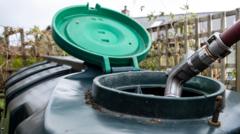
The sound comes in the middle of the night.
It is not a bang or a crash, though in the dead quiet of a February freeze, it might as well be. It is a heavy, metallic clunk followed by the dry, wheezing rattle of a furnace blower pushing nothing but basement air through the vents. You lie there under three layers of wool blankets, staring at the ceiling, doing the math in the dark before your feet even hit the freezing floorboards.
A standard residential oil tank holds 275 gallons. When the gauge on top of that rust-flecked steel cylinder drops past the quarter mark, the arithmetic of survival takes over your life.
For decades, public policy treated home heating like a uniform utility, assuming that if you flipped a switch or turned a dial, warmth simply arrived on a monthly installment plan. That assumption missed millions of rural, northern, and older-home residents who do not have a municipal gas line running down their street. Instead, they have a fill pipe sticking out of their siding and a relationship with energy that feels less like a modern convenience and more like a high-stakes poker game played against the weather.
The Invisible Math of a Cold Winter
Consider a hypothetical scenario that plays out across thousands of rural kitchens every autumn. Let us call her Clara. She is seventy-one, lives on a fixed pension in a three-bedroom farmhouse built before the Second World War, and keeps her thermostat set at a stubborn sixty-two degrees.
Clara does not pay for heat in gentle, predictable slices. She pays for it in brutal, lump-sum shocks.
Unlike natural gas or electric customers, who pay after they consume energy, heating oil households typically pay upfront or within days of a delivery. When the delivery truck backs down her gravel driveway in January, the driver is not dropping off thirty dollars' worth of warmth. Most suppliers enforce a minimum delivery threshold—often 100 or 150 gallons—meaning Clara must hand over four hundred, six hundred, or sometimes nearly a thousand dollars in a single afternoon just to keep her pipes from bursting.
- The upfront cash trap: While pipeline utilities spread costs over twelve billing cycles, delivered fuels demand liquidity right when household budgets are tightest.
- The price whiplash: Heating oil tracks global crude markets directly, meaning a geopolitical shock thousands of miles away can double a family's winter heating bill within weeks.
- The efficiency penalty: Many oil furnaces still operating in rural homes are twenty to thirty years old, burning fuel at 75 or 80 percent efficiency while modern heat pumps operate at well over 200 percent efficiency.
I remember the first winter I lived in an oil-heated house, standing in a damp cellar with a flashlight, tapping the side of the tank with my knuckles like a doctor percussing a patient's chest, trying to hear where the liquid line stopped because the plastic float gauge had jammed years earlier. That specific anxiety—the fear of running dry on a Sunday night during a blizzard and having to pay an emergency bleeding-and-priming fee on top of a fuel surcharge—is something you never forget once you have felt it.
Why Traditional Aid Kept Missing the Mark
For years, government energy assistance programs were built around the architecture of the electric grid and the gas pipeline. The paperwork assumed a monthly utility bill with an account number, a meter reading, and a regulated shut-off notice.
If you heated with oil, propane, or wood, you were an administrative awkwardness.
By the time a household using heating oil realized they could not afford a refill, they were not facing a thirty-day grace period from a regulated utility company. They were facing an empty tank. When a tank runs dry, sludge from the bottom gets pulled into the fuel line, clogging the filter and nozzle, turning a simple fuel shortage into a mechanical breakdown requiring an HVAC technician.
That is why expanded support for households reliant on heating oil represents more than a line item in a budget. It is a structural correction to a blind spot that left the most vulnerable homes exposed to the sharpest edges of energy volatility.
Think of home energy like buying groceries. Most urban and suburban households have a neighborhood market where they can buy one loaf of bread and a quart of milk every few days using a debit card. Heating oil households are forced to drive to a warehouse club once a month and buy an entire pallet of food in cash, with the price changing every time they pull into the parking lot.
When governments finally began expanding direct heating oil grants, waiving rigid income cliffs, and bundling fuel relief with subsidized heat pump conversions, the shift acknowledged a basic physical reality. You cannot ask a family to simply use less heat when the alternative is hypothermia or frozen plumbing.
How the New Support Actually Works on the Ground
Understanding the mechanics of modern heating oil relief requires looking past the press releases and seeing how money actually moves from a public treasury into a basement tank.
First, eligibility thresholds have widened. Historically, energy assistance targeted only households living well below the federal poverty line. Yet the brutal spike in distillate fuel prices over recent winters pushed middle-income families, retirees, and working tradespeople into energy poverty—defined by economists as spending more than six percent of household income on home energy bills. Updated programs increasingly recognize moderate-income households, particularly in regions where oil remains the primary heating source for up to a third of the population.
Second, the delivery of aid has sped up. Rather than forcing residents to pay out of pocket and wait six months for a tax credit, expanded frameworks increasingly rely on direct vendor payments and automatic lump-sum disbursements tied to existing benefit rolls. When the money goes straight to the fuel distributor as a credit on the household's account, the delivery truck rolls without the homeowner having to scramble for a payday loan or put groceries on a high-interest credit card.
Third—and most crucially—policy has finally connected short-term survival with long-term escape.
Paying for a tank of oil keeps a family warm until March. Helping that family replace the oil burner altogether keeps them warm for the next twenty years.
The Bridge Out of the Basement
Walk through any older neighborhood in New England, Atlantic Canada, the Upper Midwest, or rural parts of the United Kingdom, and you will see the physical legacy of the mid-twentieth century. Between 1945 and 1970, oil heating was marketed as the clean, modern alternative to shoveling coal into a cellar hopper. Millions of homes were built around those roaring, cast-iron boilers.
Today, those same homes are trapped in an aging infrastructure loop.
Replacing an oil furnace and decommissioning a buried or basement oil tank is expensive. Between removing the old steel tank—which carries environmental liability if it has leaked—upgrading an electrical panel from 100 amps to 200 amps, and installing cold-climate air-source heat pumps, the upfront cost easily crosses fifteen or twenty thousand dollars. For a household already struggling to pay eight hundred dollars for a tank of oil, twenty thousand dollars might as well be twenty million.
This is where the combination of immediate fuel subsidies and zero-interest or grant-funded heat pump transitions changes the equation.
Consider what happens next when both tools work together:
- Immediate stabilization: Direct fuel assistance covers the winter's oil deliveries, stopping the financial bleeding and preventing emergency tank run-outs.
- Audit and weatherization: A certified energy advisor inspects the home, sealing drafty rim joists and insulating attics so the house stops leaking heat into the winter sky.
- The mechanical switch: Enhanced rebates—often covering up to eighty or one hundred percent of equipment costs for low- and moderate-income households—pay for the installation of high-efficiency cold-climate heat pumps.
To be honest, the transition is not always tidy. Contractors get backlogged. Older homes with radiator pipes instead of ductwork require creative engineering, and rural electrical grids sometimes groan under the added winter load. People have every right to feel skeptical when a bureaucrat promises a painless switch in the middle of January. Nobody wants to be a test case when it is ten degrees below zero outside.
Yet the math of the transition is undeniable. Cold-climate heat pumps engineered over the last decade no longer lose their nerve when the temperature drops below freezing; modern variable-speed compressors pull ambient heat from outdoor air even at minus fifteen degrees Fahrenheit. Once installed, they eliminate the delivery truck, erase the tank-leak anxiety, and cut annual heating costs in half compared to fluctuating oil prices.
What Households Need to Do Before the Frost Sets In
If you or someone you care for still relies on a fill pipe outside the foundation wall, waiting until the gauge hits empty is the single most expensive mistake you can make.
Support programs almost always operate on finite funding pools or seasonal enrollment windows. Whether it is federal low-income home energy assistance, state-level fuel funds, utility-sponsored weatherization grants, or municipal heat pump rebates, the money flows first to the people who apply before the first hard freeze.
Start by gathering three pieces of paper: proof of household income, a recent fuel delivery receipt showing your vendor's account details, and a current electric bill. Contact your local community action agency or state energy office directly rather than relying on rumors from neighbors about who qualifies. Many homeowners assume owning their house disqualifies them from assistance, or that having a modest savings account locks them out, when in reality asset tests have been dropped across numerous jurisdictions specifically to reach seniors like Clara.
Even if your income sits slightly above the threshold for free fuel deliveries, check the tiered rebates for insulation and heat pump upgrades. Pairing a federal tax credit with a state rebate and a local utility incentive often stacks enough support to bring a full heating system replacement within reach of an ordinary monthly budget.
The goal is simple. No one should have to lie awake at three in the morning listening to a furnace struggle, measuring their comfort in eighths of an inch on a plastic gauge, wondering whether they can afford to turn the dial up two degrees before dawn.
Down in the basement, the steel tank sits quiet, waiting for a truck that one day will no longer need to come.