At 4:30 in the morning, before the freeways begin their low, metallic hum, Los Angeles smells like damp asphalt, eucalyptus, and exhaust.
Walk down a stretch of Vermont Avenue at that hour and you will see the city’s true ledger written in nylon and cardboard. Tents pitched tight against chain-link fences. Shopping carts lashed together with bungee cords. Men and women wrapped in grey wool blankets, breathing shallowly in the Pacific chill while six-figure sedans idle at the red light ten feet away. For decades, the official response from the twenty-seventh floor of City Hall was a shrug dressed up in bureaucratic jargon. Committees were formed. Studies were commissioned. Police cruisers rolled through at dawn to throw belongings into the backs of sanitation trucks, pushing the crisis three blocks east until the next complaint came in. Read more on a connected issue: this related article.
Then came a woman with a clipboard, an urban planning degree, and a refusal to accept that misery was simply the price of sunshine.
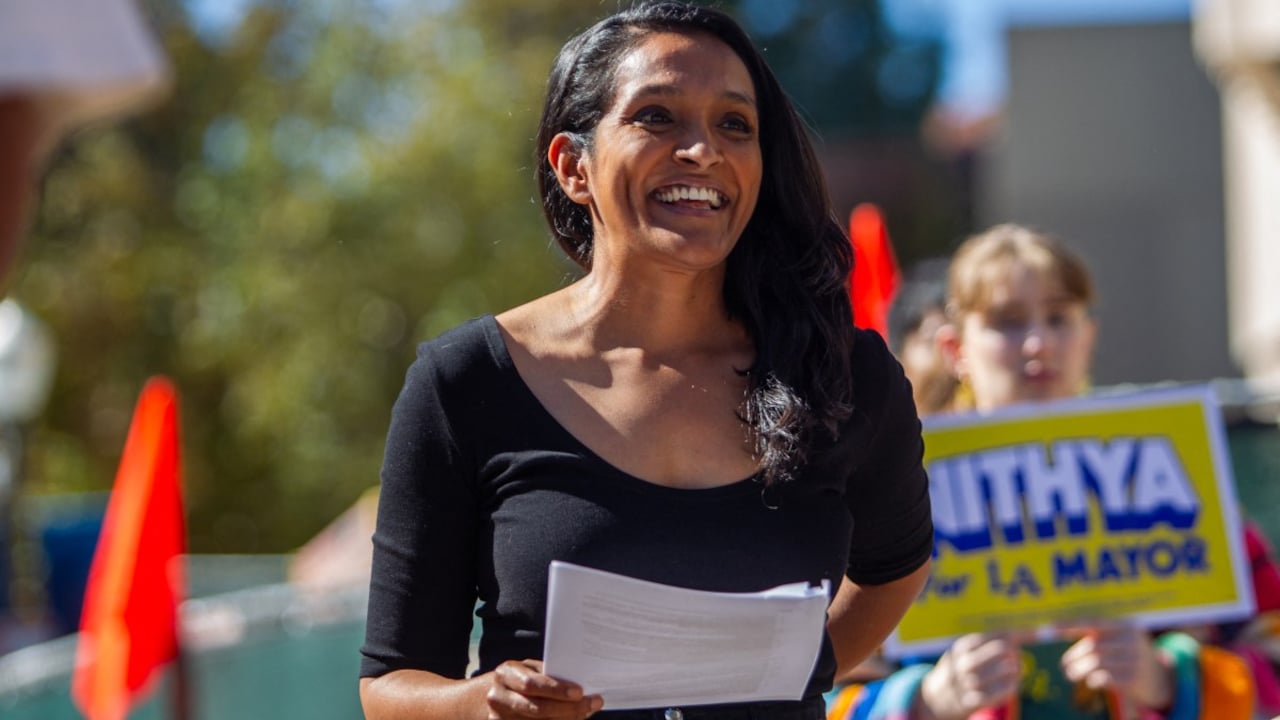
When Nithya Raman won the race for Mayor of Los Angeles, defeating entrenched political machinery to become the first South Asian American, the first Indian-born resident, and the first democratic socialist to hold the city’s highest office, the headlines treated it like a statistical anomaly. A political upset. A sudden lurch to the left in America’s second-largest city. More analysis by Al Jazeera delves into similar views on this issue.
They missed the point entirely.
Raman’s victory was not a sudden spasm of ideology. It was the inevitable detonation of a fuse lit years ago in living rooms, overcrowded apartments, and sidewalk encampments across the sprawling basin—a quiet, relentless revolt by people who realized that the city they built could no longer afford to house them.
The Architecture of an Unlikely Insurgent
To understand how an immigrant raised between Kerala, India, and Louisiana ended up holding the keys to a $13 billion municipal budget, you have to stop looking at campaign finance spreadsheets and start looking at how cities actually work.
Most politicians view a metropolis the way a real estate developer views a blueprint. They see zoning codes, tax revenues, and electoral districts. Raman, who earned her master’s degree in urban planning from MIT and spent years working on sanitation and housing access in the slums of Mumbai before co-founding a homelessness coalition in Silver Lake, views a city the way a cardiologist views a chest X-ray. She looks for blockages. She looks at where the lifeblood—housing, transit, basic human dignity—is being choked off by decades of calcified policy.
Consider a hypothetical Angelenos named Mateo. Let’s call him a composite of ten thousand real people living between Koreatown and the San Fernando Valley right now. Mateo works forty-eight hours a week stocking warehouse shelves in Vernon. He makes twenty-two dollars an hour. Five years ago, he split a two-bedroom apartment with his brother for $1,650 a month. Today, after a corporate landlord bought the building, slapped grey paint over the stucco, and rebranded it as "luxury living," the rent is $2,900. Mateo’s wages went up by twelve percent; his rent went up by seventy-five. One blown transmission on his Honda Civic, one unpaid week off for the flu, and Mateo isn't just struggling. He is sleeping in the backseat of his car.
For years, City Hall treated Mateo’s story as an individual moral failing or an unsolvable act of nature.
Raman treated it as a math problem with a deliberate, man-made cause.
I remember sitting in a cramped community room in East Hollywood back in 2020, long before a mayoral run was even a whisper, watching her dismantle a city housing report in front of eighty exhausted renters and small business owners. There were no teleprompters. No polished stump speeches. Just a woman in a cardigan holding a highlighter, patiently explaining how municipal zoning laws had effectively outlawed affordable apartment construction across seventy-five percent of the city's residential land. People leaned forward in their folding chairs. You could practically hear the gears clicking in the room. The shame they had been carrying around—the quiet, gnawing fear that they were failing at life because they couldn't pay $2,500 for a studio—evaporated. It wasn't them. The table was tilted.
Breaking the Machine
When Raman first stunned the establishment by winning a seat on the Los Angeles City Council in 2020, unseating an incumbent for the first time in seventeen years, the political class dismissed it as a fluke of pandemic-era boredom. They assumed the machine would absorb her, sand down her edges, and teach her how to play the game of quiet favors and backroom compromises.
They miscalculated.
Instead of assimilating into City Hall’s culture, Raman brought the street inside. Her council office operated less like a traditional political fiefdom and more like a triage center. When sweeping anti-camping ordinances were proposed—laws that made it a crime to sit, lie, or sleep near schools, parks, and libraries without providing a single actual bed to go to—she stood almost alone on the council floor and voted no. She took relentless heat for it. Pundits called her naive. Critics painted her as soft on disorder. Business associations poured millions into campaigns designed to crush her political future.
Yet something strange happened when voters actually looked at the results.
In neighborhoods where traditional politicians relied on police sweeps—clearing an encampment on Tuesday only to watch the exact same tents reappear on Friday—nothing changed except the trauma inflicted on people who already had nothing. Meanwhile, Raman’s approach, rooted in the deceptively simple philosophy of "housing first," began producing stubborn, undeniable results. By pairing street-level outreach workers directly with interim housing and permanent supportive units, her district moved hundreds of chronically unhoused residents off sidewalks permanently, not temporarily.
Think of the difference between mopping a flooded kitchen floor while the faucet is still wide open, and actually reaching under the sink to turn the valve. For decades, Los Angeles spent hundreds of millions of dollars buying bigger, heavier mops. Raman kept pointing at the pipe.
The Campaign Nobody Saw Coming
By the time the mayoral race heated up, the conventional wisdom in Sacramento and Washington was set in stone. Los Angeles, the pundits declared, was swinging back toward law-and-order centrism. Voters were angry about visible poverty, frustrated by sluggish city services, and anxious about the cost of living. Surely, they would turn to a familiar, moderate executive promising swift crackdowns and business-friendly deregulation.
They forgot who actually lives in Los Angeles.
They forgot the nurses commuting ninety minutes each way from Palmdale because they cannot afford to live near the hospitals where they work. They forgot the adjunct professors grading papers by dashboard light in their parked cars. They forgot the second-generation immigrants watching their childhood neighborhoods turn into sterile investment portfolios for out-of-state hedge funds.
Raman’s mayoral campaign did not win because she had the loudest television ads. She was heavily outspent by real estate developers, police unions, and corporate political action committees that treated her candidacy like an existential threat. She won because she built an army of people who felt invisible to the political establishment.
On weekends, thousands of volunteers—baristas, film editors, retired teachers, warehouse workers—walked the blistering concrete of the San Fernando Valley and the steep hills of Boyle Heights. They didn't hand out glossy brochures filled with empty slogans. They knocked on doors and asked a question that almost no politician in Los Angeles ever dares to ask: What would it take for you to actually feel secure in this city?
The answers were remarkably consistent. People wanted to walk down the sidewalk without stepping over human suffering, yes—but they also knew that arresting destitute people wasn't going to make them vanish into thin air. They wanted buses that arrived on time without baking in traffic. They wanted landlords held accountable when black mold grew through bedroom walls. They wanted a mayor who didn't treat basic human needs as radical luxuries.
And beneath all of it was a quiet pride in seeing someone like her lead. Born in Kerala, raised in Baton Rouge, educated at Harvard and MIT, Raman embodied the exact story Los Angeles claims to celebrate on its tourism brochures—an immigrant woman who crossed oceans and cultures, not to extract wealth from the city, but to repair its foundation.
What Democratic Socialism Actually Looks Like at Street Level
Say the words "democratic socialist" in American politics and half the room immediately pictures breadlines, grey concrete bunkers, and authoritarian bureaucracy. It is a phrase loaded with decades of Cold War baggage, routinely weaponized by opponents to shut down conversation before it starts.
Strip away the cable-news hysteria, however, and look at what Nithya Raman’s platform actually proposes for a city of nearly four million people. It isn't seizing factories. It is asking why a city with the weather of paradise and the economy of a G20 nation allows tens of thousands of its residents to sleep on concrete while luxury condos sit vacant as tax shelters.
Her governing blueprint rests on three straightforward pillars that feel radical only because Los Angeles has neglected them for so long:
First, housing as public infrastructure. Just as a city builds water pipes and electrical grids because private markets will not connect poor neighborhoods on their own, Raman argues the municipality must directly finance, acquire, and preserve social housing—mixed-income developments owned permanently by the public or non-profit trusts, insulated from speculative flipping.
Second, reimagining public safety. Instead of sending armed police officers to handle mental health crises, substance abuse overdoses, and wellness checks—calls that consume millions of overtime dollars while leaving violent crime investigations understaffed—her administration prioritizes unarmed crisis response teams staffed by clinicians and paramedics. Let police handle violent crime; let trained healthcare workers handle medical emergencies.
Third, taking transit seriously. In a city strangled by car dependency, Raman has consistently fought to dedicate street lanes to rapid buses, protect pedestrian crosswalks, and link affordable housing directly to metro corridors so working families aren't forced to spend a quarter of their income on gas, insurance, and car payments.
None of this is utopian fantasy. Variants of these policies are standard operating procedure in Vienna, Tokyo, and Singapore—cities that routinely top global livability rankings while maintaining thriving private sectors. What made them revolutionary in Los Angeles was simply the willingness to say them out loud without flinching when major campaign donors threatened to walk out of the room.
The Weight of the Crown
Still, winning an election is one thing. Governing Los Angeles is another beast entirely.
It is worth being completely honest here: the honeymoon will last approximately forty-eight hours. The structural problems facing Mayor Raman are immense, stubborn, and largely beyond the unilateral control of any single officeholder.
She inherits a fragmented city charter where power is deliberately divided among fifteen independent council districts, an independently elected City Attorney and Controller, a massive county bureaucracy that actually controls health and mental health funding, and state housing mandates that collide daily with fierce neighborhood resistance. Even the most brilliant urban planner cannot wave a wand and erase a shortage of half a million affordable homes overnight.
There will be ugly compromises. There will be moments when federal funding dries up, when state regulators drag their feet, when entrenched municipal unions push back against reform, and when the very movement that carried her to victory grows frustrated by the agonizingly slow pace of bureaucratic change. Cynics are already sharpening their knives, waiting for the first encampment that refuses to clear or the first budget shortfall to declare that idealism has crashed into reality.
That tension is precisely why this moment matters far beyond the borders of Southern California.
For forty years, major American cities operated under an unspoken consensus: attract corporate capital at all costs, subsidize luxury development, police the fallout, and hope the wealth eventually trickles down to the people washing the dishes and driving the buses. Los Angeles is the ultimate test case of what happens when that model runs out of road. You cannot police your way out of an eviction crisis. You cannot PR-campaign your way past stagnant wages and $3,000 apartments.
By electing Nithya Raman, the voters of Los Angeles decided to stop pretending the old playbook was working. They chose an urban planner over a political insider, a tenant advocate over a developer favorite, and a bold, unproven experiment over guaranteed decline.
Dawn on Vermont Avenue
Tomorrow morning, at 4:30 AM, the fog will still roll in off the Pacific. The tents will still be there along Vermont Avenue. Mateo will still wake up to his phone alarm in the dim interior of his parked Honda, rubbing sleep from his eyes before starting his shift in Vernon. Nobody’s life changes simply because a ballot count crosses fifty percent.
Yet walk down that same block now, and the air feels subtly different. For the first time in a generation, the person sitting in the corner office on Spring Street knows what those tents cost, knows why they are there, and won't look away when the sun comes up.