The cold in Warsaw in February does not merely bite; it settles into the marrow of your bones and stays there until May.
Walk down Wiejska Street at dusk, past the low, neoclassical curves of the Polish parliament, and you will feel a tension that has nothing to do with the sub-zero air. For months now, the word "coup" has been whispered in the warm, crowded milk bars of the capital and shouted across the floor of the Sejm. To an outsider glancing at a breathless headline from London or New York, it sounds like a cinematic thriller. Tanks in the snow. Generals storming a palace. A sudden, violent seizure of power.
Look closer, though, and you realize there are no tanks. There is no gunfire.
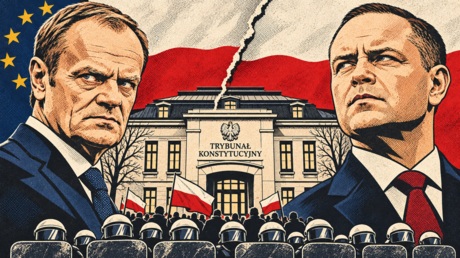
Instead, there are lawyers carrying briefcases. There are competing decrees printed on crisp white paper. There is a Constitutional Tribunal declaring a prosecutor illegitimate, and a Prime Minister ignoring the Tribunal because he considers the judges themselves to be political appointees in robes.
It is a constitutional ghost story, and it is terrifying precisely because it is so quiet.
To understand what is happening in Poland right now—and why the word "coup" is both a dangerous exaggeration and a chillingly accurate metaphor—you have to step away from the podiums and look at the kitchen tables. Consider a hypothetical family in Krakow. Let us call them Marek and Kasia. Marek is a civil engineer who spent the last decade building highways funded by Brussels; Kasia is a high school history teacher who watched her parents march against Soviet rule in the 1980s. For eight years under the nationalist Law and Justice party, known by its Polish acronym PiS, Marek and Kasia watched the country's institutions slowly bend toward a single political will. When Donald Tusk’s pro-European coalition swept into power in late 2023, Kasia wept with relief at the kitchen table. She thought the fever had broken.
She was wrong. The fever had only changed its name.
The Architecture of a Deadlock
What we are witnessing in Poland is not a coup d'état in the traditional sense. Nobody is overthrowing the state by force. Rather, it is the violent collision of two incompatible legal realities occupying the exact same geographic space.
Think of a country’s legal system like the electrical wiring behind the walls of an old house. For decades, everyone agrees on which switch turns on the lights and which breaker shuts off the power. Then, over eight years, one tenant rewires the entire building in secret, installing hidden circuits so that even when they are voted out of the house, their finger remains on the main fuse box. When the new tenants move in, they flip the switches on the wall, and nothing happens. To turn the lights back on, they have to take a crowbar to the drywall.
That crowbar is what Poland's current government is swinging, and the dust is choking the entire nation.
Between 2015 and 2023, the PiS government systematically reshaped Poland’s judiciary, public media, and state-owned enterprises. They altered the way judges were appointed to the National Council of the Judiciary, packed the Constitutional Tribunal with loyalists, and turned public television—TVP—into a relentless partisan megaphone. At the time, the European Union froze billions of euros in recovery funds, warning that Warsaw was sliding toward autocracy.
When Donald Tusk returned to the Prime Minister’s office, he faced an impossible trap. He had a democratic mandate to restore the rule of law and unlock those frozen European funds. Yet every traditional legal path to undo his predecessors' work was blocked by the very institutions his predecessors had captured—most notably the Constitutional Tribunal and President Andrzej Duda, a PiS ally armed with a presidential veto that Tusk’s coalition lacked the three-fifths parliamentary majority to override.
So, Tusk stopped waiting for the locks to turn. He started breaking them.
In December 2023, his culture minister simply fired the heads of state television, radio, and the news agency, bypassing the PiS-controlled media council entirely. The signal went dark. Politicians staged sit-ins inside the broadcast studios. Weeks later, police walked into the Presidential Palace—while the president was out—to arrest two former PiS ministers who had been convicted of abuse of power, whom the president had previously pardoned in a maneuver the Supreme Court deemed legally invalid.
Then came the prosecutors. Then came the ambassadors. Then came the Constitutional Tribunal itself, which ruled that the government's own actions were unconstitutional, only for the government to refuse to publish the Tribunal's rulings in the official journal, effectively treating the highest court in the land as a gathering of private citizens playing dress-up.
When Everyone Claims the Crown
If your head is spinning, good. That means you are paying attention.
I remember standing outside the Supreme Court building in Warsaw during the protests years ago, watching thousands of people hold up flickering candles in the dark, chanting Konstytucja—Constitution. The word felt solid then. It felt like stone. Today, that same word feels like smoke. When PiS politicians accuse Tusk of staging a "creeping coup," they point to his bypassing of parliamentary statutes via mere resolutions. When Tusk’s allies accuse PiS of sabotaging the state, they point to a paralyzed court system where a citizen cannot even be sure if the judge hearing their divorce or business dispute was legally appointed.
Let us return to Marek and Kasia in Krakow.
Marek’s engineering firm recently won a municipal contract, only to have a losing bidder challenge the ruling in court. Because the judge overseeing the commercial dispute was appointed after the 2018 judicial overhaul—a so-called "neo-judge"—the losing lawyer argued the verdict was invalid before it was even read. Marek’s project is now frozen in amber. His workers are waiting on paychecks that depend on which version of Polish law you choose to believe in on a Tuesday morning.
This is the invisible cost that rarely makes it into the breathless geopolitical dispatches. A constitutional crisis does not stay neatly inside the halls of parliament. It leaks into the bloodstream of daily life. It makes contracts uncertain, freezes investments, and turns neighbors into amateur constitutional lawyers screaming past each other at Sunday dinner.
The Poison of the Precedent
Why does this matter beyond the borders of Central Europe? Because Poland is not an isolated anomaly. It is a stress test for every modern democracy on earth.
History teaches us a brutal, unvarnished truth about democratic backsliding: it is infinitely easier to break an institution than it is to put it back together cleanly. When an illiberal government hollows out the courts and civil service from within, using the technicalities of the law to strangle the spirit of the law, it leaves its successors with a poisoned chalice.
If the new, pro-democratic government plays strictly by the broken rules, it achieves nothing, frustrates its voters, and watches the old guard return to power at the next election. If it bends the rules to fix the system quickly, it validates the cynicism of its enemies—proving to the public that the law is never a neutral referee, only a club wielded by whoever currently holds the microphone.
Every shortcut taken in the name of saving democracy leaves a scar on the exact body you are trying to heal.
Brussels has largely looked the other way, releasing tens of billions of euros to Warsaw because Tusk is a reliable, pro-European partner at a moment when war rages just across Poland’s eastern border in Ukraine. That geopolitical reality makes sense on a strategist's map. You do not pick a fight with your most vital eastern flank while Russian missiles are falling a hundred miles away. Yet that silence carries its own quiet danger. It whispers to populist movements from Paris to Washington that the rule of law is flexible, negotiable, and ultimately secondary to political convenience.
The Quiet Before the Break
The tragic irony of modern Warsaw is that both sides genuinely believe they are the sole defenders of the republic.
Speak to a lifelong PiS supporter in the rural east, and they will tell you with fierce conviction that Tusk is dismantling Polish sovereignty at the behest of Berlin and Brussels, trashing the constitution to silence conservative voices. Speak to a voter in Gdansk or Poznan, and they will tell you with equal passion that you cannot negotiate with arsonists while the house is still burning.
Neither side is lying about their fear. Both sides are trapped in a zero-sum spiral where losing an election no longer means spending four years in the political wilderness; it means facing criminal prosecution, stripping of assets, and total institutional erasure. When the stakes of losing become existential, compromise becomes treason.
Late at night, after the protesters have gone home and the television pundits have wiped off their makeup, Warsaw looks peaceful. Trams glide down Marszalkowska Street, throwing blue sparks against the overhead wires. Couples hurry out of the cold into warm, candlelit restaurants. On the surface, the city hums with the prosperous, modern energy of a European success story.
Yet underneath that polished surface, the foundation is fractured. Two parallel states are trying to stand on the exact same patch of ground, each insisting the other does not exist. Nobody needs to march an army down Wiejska Street to break a country in half; you only need to convince forty million people that the referee has left the field.