The desert at night has a weight you can feel in your teeth.
I remember standing on a salt flat outside Duqm a few winters ago, three hundred miles south of Muscat, watching the horizon swallow the last bruised purple of dusk. There is no ambient light out there. No cell towers blinking red on distant ridges. Just the dry hiss of sand shifting across limestone and the cold, terrifying clarity of a billion stars. When you stand in that kind of silence, the modern world feels like a rumor. You forget about fiber-optic cables buried beneath the Gulf of Oman. You forget about latency, bandwidth, and the invisible wars fought over server racks in air-conditioned bunkers.
Then you look up, and you realize the silence is a lie.
Four hundred miles above that empty sand, a new kind of silk road is being stitched together in the dark. It does not carry frankincense, copper, or bolts of dyed fabric. It carries raw, unblinking computation.
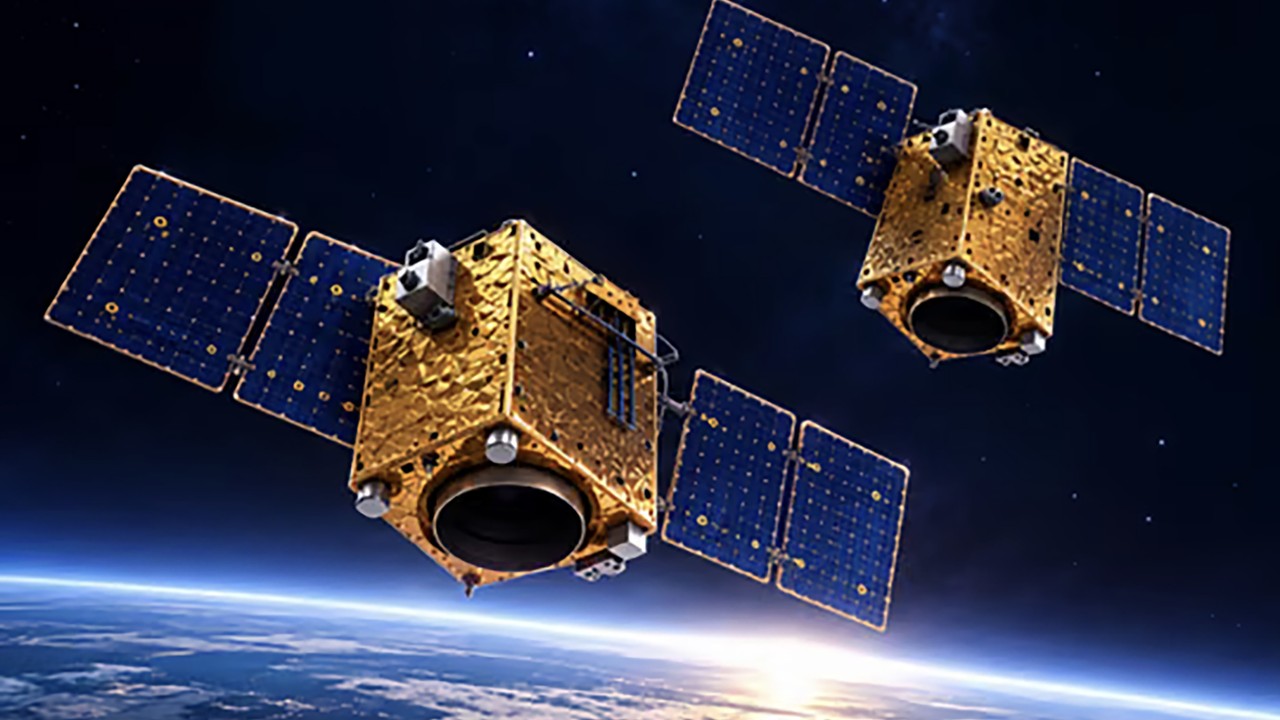
Earlier this year, a quiet announcement slipped through the wires of international trade journals, easily drowned out by louder geopolitical noise. China—specifically through a constellation of state-backed aerospace firms and commercial partners like ADA Space and its Star-Compute program—committed to building and launching a twenty-satellite artificial intelligence network for Oman.
Read that again. Not a telecommunications relay. Not a simple GPS grid. Twenty orbital data centers, equipped with high-performance AI processors and inter-satellite laser links, dedicated to the Sultanate of Oman.
To a casual observer scrolling past the headline over morning coffee, it sounds like routine infrastructure. Another cross-border tech deal in a decade full of them. A wealthy Gulf nation buying shiny hardware from an ambitious Asian superpower.
If you believe that, you are looking at the finger instead of the moon.
The Weight of a Millisecond
To understand why a nation of five million people needs twenty supercomputers hurtling around the Earth at seventeen thousand miles per hour, you have to understand the tyranny of geography.
Let us construct a hypothetical scenario—a composite of real logistics nightmares playing out every week across the Arabian Peninsula. Meet Tariq. Tariq manages a fleet of autonomous maritime drones patrolling the Strait of Hormuz, monitoring oil spills, smuggling routes, and shipping lane bottlenecks. His sensors collect four terabytes of high-resolution synthetic aperture radar and thermal imagery every hour.
Under the old architecture of the internet, Tariq’s drones are essentially blind scouts. They gather the data, compress it, beam it down to a coastal receiving station, push it through terrestrial fiber to a cloud server in Frankfurt or Singapore, wait for an algorithm to flag an anomaly, and beam the alert back to Tariq’s screen in Muscat.
By the time the machine tells Tariq that a rogue tanker has shut off its transponder near Khasab, forty minutes have vanished. In maritime security, forty minutes is an eternity. The ship is gone. The spill has doubled.
Data is heavy. Moving it across oceans through glass tubes is slow, expensive, and vulnerable to every anchor dragged across the seabed by a careless freighter. We have spent twenty years building a cloud that isn't actually in the sky; it is trapped in concrete warehouses on the ground, tethered by fragile wires.
Now, put the brain inside the satellite.
When China’s aerospace engineers talk about "space AI" or orbital edge computing, they are talking about severing that tether. Instead of beaming raw, bloated video files down to Earth to be analyzed, the twenty Omani satellites will process the data in orbit. The algorithms live on the spacecraft. They look at the desert, the sea, the pipelines, and the borders, and they think for themselves before sending a single byte home. Only the answer—a tiny, lightweight packet of pure intelligence—drops through the atmosphere to Tariq’s tablet.
Forty minutes collapses into three seconds.
Why Oman and Why Now
You might wonder why Beijing chose Muscat for this specific leap. Why not Riyadh, with its bottomless sovereign wealth funds? Why not Abu Dhabi, with its aggressive push to become the Middle East’s artificial intelligence capital?
Look at a map. Look closely at the southeastern edge of the Arabian Peninsula.
Oman is the quiet hinge of the Indian Ocean. While its neighbors built glass towers and courted Western cameras, Muscat played a longer, subtler game. For centuries, Omani dhows rode the monsoon winds from Zanzibar to Canton, trading without conquering, listening without lecturing. Today, that same neutrality makes Oman the ultimate geopolitical safe harbor. It maintains warm, functional ties with Washington, Tehran, Beijing, and New Delhi simultaneously—a diplomatic tightrope walk few nations on Earth could survive.
For China, building a twenty-satellite orbital AI network for Oman solves three existential problems at once.
First, there is the problem of Western sanctions. Over the last several years, export controls have choked off Beijing’s access to the most advanced terrestrial semiconductors. If you cannot easily buy the best chips to build massive data centers on the ground, you change the arena. You take the computing power into orbit, where sovereign borders blur, international treaties are seventy years out of date, and space-qualified hardware operates under an entirely different set of supply-chain rules.
Second, there is the Digital Silk Road. Since 2015, China has systematically laid undersea cables, built 5G networks, and financed smart cities from Nairobi to Kuala Lumpur. Putting an AI constellation above Oman extends that infrastructure vertically. Whoever owns the orbital layer owns the nervous system of the region. When Omani ministries, port authorities, and energy companies build their daily workflows on Chinese space-based AI, switching providers becomes functionally impossible. You do not rip out your own spine.
Third, there is the sheer, brutal utility of the location. Satellites in low-Earth orbit do not hover over one spot; they whip around the globe, crossing the equator repeatedly. A constellation tailored for Oman’s latitude sweeps across the most contested trade routes on the planet—the Red Sea, the Persian Gulf, the Arabian Sea, the Horn of Africa, and the western Indian Ocean.
Every pass over Muscat is also a pass over the choke points of global energy.
The Architecture of Invisible Eyes
I spent years working alongside remote-sensing analysts, staring at grainy satellite feeds until my eyes burned, trying to count shipping containers or spot illegal mining scars in remote valleys. In those days, ninety percent of the imagery we downloaded was useless. Clouds obscured the target. Shadows distorted the terrain. We paid millions of dollars for pictures of white fluff and spent weeks manually sorting through garbage to find three frames of truth.
That era is dying.
Think of the difference between a traditional satellite and an AI-equipped orbital node as the difference between a disposable camera and a seasoned detective. A traditional satellite takes a picture of everything blindly and dumps the film on your desk. An AI satellite looks through the lens, recognizes that seventy percent of the frame is covered by monsoon clouds, discards the useless pixels immediately, identifies a subtle thermal plume rising from an unmapped desert facility, cross-references it with three months of historical patterns, and alerts an analyst before the spacecraft even clears the horizon.
The twenty satellites planned for Oman will reportedly link together using laser communication terminals. Let that sink in. Instead of bouncing radio waves back and forth to ground stations—a process subject to atmospheric interference and interception—these spacecraft will fire pulses of light directly at one another across the vacuum of space, sharing computational loads like a flying supercomputer.
If one satellite spots a flash flood building in the Hajar Mountains, it passes the telemetry via laser to the next satellite in the chain, which calculates the downstream impact on coastal desalination plants and routes emergency alerts straight to municipal grids.
It is elegant. It is breathtakingly efficient. And it terrifies defense planners from Brussels to the Pentagon.
The Ghost in the Machine
We need to be honest about what happens when dual-use technology leaves the atmosphere.
In aerospace, "dual-use" is a polite euphemism. It means the exact same camera that tracks locust swarms devastating Omani date farms can also track the movement of armored brigades across a border. The exact same algorithm that detects illegal fishing trawlers off Masirah Island can identify the wake signature of a submerged submarine.
When a foreign power designs, launches, and helps operate the orbital brain of a sovereign nation, where does commercial service end and intelligence gathering begin?
I have sat in enough late-night briefings to know that nobody in Washington or Beijing actually knows where that line is anymore. When data is processed in space, encrypted by proprietary algorithms, and beamed down through closed architectures, auditing it becomes a nightmare. Does Oman truly own the code running on those twenty satellites, or is Muscat essentially renting space on a flying brain whose deepest reflexes were trained in Shenzhen and Beijing?
Even the engineers building these systems admit—quietly, off the record, over lukewarm tea—that autonomy in orbit introduces wild unpredictability. Machine learning models trained on terrestrial datasets behave strangely when exposed to cosmic radiation, extreme thermal swings, and the weird geometry of orbital angles. A shadow cast by a sand dune at 4:00 PM can trick an edge-computing model into seeing a convoy of trucks. When humans are taken out of the initial filtering loop to save milliseconds, false positives stop being minor glitches. They become diplomatic incidents.
Beyond the Horizon
Back on the salt flats outside Duqm, the port is growing. Massive cranes now silhouette themselves against the stars where there used to be nothing but scrub brush and wind. Oman is betting its post-oil future on becoming a logistics juggernaut—a green hydrogen hub, a deep-water transshipment giant, a bridge between East and West that answers to no single master.
To pull that off, the Sultanate cannot rely on twentieth-century pipes and cables. It needs eyes that never blink and a brain that never sleeps. By partnering with China to put twenty AI satellites into orbit, Oman is leapfrogging an entire generation of terrestrial infrastructure. It is refusing to wait for the future to arrive by sea; it is pulling the future down from the sky.
Yet as the rockets prepare to lift off from launchpads in Jiuquan or Wenchang, carrying Omani ambitions bolted inside Chinese fairings, a quiet transformation is taking place above our heads.
For six decades, space was the ultimate high ground—a place where superpowers parked weather stations, spy cameras, and television relays. Now, the sky is becoming a factory floor. It is becoming a server farm. The distance between seeing a thing and deciding what to do about it is shrinking to zero, and the decisions are no longer being made in rooms with windows and human voices.
Next time you step outside on a clear night, far from the glow of city streetlights, look up at the slow, steady drift of a satellite crossing the constellations. It looks like a wandering star, silent and harmless.
It isn't just watching you anymore. It is thinking.