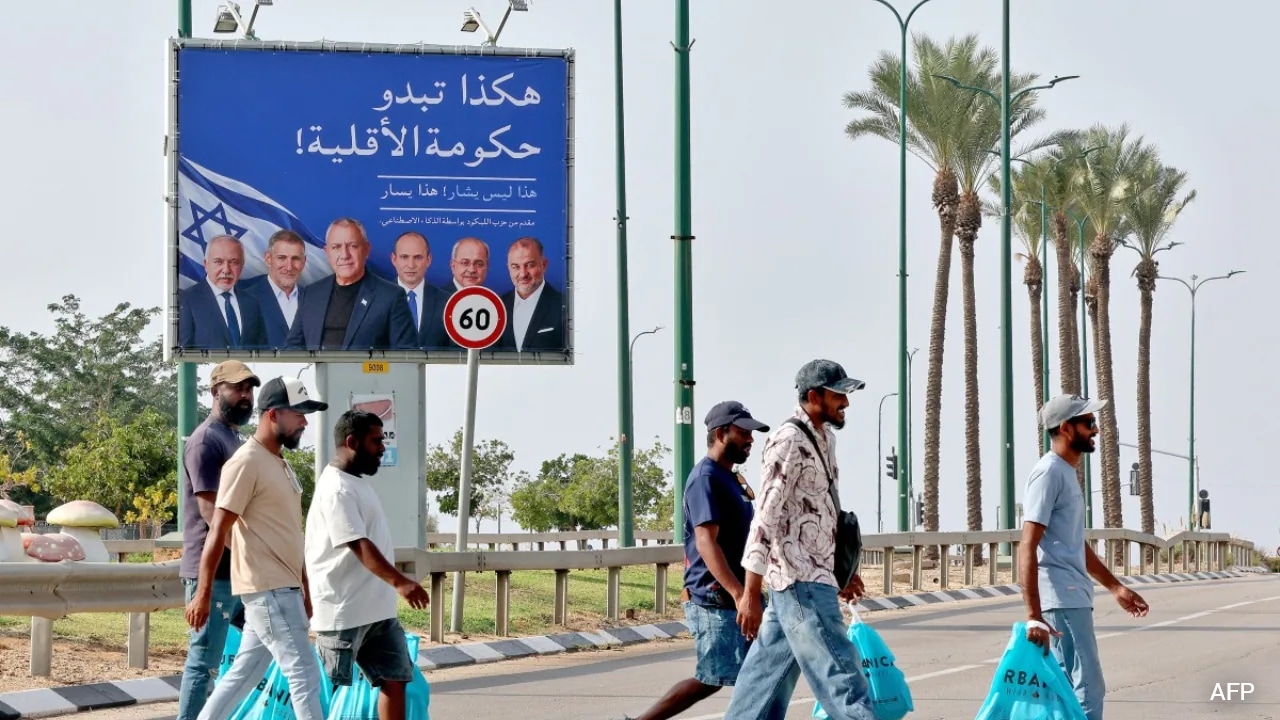
In Israel’s hyper-fragmented parliamentary system, the ultimate kingmakers are no longer the ideologues on the far right or the establishment blocs in Tel Aviv. Arab Israeli voters—who make up roughly 21 percent of the nation’s population—hold the mathematical keys to the Knesset. Because Israel’s Jewish electorate remains locked in a near-even ideological stalemate, even a marginal shift in voter turnout within Arab towns can topple an incumbent prime minister or prevent a rival coalition from ever reaching the mandatory 61-seat majority.
It is a structural paradox. A minority community that has spent decades on the political margins now dictates the survival of governments that frequently exclude them.
To understand how this happens, you have to look past the campaign slogans and examine the cold mechanics of the Knesset electoral threshold. Israel operates under a system of pure proportional representation, where the entire country acts as a single electoral district. Every party must clear a strict 3.25 percent threshold of the total valid votes cast to win even a single seat in the 120-member parliament.
When Arab voter turnout drops, the total number of valid votes shrinks. That artificially lowers the raw number of votes required for smaller, predominantly Jewish parties to clear the bar, handing them windfall seats they could never win in a high-turnout election. Conversely, when Arab citizens show up to the polls in force, they expand the denominator, squeezing out fringe factions and denying right-wing or center-left blocs the mathematical path to a governing majority.
The Anatomy of a Stalemate
For years, conventional wisdom in Jerusalem treated the Arab vote as a static, predictable bloc that remained permanently in the opposition. Zionist parties across the political spectrum operated under an unwritten rule: you do not form a governing coalition with Arab parties.
That taboo shattered in 2021. Mansour Abbas, leader of the Islamist Ra'am party, broke away from the broader Joint List alliance and did something unprecedented. He joined a governing coalition alongside centrist, leftist, and right-wing nationalist parties, proving that pragmatic political horse-trading could override decades of ideological rigidity.
His gamble changed the calculus for everyone. Suddenly, Arab politicians were no longer just protest voices shouting from the back benches. They were sitting at the cabinet table, negotiating billions of shekels in infrastructure budgets, crime-fighting initiatives, and municipal funding for neglected towns in the Galilee and the Negev.
Yet that historic breakthrough also exposed deep fissures within Palestinian society inside Israel.
The Cost of Pragmatism
Joining an Israeli government requires making painful compromises. While Abbas secured unprecedented financial commitments for Arab municipalities, critics within his own community accused him of legitimizing policies they fundamentally oppose, particularly regarding military operations in Gaza and the ongoing occupation of the West Bank.
This tension is the central fault line in Arab Israeli politics today. Voters are torn between two competing instincts:
- Civic integration and material progress: Using parliamentary power to fix crumbling schools, pave roads, and combat the devastating wave of organized crime plaguing Arab cities.
- National identity and solidarity: Refusing to prop up governments whose broader security and territorial policies clash with Palestinian national aspirations.
When disillusionment sets in, voters do not switch parties. They simply stay home.
Why Turnout Is the Real Battleground
In Western democracies, campaigns spend millions trying to persuade undecided swing voters to cross party lines. In Israel’s Arab sector, the battle is almost entirely about mobilization versus apathy.
Consider the numbers from recent election cycles. When Arab turnout surged past 64 percent in March 2020, the unified Joint List captured an extraordinary 15 seats, making it the third-largest faction in the Knesset and effectively blocking Benjamin Netanyahu from forming a right-wing government. Less than three years later, in November 2022, internal splits caused the alliance to fracture into competing lists—Hadash-Ta'al, Ra'am, and Balad.
Turnout dipped below 53 percent.
Even worse, Balad ran independently and failed to cross the 3.25 percent threshold, wasting nearly 140,000 valid votes. Those discarded ballots vanished into the electoral ether, directly enabling Netanyahu’s right-wing and religious bloc to secure a comfortable 64-seat majority despite winning nearly the exact same number of raw votes as the opposition bloc.
Let us look at a hypothetical example to see how unforgiving this math is. Suppose 4.5 million Israelis cast valid ballots. The 3.25 percent threshold sits at 146,250 votes. If an Arab faction wins 140,000 votes, it gets zero seats. Those 140,000 votes are erased from the calculation, meaning the remaining 4.36 million votes are divided among the parties that passed. The threshold effectively drops, gifting extra seats to the largest surviving parties—often the very factions campaigning against Arab political influence.
The Mechanics of Suppression and Cynicism
Low turnout does not happen in a vacuum. It is the product of deliberate political strategy on one side and deep-seated institutional exhaustion on the other.
Right-wing strategists have long understood that depressing Arab participation is far easier than winning over center-left Jewish voters. Over the past decade, campaigns have deployed everything from aggressive rhetoric questioning the loyalty of Arab citizens to controversial surveillance initiatives at polling stations in Arab towns. The message is subtle but unmistakable: your vote does not belong here, and even if you cast it, we will never let you govern.
At the same time, mainstream centrist parties often treat the Arab electorate with a mixture of condescension and fear. Eager to prove their security credentials to soft-right Jewish swing voters, centrist leaders frequently distance themselves from Arab lawmakers during campaigns, only to quietly court their support the morning after the polls close.
Voters notice the hypocrisy.
When a community is told for three months that it is unfit to sit in a coalition, and then asked on election day to save Israeli democracy from extremism, cynicism becomes the most rational response.
The Organized Crime Crisis on the Ballot
If you walk through the streets of Nazareth, Umm al-Fahm, or Rahat, people rarely talk about grand diplomatic peace plans. They talk about stray bullets.
For years, Arab communities inside Israel have suffered from an epidemic of violent crime, extortion, and gang warfare that has claimed hundreds of lives annually. Local mayors, civic leaders, and ordinary families blame systemic police neglect, pointing out that murder cases in Jewish neighborhoods are solved at vastly higher rates than those in Arab towns.
This crisis has transformed the political priorities of the electorate. For a mother worried about her children walking home from school, abstract debates over parliamentary purity feel like a luxury she cannot afford. She wants results. She wants budgets for youth centers, functioning police stations, and economic opportunity.
This is where the pragmatic approach gains traction. Supporters argue that sitting in the opposition for another fifty years will not stop a single bullet or build a single classroom. By demanding concrete budgets in exchange for parliamentary backing—even from outside the coalition through a confidence-and-supply arrangement—Arab lawmakers can force the state to fulfill its basic obligations to tax-paying citizens.
Opponents counter that budgets are a trap. They argue that trading political legitimacy for municipal funds turns basic citizenship rights into bargaining chips, allowing the government to buy silence on larger issues of systemic inequality and land confiscation.
The Fractured Leadership Dilemma
The inability of Arab political leaders to resolve this ideological split remains their greatest vulnerability. The Israeli electoral system ruthlessly punishes fragmentation.
Whenever the major Arab factions—the secular nationalists of Balad, the socialist-leaning Hadash, the centrist Ta'al, and the conservative Islamists of Ra'am—unite under a single technical banner, they command massive leverage. Unity signals seriousness to voters, driving turnout upward and ensuring that not a single ballot is wasted below the threshold.
Yet unity is notoriously fragile.
Putting communists, secular pan-Arab nationalists, and religious conservatives on the same ticket requires constant compromise on social issues, religious legislation, and parliamentary tactics. When election season arrives, ideological purists inevitably clash with pragmatists over whether to recommend a Zionist candidate for prime minister to the president.
Each time the alliance shatters, the result is identical: mutual recriminations on Arabic-language media, confused voters staying home, and a dramatic loss of Knesset seats.
Beyond the Ballot Box
It is a mistake to view the power of Israel’s Arab citizens solely through the lens of Knesset seat counts. Even when sidelined in parliament, this demographic shapes the country’s economic and social reality in ways that no coalition agreement can undo.
Arab professionals now make up a massive share of Israel’s healthcare workforce—roughly a quarter of all doctors and nearly half of all pharmacists in the country. They are increasingly visible in academia, technology hubs, and corporate management. This deep economic integration creates a structural reality that political rhetoric cannot erase: Israel cannot function without its Arab citizens.
Yet this economic integration exists alongside acute political alienation. Young, educated Arab professionals find themselves thriving in Tel Aviv hospitals and Haifa tech firms during the day, while returning to towns that lack basic zoning permits, public transit, or equal municipal funding.
That gap between economic contribution and political representation is unsustainable.
The Structural Reality Nobody Can Escape
Israeli politics is trapped in a demographic vise. Ultra-Orthodox and national-religious populations are growing rapidly, pulling the Jewish electorate steadily rightward. Meanwhile, the Arab population continues to hold roughly a fifth of the country's demographic weight.
Neither side can completely erase the other from the electoral map.
For any centrist or center-left opposition bloc hoping to build an alternative government, there is simply no mathematical path to 61 seats without relying on Arab parties—either inside the cabinet or as an external safety net. Pretending otherwise is an exercise in political delusion.
Conversely, for right-wing blocs, maintaining power depends almost entirely on keeping Arab turnout suppressed or exploiting internal divisions among Arab factions so that thousands of votes vanish beneath the 3.25 percent threshold.
The next time Israel goes to the polls, the pundits will obsess over the latest polls in Jerusalem, the rivalries between former generals, and the rhetoric of party leaders in Tel Aviv. Ignore the noise and watch the turnout numbers in Nazareth, Taibe, and Sakhnin—because by the time those ballot boxes close, the fate of the next government will already be sealed.