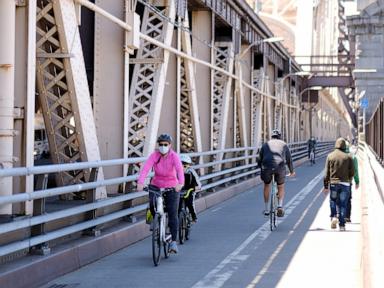
A head-on collision on the Queensboro Bridge bike path has left two men dead, shattering a carbon-fiber road bike into splinters and exposing a fatal regulatory failure on New York City infrastructure.
The crash occurred during the height of the morning commute when 39-year-old Francis Del Valle, operating a high-powered, illegal electric stand-up scooter, collided with 35-year-old Dmytro Stechenko, who was riding a traditional pedal road bike. Moving in opposite directions on the narrow, segregated northern span pathway, the impact was so catastrophic that witnesses likened the debris field to a high-speed motorcycle wreck. Both men were wearing helmets, yet the sheer kinetic energy of the crash rendered safety gear useless. Both were pronounced dead after being rushed to New York-Presbyterian Hospital in Queens.
This double fatality represents a structural breaking point for urban transit policy. It exposes the fiction that merely separating bicycles from automobiles solves the safety equation. While city officials routinely celebrate the expansion of protected bike lanes, they have quietly ignored a dangerous technological escalation happening within those very lanes. Traditional bicycles are now sharing narrow, enclosed pathways with unregistered, un-plated motorized vehicles capable of highway speeds.
The tragedy on the Queensboro Bridge was not an isolated stroke of bad luck. It was the predictable result of a city that permits the open sale of illicit motorized vehicles while relying on an outdated 15-mile-per-hour speed limit sign to police narrow, bidirectional paths.
The Kinematics of an Avoidable Wreck
Investigative details reveal that Del Valle was operating a Teverun Blade GT II. This specific model is a heavy-duty stand-up scooter equipped with dual motors, weighing roughly 83 pounds, and advertised to accelerate from zero to 53 miles per hour in under four seconds. Under New York State and City vehicle laws, any electric micromobility device capable of exceeding 20 miles per hour is strictly illegal to operate on public streets, let alone inside a designated bicycle lane.
Yet, these machines are readily available for purchase online, delivered directly to New York doorsteps without verification, registration, or regulatory oversight.
The physics of the collision explain the total destruction witnessed by first responders. Consider a standard, lightweight carbon-fiber road bike traveling downhill into Queens, paired with an 83-pound motorized vehicle surging uphill toward Manhattan. When two objects meet head-on at those combined velocities, the kinetic energy dissipated upon impact mimics a head-on automotive crash. Photos from the scene showed Stechenko’s premium Factor road bike snapped cleanly in two pieces, its frame completely severed by the force of the incoming scooter.
[Westbound Lane: 83lb E-Scooter (Capable of 50+ mph)]
                      ⬇ HEAD-ON IMPACT
[Eastbound Lane: Lightweight Carbon Road Bike (Downhill Descent)]
Street safety advocates have warned about this specific imbalance for years. While the city successfully moved pedestrians off the northern outer roadway to a dedicated southern path to resolve chronic overcrowding, the reallocation did nothing to address the widening velocity gap among the vehicles left behind. The northern path remains a bidirectional choke point where commuters on lightweight pedal bikes must dodge heavy, motorized vehicles moving at speeds that far exceed human reaction times.
The Open Market for Illicit Speed
City Hall and the local Department of Transportation have repeatedly stated that high-speed e-scooters are illegal. Mayor Zohran Mamdani’s administration issued a standard post-crash statement emphasizing their commitment to removing these devices from the streets. But this enforcement strategy treats the issue as a rider-compliance problem rather than a systemic retail failure.
The brutal truth is that New York City has allowed an underground economy of un-regulated, ultra-fast electric vehicles to integrate seamlessly into the daily commute.
- The Retail Loophole: Local brick-and-mortar shops and online distributors openly market "beast mode" scooters and high-wattage e-motos. They circumvent local laws by labeling them as "off-road use only," knowing full well they will be driven directly into the urban transit grid.
- The Delivery Surge: The explosion of app-based delivery infrastructure relies heavily on throttle-powered commercial e-bikes. While many of these are legal Class 3 vehicles capped at 25 miles per hour, an increasing number are modified or swapped for heavier, un-plated electric mopeds that routinely filter into protected bike paths to bypass street traffic.
- The Enforcement Void: The New York Police Department periodically conducts high-profile confiscation sweeps, ticketing riders or impounding low-end delivery vehicles. However, they lack a sustained, systematic strategy to interdict high-end, heavy-performance scooters like the Blade GT II at the point of sale or entry into the bridge infrastructure.
This lack of structural control has created an environment where commuters cannot trust the safety of designated infrastructure. A protected bike lane is only protective if the vehicles inside it operate within a shared, predictable spectrum of mass and velocity.
Failed Geometry and the Illusion of Safety
Urban planners frequently point to physical segregation—separating bikes from cars with concrete barriers or reallocating bridge lanes—as the gold standard of safety. But the Queensboro Bridge crash demonstrates that internal geometry matters just as much as external separation.
The northern outer roadway is narrow. When a bidirectional path is compressed into a tight corridor bounded by steel bridge trusses on one side and a high fence on the other, there is zero margin for error. A rider trying to overtake a slower cyclist has nowhere to escape if an oncoming vehicle suddenly appears over the crest of the bridge incline.
When you introduce a vehicle that possesses the weight and speed of a light motorcycle into this environment, the lane ceases to function as a bicycle path. It becomes a high-risk, unregulated speedway.
The city's current legislative answer is a proposed "Ride Safe, Ride Right" bill aimed at restricting the sale of the most dangerous micromobility devices. While legislative intent is clear, enforcement remains a logistical nightmare. Banning a specific model does little to stop the influx of generic components, battery modifications, and aftermarket firmware hacks that can turn a street-legal electric scooter into a high-speed machine.
Fixing the Micromobility Chaos
The double fatality on the Queensboro Bridge cannot be dismissed as an anomaly. If New York City wants to maintain the viability of its micromobility network, it must abandon passive enforcement and implement aggressive, structural changes to how high-powered electric vehicles are managed.
First, the city must mandate point-of-sale liability. Retailers operating within the five boroughs must be legally barred from selling vehicles that exceed the city's weight and speed thresholds unless the buyer can prove registration for closed-course use. Online retailers shipping to New York addresses must face stiff municipal fines for delivering non-compliant hardware.
Second, the structural design of major bridge crossings must adapt to the reality of vehicle differentiation. If the city cannot successfully keep heavy, motorized vehicles out of bike lanes, it must create a three-tiered infrastructure system.
- Traditional and Low-Speed Infrastructure: Reserved strictly for acoustic bicycles, legal Class 1 and Class 2 e-bikes, and low-speed stand-up scooters capped at 15 miles per hour.
- High-Speed Micromobility Lanes: Dedicated paths for high-speed commuter e-bikes, legal mopeds, and commercial delivery vehicles, completely separated from traditional pedal cyclists.
- Automotive Roadways: Standard lanes for cars, trucks, and registered, plated motorcycles.
On historical bridges like the Queensboro, Brooklyn, and Manhattan structures, creating three distinct tiers is a massive engineering and political challenge. It would require reclaiming even more space from traditional automobile traffic—a move that inevitably triggers fierce resistance from motorists and commercial transport lobbies.
But the alternative is already playing out on the asphalt. Continuing with the current system means accepting that our public infrastructure will remain an erratic lottery, where a routine morning commute can instantly turn into a fatal, high-impact collision.
The wreckage on the Queensboro Bridge is a clear warning. The city's transit network has evolved far faster than its laws, and until infrastructure geometry matches the reality of the machines riding on it, the protected lanes meant to save lives will continue to be spaces of profound danger.