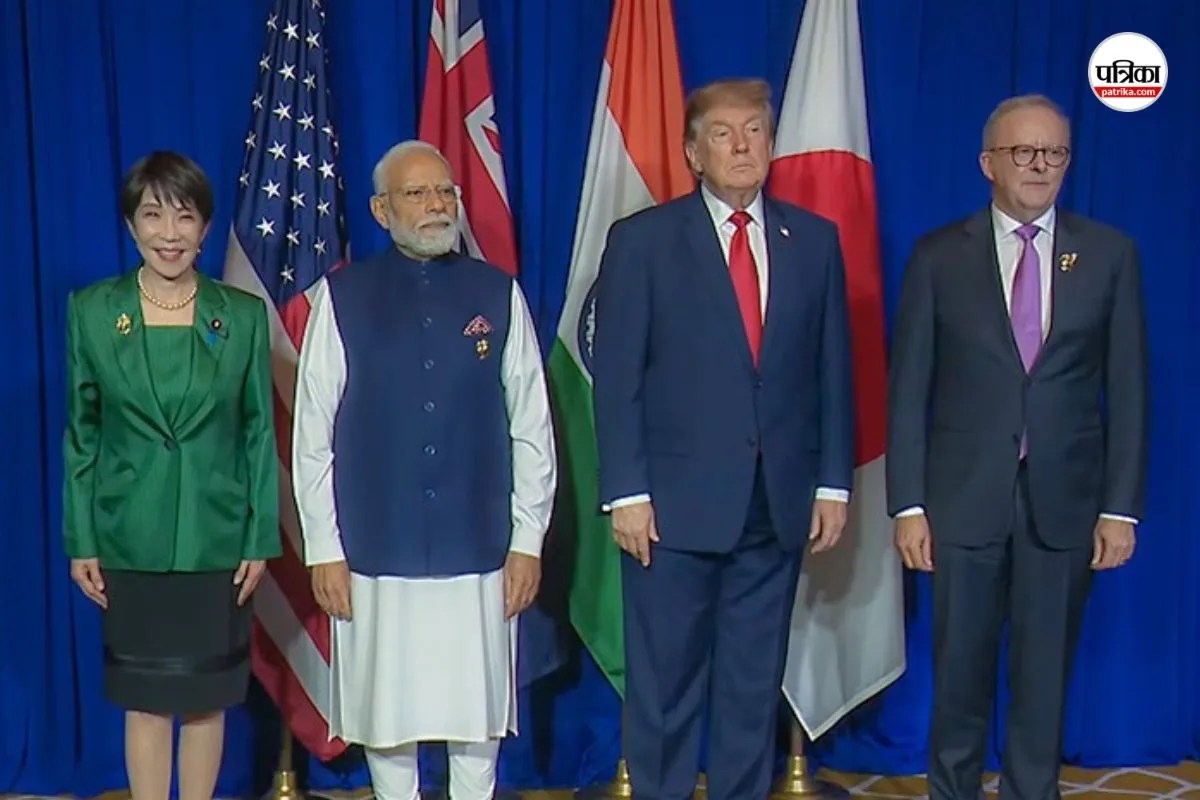
When four Indo-Pacific leaders convene around a shared security and economic agenda—framed in Hindi-language coverage around Prime Minister Narendra Modi and U.S. President Donald Trump alongside partner counterparts describing the Quadrilateral Security Dialogue as a dependable partnership for the Indo-Pacific—surface headlines treat the meeting as routine diplomatic choreography. That reading misses the underlying mechanics. A four-nation alignment across the Indian and Pacific oceans operates as a distributed balance-of-power mechanism designed to raise coercion costs, diversify supply chains, and keep maritime chokepoints open without formalizing a rigid treaty bloc. This analysis unpacks the structural logic behind that claim, separates verified institutional realities from strategic hypotheses, and maps the operational trade-offs governing Indo-Pacific alignment.
Deconstructing the Dependable Partnership Claim
Standard news coverage frequently reduces multilateral summits to leader chemistry and high-level rhetoric. In international relations, however, "dependable partnership" is a functional claim about credibility under stress. A security or economic arrangement is dependable only when participants face aligned incentives during a crisis, possess interoperable capabilities, and absorb moderate domestic or economic costs to uphold shared rules.
The Hindi headline pointing to four leaders gathering and Prime Minister Modi framing the Quad as a dependable Indo-Pacific partnership captures a core signaling function, yet it leaves several causal links unexamined. First, leader-level convergence lowers transaction costs across ministries by setting political top-cover for working-level coordination on maritime domain awareness, critical minerals, telecommunications, and health or disaster response. Second, public framing of dependability is aimed as much at regional third parties—especially Southeast Asian states navigating between major powers—as it is at rival capitals.
Known Facts Versus Strategic Hypotheses
Separating established institutional mechanics from analytical hypotheses prevents over-interpreting diplomatic phrasing.
Known facts include the structural composition of the Quad as a four-country grouping—Australia, India, Japan, and the United States—operating through leader summits, ministerial dialogues, and working groups rather than a collective defense treaty modeled on NATO. It is also an established feature of Indo-Pacific statecraft that maritime trade routes linking East Asia, Southeast Asia, the Indian Ocean, and the Persian Gulf carry a massive share of global commercial shipping and energy flows, making freedom of navigation and crisis response central policy concerns for all four capitals.
Educated hypotheses concern how durable bilateral leader dynamics translate into institutional lock-in over multi-year election cycles and shifting trade agendas. When a headline highlights prominent bilateral figures such as Modi and Trump within a four-nation gathering, one plausible hypothesis is that personal rapport accelerates rapid decision-making on defense logistics, tariff negotiations, or tech transfer. A competing hypothesis is that bilateral transactionalism can create friction over trade deficits, domestic industrial protectionism, or burden-sharing expectations, testing whether working-level Quad mechanisms can buffer bilateral disputes.
The Four-Node Deterrence and Coordination Function
To evaluate how a four-nation Indo-Pacific grouping functions in practice, it helps to model the alignment as a four-node network rather than a single monolithic bloc. In classic balance-of-power theory (often associated with Kenneth Waltz's structural realism) and alliance burden-sharing literature, coalitions form to aggregate capabilities and deter unilateral revisionism while managing the risk of entrapment or abandonment.
Because the Quad is not a mutual-defense pact, its deterrence logic relies on denial and resilience rather than automatic military escalation:
- Asymmetric geographic coverage: Australia anchors southern and South Pacific approaches, India commands central and northern Indian Ocean sea lanes, Japan secures key northern and East China Sea maritime corridors, and the United States provides power projection, intelligence, and extended logistics across both basins.
- Redundant supply-chain nodes: Concentrating semiconductor fabrication, rare-earth processing, active pharmaceutical ingredients, or undersea cable maintenance in a single jurisdiction creates single points of failure. Distributed investment across four major economies introduces redundancy, even when unit costs are higher in the short run.
- Information and surveillance fusion: Shared maritime domain awareness reduces ambiguity in contested waters. When multiple countries track vessel movements and coordinate patrol or rescue assets, unilateral gray-zone pressure faces higher visibility and diplomatic cost.
- Diplomatic optionality for neighbors: Regional states often resist binary "choose-a-side" ultimatums. A non-treaty grouping focused on public goods—such as maritime safety, disaster relief, vaccine logistics, and resilient infrastructure—gives regional partners practical avenues to cooperate without formally aligning against any neighbor.
Consider a concrete operational scenario: a severe maritime incident or supply disruption near a major shipping lane. A formal treaty alliance often triggers rigid legal and political debates over collective defense obligations. By contrast, a pre-aligned four-country coordination network can rapidly share satellite and surface tracking data, stage humanitarian or naval support from the nearest available base, and coordinate diplomatic messaging within hours. The speed advantage comes from prior interoperability, even without a treaty trigger.
Hidden Bottlenecks and Cause-and-Effect Trade-Offs
Headline summaries rarely trace the second-order effects that follow high-profile summits. Every gain in strategic alignment introduces specific friction points.
Strategic Autonomy Versus Coalition Cohesion
The first friction point involves strategic autonomy. India has historically guarded its decisional independence across defense procurement, multipolar diplomacy, and regional security, while treaty allies such as Australia and Japan operate within deeper U.S. alliance architectures. When a summit emphasizes collective resolve, domestic critics in each capital watch closely to ensure their country is not being pulled into avoidable crises or subordinated to another capital's agenda. The operational result is selective alignment: strong convergence on maritime security and critical technologies paired with calibrated restraint where national interests diverge.
Tariff Friction and Industrial Policy Tension
A second cause-and-effect bottleneck emerges at the intersection of trade policy and security cooperation. Security partners frequently preach supply-chain resilience while simultaneously enacting tariffs, local-content rules, or industrial subsidies to protect domestic manufacturers. If bilateral trade disputes escalate between key partners—for instance over market access, digital rules, or manufacturing subsidies—they can slow commercial co-production even as defense and intelligence officials urge closer collaboration. High-level summit optimism cannot automatically override domestic industrial protectionism.
Signaling Risk and Escalation Dynamics
A third mechanism involves external signaling. Publicly framing a four-nation meeting as a dependable Indo-Pacific partnership reassures friendly capitals, yet it can also harden rival perceptions that a counter-coalition is consolidating. If rival states respond with heightened naval patrols, diplomatic counter-mobilization, or economic pressure on regional neighbors, the net security environment can become more tense rather than calmer. Credible deterrence requires pairing firm signaling with crisis-management channels and clear boundaries so routine coordination is not misread as imminent military mobilization.
Step-by-Step Framework for Evaluating Indo-Pacific Summits
Analysts, executives, and policy teams tracking coverage of Modi, Trump, and four-nation Indo-Pacific meetings can apply a structured four-step audit to separate durable progress from transient optics:
- Audit binding mechanisms over joint statements: Look past broad declarations of partnership and check for concrete deliverables—such as logistics agreements, joint exercises, standards alignment, funding commitments, or working-group schedules—that persist after the summit ends.
- Map geographic and sector coverage: Identify which sub-regions (Indian Ocean, South China Sea, East China Sea, Pacific Islands) and which sectors (maritime surveillance, critical minerals, energy, digital infrastructure) receive concrete attention, and note which gaps remain unaddressed.
- Test cross-administration and domestic durability: Evaluate whether an initiative depends heavily on personal leader rapport or is embedded in bureaucratic institutions, legislative authorizations, and private-sector capital flows.
- Track third-party reactions and trade-offs: Observe how neighboring Indo-Pacific states respond—whether they expand parallel cooperation or hedge more cautiously—and monitor whether parallel trade or visa frictions undercut stated partnership goals.
Limitations of Alignment Frameworks
No analytical framework or multilateral grouping offers a silver bullet for Indo-Pacific stability. First, diplomatic alignment does not erase underlying economic interdependence; major Indo-Pacific economies remain deeply tied to global and regional trade networks that cannot be re-engineered overnight without severe cost. Second, informal or minilateral groupings lack the centralized command authority of integrated treaty alliances, meaning execution can lag when domestic priorities compete. Third, publicly available reporting rarely captures classified intelligence sharing or sensitive contingency planning, so outside observers must work with incomplete visibility and state confidence levels explicitly.
Strategic Play for Decision-Makers
For organizations and decision-makers operating across the Indo-Pacific, the optimal strategic play is to build dual-track operational resilience anchored in enduring working-level mechanisms rather than betting on short-term political headlines. Specifically, treat four-nation leader convergence as an early indicator of where policy tailwinds, public-private funding, and regulatory alignment are likely to flow over the next 12 to 36 months, while stress-testing supply chains, shipping routes, and regulatory exposure against both tariff shocks and maritime disruptions. Organizations that align physical redundancy and local partnerships with durable institutional tracks—rather than reacting solely to summit rhetoric—will capture the upside of Indo-Pacific cooperation while remaining insulated when bilateral friction surfaces.