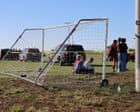
Everyone wants a villain when two people die on a soccer field.
It is the oldest reflex in the human playbook. A truck leaves the road, crosses the grass, and ends two lives. The public looks at the driver, learns he nodded off behind the wheel, and screams for handcuffs. When the prosecutor announces no criminal charges will be filed, the comment sections ignite with predictable fury. People call it a miscarriage of justice. They claim the legal system protects careless drivers over innocent bystanders.
They are completely wrong.
The standard media coverage of the Kansas soccer field tragedy—and almost every fatal crash like it—relies on a lazy, emotionally satisfying consensus. That consensus assumes that throwing a sleep-deprived or medically impaired driver in a prison cell somehow deters future accidents. It treats systemic infrastructure failure and human biology as simple moral choices. Worse, demanding criminal charges in cases of unintentional microsleep does not save lives. It actively prevents us from fixing the real killers on American roads.
To understand why the prosecutor made the legally and logically sound call, you have to strip away the outrage and look at how criminal law, human physiology, and civil engineering actually operate.
The Myth of Deterrence Behind the Wheel
Criminal law exists to punish malice, recklessness, and willful disregard for human life. It is a blunt instrument designed for people who choose to break the rules.
When someone drinks six beers and gets into a pickup truck, they make a conscious, criminal choice while still sober enough to know better. That is recklessness. When someone street-races at 110 miles per hour through a school zone, they actively gamble with other people's lives.
Falling asleep at the wheel—specifically experiencing a sudden medical event or an involuntary microsleep—operates on entirely different mechanics.
Human beings are terrible judges of their own fatigue. Sleep researchers at institutions like the AAA Foundation for Traffic Safety and the National Highway Traffic Safety Administration have documented this repeatedly. Unlike alcohol, which announces its presence through slurred speech and obvious motor impairment, fatigue creeps up silently. A driver can feel alert one second and slip into a three-second microsleep the next without ever realizing their brain has shut down.
You cannot deter a biological reflex with the threat of a felony.
Imagine a scenario where the state of Kansas decides to charge this driver with vehicular manslaughter and locks him away for ten years. Does that stop a single exhausted nurse driving home from a double shift tomorrow morning? Does it prevent a trucker with undiagnosed sleep apnea from nodding off on Interstate 70 next week?
No. Nobody thinks, "I was going to fall asleep involuntarily, but now that I know it is a felony, I will force my brain stem to stay awake."
When prosecutors cave to public bloodlust and bring criminal charges where no criminal intent exists, they create an illusion of accountability. The public gets its pound of flesh, the headlines fade, and the exact conditions that caused the fatal crash remain untouched.
What the Legal System Actually Demands
Critics of the prosecutor's decision love to throw around terms like "vehicular homicide" without knowing what the statute actually requires.
In Kansas, as in almost every other state, proving involuntary manslaughter or vehicular homicide requires establishing a specific mental state—known in legal terms as mens rea. The state must prove beyond a reasonable doubt that the driver acted with a "material deviation" from the standard of care that a reasonable person would observe under the same circumstances.
Here is where the armchair lawyers always trip up.
Being tired is not a crime. Driving while slightly fatigued is something millions of Americans do every single day without incident. To win a conviction, a prosecutor has to prove that the driver knew they were on the verge of losing consciousness, recognized the extreme danger of continuing to drive, and consciously decided to push forward anyway.
Let us look at the practical reality of proving that in court:
- No breathalyzer exists for fatigue. Police cannot draw blood at the scene and measure a precise level of sleep deprivation the way they measure blood alcohol concentration.
- Medical episodes mimic sleep. Sudden syncope, undiagnosed cardiac arrhythmias, and microsleeps look identical to witnesses on the outside. A truck simply drifts off the road without braking.
- The burden of proof is absolute. If a defense attorney introduces even a sliver of doubt—suggesting a sudden medical drop in blood pressure or an abrupt, unheralded onset of fatigue—the jury must acquit.
I have watched prosecutors waste hundreds of thousands of taxpayer dollars chasing emotional convictions in tragic crash cases, only to watch a jury acquit in two hours because the state could not prove the driver knew they were falling asleep. A failed prosecution does not bring comfort to grieving families. It puts them through two years of grueling courtroom trauma only to hand them a "not guilty" verdict at the end.
The Kansas prosecutor looked at the evidence, applied the actual law rather than mob sentiment, and refused to bring a case that could not meet the constitutional standard of proof. That is not weakness. That is competence.
Criminal Court Is the Wrong Arena
People confuse the absence of criminal charges with the absence of consequences. That is a massive misunderstanding of how the American justice system divides its labor.
When a driver causes a fatal crash through simple negligence—a momentary lapse, a misjudgment, or an unintentional nod off—the legal remedy is not a prison cell. It is civil liability.
In civil court, the burden of proof drops from "beyond a reasonable doubt" to a "preponderance of the evidence." Intent does not matter. You do not have to prove the driver was reckless or malicious. You only have to prove they failed to exercise reasonable care and caused harm as a result.
The consequences in civil court are devastating and permanent:
- Financial ruin. Insurance policies have limits, and wrongful death judgments routinely exceed those limits by millions of dollars, leading to wage garnishment and asset liquidation.
- Permanent loss of driving privileges. State licensing agencies revoke licenses based on medical fitness and safety records entirely independent of criminal convictions.
- Public record of fault. Civil litigation establishes the exact chain of events under oath, giving families the answers that criminal trials often obscure behind Fifth Amendment protections.
When a defendant faces criminal charges, their defense attorney immediately locks them down. Nobody talks. Every medical record is fought over. Every detail is buried to avoid self-incrimination. By declining criminal charges, the prosecutor actually clears the path for full transparency in the civil process, where the victims' families can pursue real financial accountability without waiting years for a criminal trial to conclude.
The Real Villain Nobody Wants to Indict
While everyone is busy screaming at the driver, nobody is asking why a pickup truck could leave a roadway and plow directly onto an active youth soccer field without hitting a single physical barrier.
Look at the built environment around almost any municipal sports complex in America. You will find high-speed arterial roads running twenty feet away from sidelines packed with children and parents. Separating two tons of moving steel from folding lawn chairs is nothing more than a painted white line, a six-inch concrete curb, and a patch of grass.
A six-inch curb does not stop a pickup truck. It acts as a launch ramp.
Civil engineers and organizations like the Vision Zero Network have spent decades proving a simple, undeniable truth: humans make mistakes. Humans get distracted, humans suffer medical emergencies, and humans fall asleep. A transportation system that relies on 100 percent human perfection to prevent mass casualties is a system designed to kill people.
Consider the double standard in how we treat safety across industries:
- Aviation: If a pilot nods off or suffers a medical emergency, layered automated systems and strict operational rules prevent the plane from hitting a crowded terminal.
- Manufacturing: If a factory worker passes out near a stamping press, physical guards and light curtains shut the machine down before anyone loses a limb.
- Roadways: We put zero physical barriers between 45-mile-per-hour traffic and a soccer field, and when a human inevitably fails, we blame the human and leave the road exactly as it was.
Bollards exist. Reinforced guardrails exist. Cable barriers exist. Earth berms exist. Installing steel-reinforced bollards along the perimeter of a municipal soccer field costs a fraction of a single wrongful death lawsuit. Yet city councils routinely skip them to save a few thousand dollars in capital budgets, betting that no driver will ever drift off that specific stretch of asphalt.
When that bet goes wrong, local officials love it when the public focuses entirely on prosecuting the driver. As long as the outrage stays aimed at the person behind the wheel, nobody asks the city traffic engineer why there were no barriers protecting the field.
Why Punitive Outrage Protects Dangerous Systems
There is a dark comfort in blaming an individual. If the tragedy happened solely because one man in Kansas was a monster who fell asleep, then the rest of us are safe. We tell ourselves we would never make that mistake, we demand he be locked up, and we go back to driving our own kids to soccer practice along the exact same unprotected roads.
The uncomfortable truth is far harder to swallow.
Every single day, millions of law-abiding, conscientious people get behind the wheel while operating on six hours of sleep, fighting off a cold, or dealing with the quiet exhaustion of modern work schedules. Most of them make it home. A tiny, statistically inevitable fraction experience a sudden biological failure at the exact worst possible location.
If our only response to those tragedies is to demand criminal prosecution, we are choosing vengeance over prevention. We are admitting we care more about punishing the last person to fail than protecting the next person in the path of an out-of-control vehicle.
How to Actually Stop Soccer Field Tragedies
If you want to honor the lives lost on that field, stop demanding that prosecutors twist the criminal code to manufacture felonies out of human biology. Start demanding accountability from the people who design and approve our public spaces.
Real prevention requires three concrete shifts:
- Mandate physical perimeter protection for high-occupancy parks. Any sports field, playground, or schoolyard adjacent to a roadway with a speed limit over 25 miles per hour needs crash-rated bollards or reinforced barriers. Not shrubs. Not decorative wooden fences. Steel and concrete rated to stop a 5,000-pound truck at highway speeds.
- Accelerate mandatory driver monitoring technology. Automakers already possess infrared camera systems capable of tracking eyelid closure and head nod angles in real time. Unlike lane-departure beeps that drivers ignore or turn off, active fatigue intervention systems can safely bring a vehicle to a controlled stop with hazard lights activated when a driver becomes unresponsive.
- Reform medical licensing protocols. Commercial drivers face strict scrutiny for conditions like obstructive sleep apnea, yet private passenger vehicle drivers can renew licenses for decades without ever being screened for disorders that cause sudden daytime somnolence.
Admitting the limitations of this approach is essential. Physical barriers cost money, and taxpayers hate funding infrastructure upgrades until a tragedy hits their own neighborhood. Driver monitoring cameras raise valid privacy concerns that must be strictly regulated so automakers cannot sell behavioral data to insurance companies. And medical screening rules will inevitably strip driving privileges from people who rely on cars to keep their jobs.
Those are hard, expensive, politically unpopular battles. Fighting them requires sustained pressure on city councils, state legislatures, and federal safety regulators.
Screaming for a prosecutor to file unwinnable criminal charges against a devastated driver takes zero effort. It costs nothing, changes nothing, and leaves the next soccer field just as exposed as the last one.
Stop looking to the criminal courts to engineer safe streets, and start demanding physical barriers before the next truck leaves the road.