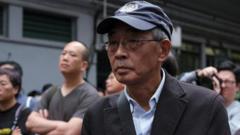
Ink has a distinct weight when it is printed on cheap paper. It smells of vinegar and charcoal. For decades, Lam Wing-kee lived in that scent. He spent his days in the cramped, narrow aisles of Causeway Bay Books in Hong Kong, hauling heavy cardboard boxes, filing paperbacks, and chatting with the eccentric, curious readers who climbed the stairs to his second-floor shop. He was a quiet man. Short, slightly stooped, with thin-rimmed glasses and the tired eyes of someone who read late into the night under bad lighting. He did not look like a revolutionary. He looked like an archivist of gossip.
Yet, a totalitarian state feared his inventory.
Lam sold books that were forbidden across the border in mainland China. They were colorful, sensational paperbacks filled with rumors about the private lives of Communist Party elites, backroom political betrayals, and factional infighting. To a casual observer, they were the political equivalent of supermarket tabloids. But in a system built on absolute narrative control, a single unauthorized sentence is a hairline crack in the dam.
On Thursday evening, in a quiet room at MacKay Memorial Hospital in Taipei, Lam Wing-kee died. He was 70. The official cause was a recurrence of lung cancer, a disease that finally claimed a body that state interrogation and psychological warfare could not break. His passing marks the end of a life that became an accidental monument to human defiance.
To understand why a bookstore manager matters, one must go back to October 2015.
Lam packed a bag and crossed the border from Hong Kong into the mainland city of Shenzhen. It was a journey he had made countless times. But this time, the ordinary routine fractured. Men stepped out of the shadows. They did not show badges. They did not state charges. They simply took him.
He was stripped of his belongings and forced onto a train. A blindfold was tied tight across his eyes, plunging him into darkness for thirteen hours as the locomotive carried him deep into the eastern province of Ningbo. When the blindfold came off, he was in a small, windowless room. The walls were padded to prevent suicide. For five months, Lam lived under twenty-four-hour surveillance. Two guards sat in the room with him at all times, watching his every breath, every blink, every movement. He was interrogated repeatedly. The goal was simple: break his mind, map his network, and seize the digital hard drive containing the names of mainland customers who had purchased his forbidden literature.
He was one of five booksellers from the same shop who vanished into thin air that year. One was snatched from his holiday home in Thailand. Another disappeared right from the streets of Hong Kong, a city that was supposed to be protected by the rule of law. The message from Beijing was loud, clear, and terrifying: no matter where you are, we can touch you.
The state almost succeeded. Under intense psychological pressure, isolated from his family and unsure if he would ever see the sun again, Lam did what almost anyone would do to survive. He confessed. He sat in front of a Chinese state television camera, looked into the lens, and admitted to distributing illegal books. It was a choreographed performance, a ritual humiliation designed to show the absolute dominance of the regime.
In June 2016, his captors offered him a deal. They allowed him to return to Hong Kong on one condition. He had to retrieve the physical hard drive containing the bookstore’s client list and bring it back across the border. If he complied, he might buy a semblance of freedom. If he refused, his life was forfeit.
Lam boarded the train back to Hong Kong. The weight of that choice must have been paralyzing. On one hand lay the quiet compliance that keeps a man alive. On the other lay an act of defiance that would permanently burn his life to the ground. He had the hard drive in his possession. He was supposed to board a return train to the mainland.
Instead, he walked out of the station.
He smoke-tested his freedom on the platform, lit a cigarette, and made a decision. He did not get back on the train. Two days later, instead of surrendering to his handlers, Lam stood before a packed room of journalists in Hong Kong. His voice trembled, but it did not break. He exposed the entire operation. He told the world about the blindfold, the padded room, the forced confession, and the relentless pressure to betray his customers.
"I can choose not to return," Lam told the cameras, his small frame illuminated by a hundred flashing bulbs. "If I do not speak out, if I think only of myself, Hong Kong is finished."
It was an explosive moment of raw truth that shattered the carefully constructed narrative of the Chinese state. He chose vulnerability over safety. By refusing to turn over the client list, he protected thousands of ordinary people whose names were written on that digital ledger.
But heroes rarely get to live happily ever after.
By 2019, Hong Kong was no longer a sanctuary. The local government introduced an extradition bill that would have allowed individuals to be legally sent to the mainland for trial. Lam knew exactly what that meant for him. The air was thickening. The city he loved was transforming into a trap.
He packed a single suitcase and fled to Taiwan.
Exile is a slow, quiet ache. It strips away your landmarks, your community, your language, and your history. But Lam refused to fade into obscurity. In 2020, in the heart of Taipei’s Zhongshan District, he opened a new shop. He called it Causeway Bay Books.
The name was a defiance in itself. The new shop was tiny, located on the tenth floor of a nondescript commercial building, but it became a lighthouse. Hong Kongers who had fled their homeland gathered there to find familiar faces, familiar books, and a taste of the freedom they had lost. Lam sat behind the counter, chain-smoking, brewing tea, and talking to anyone who walked through the door. He used his ordinary life to defend an extraordinary principle.
The risks did not vanish just because he changed islands. Before the Taipei shop even opened, a man threw red paint on him in the street—a visceral warning from local pro-Beijing proxies that he was still watched. He brushed it off. He kept ordering books.
Last year, the cancer returned. It was aggressive, spreading to his lungs, eroding the energy he used to keep the store open. By last month, his health had deteriorated so severely that he was forced to turn the key in the lock and temporarily close the shop. He told local journalists that if his health improved, he would open the doors again. If not, he wouldn't. There was no self-pity in his voice. Just the calm acceptance of a man who had already faced down an empire.
On Tuesday, he entered the hospital. By Wednesday, he was in a coma. On Thursday evening, surrounded by a small group of friends from Hong Kong who refused to leave his bedside, he drew his last breath.
There is an old saying that a book is a loaded weapon in the bedroom of an illiterate. To Lam Wing-kee, a book was simply a mirror. He died far from the city he tried to save, a refugee of speech in a world that is becoming increasingly hostile to it. He leaves behind no grand institutions, no vast fortunes, and no political parties.
He leaves behind an empty chair in a small Taipei bookstore, the lingering scent of old paper, and a reminder that sometimes, the most radical thing an ordinary person can do is refuse to get back on the train.