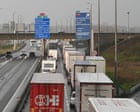
The British government's triumphant announcement that post-Brexit food export rules will be scrapped by mid-2027 is a carefully engineered political illusion. While Whitehall promises that a new sanitary and phytosanitary agreement will instantly inject £5.1 billion annually into the economy and erase a mountain of red tape, the reality on the ground in Brussels and across the English Channel tells a much more volatile story. The European Commission instantly cooled the celebrations, pointedly noting that negotiations remain unfinished and unconfirmed, exposing a massive rift between British political messaging and continental legal reality.
For five years, British agricultural exporters have lived in a state of regulatory whiplash. The promise of an easy, frictionless trade relationship outside the European Union single market collapsed into a Kafkaesque nightmare of veterinary certificates, border delays, and impounded trucks. While the newly announced framework offers a tempting vision of relief for small- and medium-sized enterprises, it ignores the hard geostrategic concessions Brussels will demand in return. This is not a simple technical correction. It is a high-stakes sovereignty trade-off that the British public is completely unprepared for.
The Paperwork Trap
To understand why the government is desperate to spin this uncompleted deal as a definitive victory, one must look at the financial hemorrhaging of the British food sector since 2021.
Export Health Certificates are not mere bureaucratic formalities. They are expensive, rigid legal mandates. Each consignment of animal or plant product entering the EU requires a signature from a certified official veterinarian, often costing up to £200 per document. For a major logistics firm moving twenty trucks a day, the math becomes punitive. For a small artisanal cheese maker or a family-run sausage manufacturer, it is completely fatal.
Data shows that roughly 16,000 British food and drink businesses stopped exporting to the EU entirely after the transition period ended. They did not lose their market demand; they were simply crushed by compliance costs.
Consider the mechanics of a single shipment of frozen beef. Under the current system, a haulage firm must present dozens of sheets of paper to French customs officials in Calais to prove compliance with EU biosecurity standards. A single typographical error, a missing stamp, or a signature using the wrong color ink can result in a trailer being detained for weeks. In the fresh food industry, a three-day delay means the entire cargo becomes garbage.
The proposed 2027 framework promises to eliminate these specific health certificates and remove the requirement for health labels on goods moving into Northern Ireland. Yet, the Department for Environment, Food and Rural Affairs published its preparatory guidance with an unspoken caveat. The red tape will only disappear if the UK agrees to dynamic alignment with EU rules.
The Price of Admission
Brussels has a foundational rule that British negotiators continually try to bypass: you cannot enjoy the benefits of the single market without accepting its obligations.
+-----------------------------+------------------------------------+
| British Government Mandate   | European Union Counter-Demand      |
+-----------------------------+------------------------------------+
| Zero Border Health Checks   | Dynamic Alignment on Agrochemicals |
| No Veterinary Certificates  | Access to UK Fishing Waters        |
| Fast-Tracked Port Transit   | Youth Mobility Scheme Compliance   |
+-----------------------------+------------------------------------+
The table above illustrates the fundamental deadlock. Downing Street wants a Swiss-style or New Zealand-style veterinary agreement that eliminates border friction while maintaining absolute legislative independence. Brussels sees this as structural cherry-picking.
If the UK wishes to scrap export certificates for meat, dairy, and plants, it must legally commit to matching EU standards on everything from pesticide maximum residue levels to food colorings and animal welfare rules. If the EU changes a regulation regarding livestock vaccines three years from now, Westminster will have to automatically copy that regulation into British law.
This is the definition of rule-taking without rule-making. For the political factions that championed Brexit on the platform of absolute legislative sovereignty, this concession is an unacceptable betrayal. For the agricultural sector, however, it is the bare minimum required for survival.
The Unspoken Link to Fishing and Mobility
The European Commission does not negotiate in silos. The caution displayed by EU spokespersons following the Whitehall announcement stems from the fact that Brussels views the food trade as leverage for other diplomatic priorities.
European diplomats have quietly tied the progress of the sanitary and phytosanitary deal to two highly contentious issues:
- Reciprocal access to British fishing waters, which remains a deeply symbolic issue for coastal communities in France and Scotland.
- A pan-European youth mobility scheme, which would allow young EU citizens to work and study in the UK easily—a proposal the current British government has publicly rejected due to domestic immigration anxieties.
By announcing a mid-2027 start date for a deal that has not been finalized, the British government is attempting to force the EU's hand through public expectation. It is a dangerous gamble that could backfire if Brussels decides to dig its heels in during the upcoming July summit.
The Threat to Domestic Biosecurity
While exporters look forward to fewer restrictions entering France, British domestic producers face a completely different set of risks regarding imports. The government has repeatedly delayed implementing its own Border Target Operating Model checks on incoming European food items, particularly medium-risk fruit and vegetables.
By repeatedly extending easements on incoming European produce, the UK has created a highly asymmetrical trade environment. European exporters have enjoyed relatively easy access to British supermarket shelves, while British farmers have faced full, unyielding barriers at the European border.
If the proposed deal collapses and full checks are finally turned on, the domestic food supply chain faces immediate destabilization. The UK relies on continental Europe for roughly 80 percent of its fruit and 50 percent of its vegetables. The infrastructure at British ports is simply not equipped to handle the sudden influx of physical inspections without causing massive traffic spikes and subsequent food inflation at the retail level.
The Illusion of a Clean Break
The core flaw in the public narrative surrounding this announcement is the idea that trade relations can be permanently fixed with a single document. Production standards are fluid. The global agricultural sector is constantly adjusting to climate challenges, genetic modifications, and synthetic chemistry.
If a treaty is signed in July, it will not represent an end to the Brexit debate; it will mark the beginning of a permanent, grinding regulatory committee structure. British food production will remain tethered to European decisions, managed by unelected technical experts operating far from the public eye.
Businesses cannot plan their investment cycles around political pronouncements that are immediately contradicted by the other side of the negotiating table. Until a legally binding treaty is signed, ratified, and implemented, the promised savings remain entirely on paper. The border infrastructure remains standing, the veterinarians are still charging for signatures, and the trucks are still waiting in line.