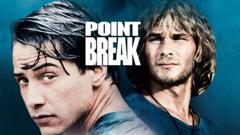
Most action movies from the nineties feel like dusty relics. They have clunky dialogue, wooden acting, and special effects that aged like milk. Then there is Point Break. Released in 1991, this isn't just a movie about surfing or bank robberies. It is a spiritual experience disguised as a high-octane thriller.
If you haven't seen it lately, you're missing out on the peak of masculine melodrama. You have Keanu Reeves as Johnny Utah, a name so ridiculous it could only belong to a former Ohio State quarterback turned FBI agent. Then you have Patrick Swayze as Bodhi, the bleached-blonde philosopher king of the surf world. Their chemistry isn't just good. It is electric.
The Brilliance of Kathryn Bigelow
People often forget that a woman directed this hyper-masculine masterpiece. Kathryn Bigelow brought a level of kinetic energy that most male directors of the era couldn't touch. She didn't just film the action. She made you feel the spray of the salt water and the terror of falling through the clouds without a parachute.
The cinematography by Donald Peterman changed how we look at extreme sports. Before this, surfing was often portrayed as a goofy hobby for stoners. Bigelow and Peterman treated it like a religion. They used high-speed cameras and innovative water rigs to put the audience inside the tube. It was immersive before that word became a marketing buzzword.
Why the Keanu Reeves and Patrick Swayze Dynamic Works
The core of the movie is the relationship between the hunter and the hunted. Johnny Utah is a straight-edge fed who thinks the world is black and white. Bodhi is the guy who shows him the grey areas. Swayze plays Bodhi with a terrifying level of charisma. You understand why a group of guys would follow him into a bank wearing Reagan and Nixon masks.
He isn't a typical villain. He doesn't want money for the sake of greed. He wants to fund a lifestyle that thumbed its nose at the system. He’s a seeker. Keanu, meanwhile, delivers a performance that defines his "earnest but slightly confused" persona. It works perfectly. Utah starts the movie wanting to bust a case and ends it losing his soul to the waves.
The Foot Chase That Changed Everything
Forget the big explosions in modern Marvel movies. The foot chase through the back alleys of Los Angeles is one of the greatest sequences in cinema history. It’s raw. It’s shaky. It’s dirty.
When Utah finally has the shot at Bodhi and decides to fire his gun into the air while screaming in frustration, it tells you everything you need to know about his character. He can't kill the man who gave him a reason to live. It’s Shakespearean. But with more neoprene.
The Ex-Presidents and 90s Counter Culture
The "Ex-Presidents" concept was a stroke of genius. Robbing banks while wearing the faces of Reagan, Carter, Nixon, and Johnson wasn't just a gimmick. It was a middle finger to the establishment. 1991 was a weird time in America. The 80s excess was dying, and the grunge era was born. Point Break captured that transition perfectly.
It tapped into the growing desire to escape the 9-to-5 grind. Bodhi’s crew lived for the "50-Year Storm." They weren't just criminals; they were athletes pushing the limits of human endurance. This resonated with an audience tired of the corporate ladder.
Why the 2015 Remake Failed
You can't catch lightning in a bottle twice. The 2015 remake tried to go "bigger" with wingsuits and extreme snowboarding. It missed the point. Point Break isn't about the stunts. It’s about the bromance. Without the specific energy of Swayze and Reeves, it’s just a flashy GoPro commercial.
The original had heart. It had a weird, poetic script that shouldn't have worked but did. When Bodhi talks about the "ride of a lifetime," you believe him. When Utah says he’s "young, dumb, and full of come," you laugh, but you also get it. He’s a guy trying too hard to be tough.
Real World Impact on Surf Culture
Before this film, surfing was a niche subculture. After it, every kid in middle America wanted a board. It popularized the "surfer dude" archetype while simultaneously legitimizing the sport's danger.
Professional surfers were used as stunts doubles and consultants. This gave the film an authenticity that "The Wild Life" or "North Shore" lacked. Darrick Doerner and other legends were involved. They made sure the waves looked real because they were real. No green screens. No fake splashes. Just raw ocean power.
How to Watch Point Break Today
If you want the best experience, find the 4K restoration. The colors of the Pacific Ocean pop in a way that the old VHS tapes never could. Look at the texture of the sand and the sweat on the actors' faces.
Don't go into it looking for a logic-driven police procedural. Go into it for the vibes. Watch it for the skydiving scenes where they talk for three minutes while falling—physics says it’s impossible, but the movie says it’s awesome.
Go find a copy of the 1991 original. Turn the volume up. Ignore your phone. Watch the final scene at Bells Beach in the rain. It’s the perfect ending to a movie that refused to play by the rules. Then, go outside and do something that scares you. That is what Bodhi would want.