A campaign staffer sits in a windowless room, the glow of a dual-monitor setup casting a blue tint over a half-eaten sandwich. Outside, the Michigan autumn is doing its usual dance—gray skies, biting wind, the smell of damp leaves. Inside, the air smells like stale coffee and panic.
The staffer clicks a mouse. A slider moves three millimeters to the right.
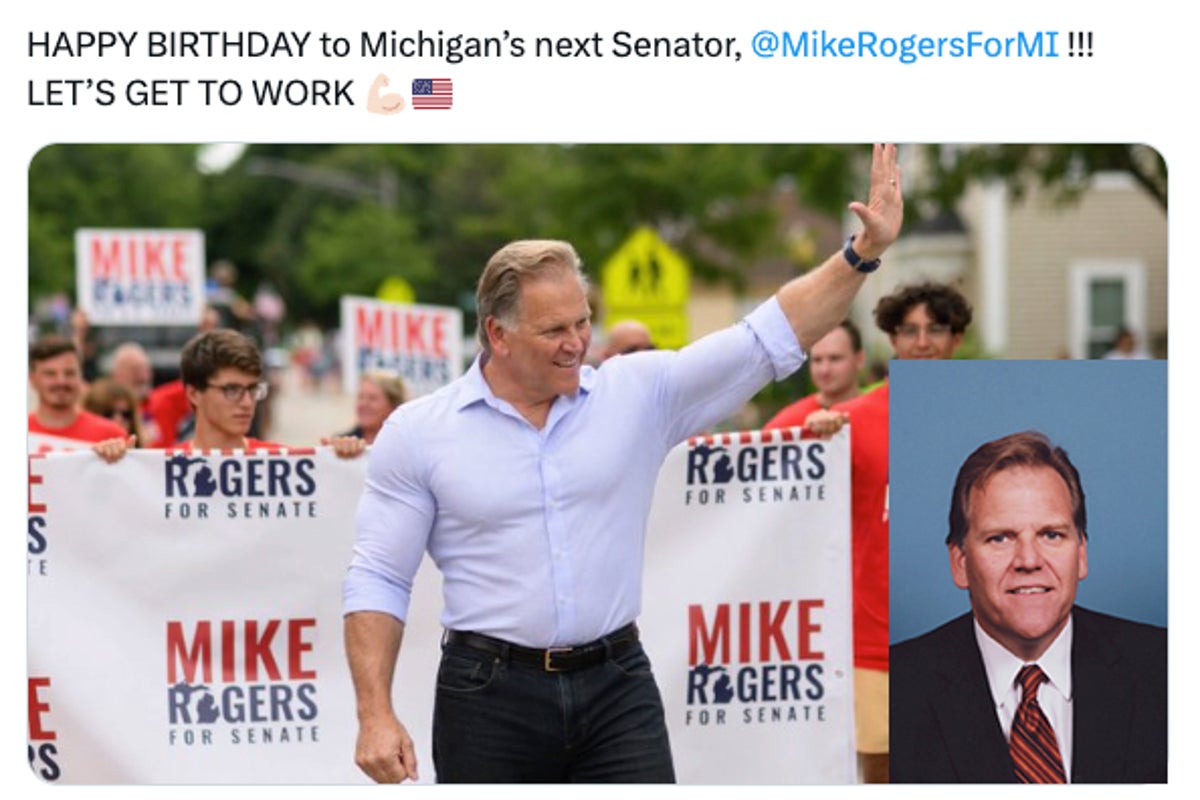
On the screen, a congressional candidate’s shoulders widen. The jawline sharpens, catching a digital beam of light that never existed in nature. The biceps fill out, stretching the fabric of a casual flannel shirt until it looks less like midwestern retail and more like a costume designed for a cinematic universe.
It takes four seconds. With those four seconds, a campaign changes direction, a candidate becomes a meme, and the fragile line between political presentation and outright fiction dissolves a little further into the digital ether.
We have arrived at the era of the automated glow-up. It is weird, it is desperate, and it is entirely predictable.
The Biceps of Macomb County
When a candidate running for Congress in Michigan’s 10th District uploaded a campaign photo to social media, the internet did not look at the policy platform. Nobody checked the tax proposals. Instead, they stared at his arms.
The image showed a man who looked less like a hopeful legislator and more like an action figure that had been left too close to a radiator. His torso was impossibly V-shaped. His forearms bore the distinct, hyper-defined vascularity of someone who spends eighteen hours a day lifting heavy iron, or someone who spent eighteen seconds inside an image-generation application.
It was, glaringly, the latter.
The backlash was instant. Voters are accustomed to a certain level of political varnish. We expect the teeth to be whitened. We expect the bald spots to be strategically obscured by camera angles. We even accept the soft-focus filters that blur the worry lines earned over fifty years of living. But we expect the human skeleton to remain structurally recognizable.
When the digital alterations are so aggressive that the candidate looks like they were rendered by a gaming engine, the illusion breaks. The reaction from the public wasn't anger; it was laughter. Humiliation is the most lethal currency in modern politics, and the candidate was suddenly bankrupt.
The campaign quickly tried to pivot, dismissing the image as a joke or a lighthearted mistake. But the damage was done. The pixels had betrayed the person.
The Chemistry of the Digital Smear
To understand why a bloated bicep matters in a local election, you have to understand the psychology of the modern voter. We are drowning in a sea of synthetic media. Every day, we consume faces that do not exist, voices synthesized from three-second audio clips, and landscapes cooked up by algorithms.
Our brains are tired. We are constantly on the lookout for deception, which means our skepticism is dialed up to a permanent ten.
When a politician uses technology to alter their physical reality, they are making a specific calculation. They assume the voter wants an archetype. They think we want the alpha leader, the strongman, the physical embodiment of resilience. It is an instinct as old as Rome—statues of emperors were routinely sculpted with the bodies of twenty-year-old athletes, regardless of the ruler’s actual age or infirmity.
But Roman sculptors did not have to contend with high-definition zoom or the collective forensic power of the internet.
Consider what happens when the deception is unmasked:
- The Trust Deficit Widens: If a candidate will lie about the size of his triceps, what does he do with a budget deficit? The leap in logic is natural for a voter. Physical deception signals a fundamental discomfort with reality.
- The Authenticity Premium Rises: In a world where everything can be faked, the unedited, raw, and flawed truth becomes incredibly valuable. A blemish is suddenly a badge of honor.
- The Message is Lost: The candidate might have had a brilliant plan for local manufacturing. It doesn't matter now. He is just the guy who photoshopped his own chest.
The irony is that politics has always been an exercise in controlled fiction. The tailored suits, the staged town halls, the carefully selected backdrops of American flags and hay bales—these are all constructs. They are theatrical props designed to broadcast competence and relatability.
The algorithm, however, removes the human element from the theater. It replaces the craft of presentation with the efficiency of optimization. It doesn't ask what looks real; it asks what looks better.
The Ghost in the Campaign Machine
Step back from the specific candidate in Michigan and look at the broader ecosystem. This isn't an isolated incident of vanity. It is a symptom of a systemic shift in how public figures view their relationship with the public.
For decades, political image-making was a collaborative process. Photographers, media consultants, and stylists worked within the boundaries of physical reality. They optimized what was there. A good photographer knew how to use the golden hour light to make a tired candidate look energized.
Now, that institutional knowledge is being replaced by software that democratizes perfection. Anyone with a smartphone can access tools that rewrite physical anatomy. The barrier to entry for complete visual reinvention has dropped to zero.
But the software lacks context. It doesn't know that a congressional candidate in a working-class district should look like a human being who buys groceries, not a character from a comic book. It only knows how to maximize symmetry, density, and contrast.
The real problem lies elsewhere. It isn't that politicians are vanity-driven—that is a historical constant. The problem is that the tools we use to communicate are actively rewriting our standards of what is acceptable. When every teenager on TikTok is using a filter to narrow their nose, a campaign manager looks at a candidate’s official portrait and thinks, Why shouldn't we give him a broader chest? Everyone else is doing it.
They forget that a teenager is trying to fit in, while a politician is asking for the authority to write laws, command resources, and represent a community. The standards are different. The stakes are infinitely higher.
The Anatomy of a Modern Refusal
We are beginning to see the counter-revolution. It is quiet, but it is growing.
Voters are developing an eye for the uncanny valley. We can spot the slightly-too-smooth skin, the unnatural geometry of a hand, the light source that doesn't match the shadows on the ground. When we see it, a switch flips in our collective consciousness. We don't just reject the image; we reject the individual behind it.
The Michigan candidate learned this the hard way. The internet didn't just mock the photo; they archived it. They compared it to real footage of him on the trail. The contrast was stark—a normal, average-looking man contrasted against his digital avatar. The avatar looked ridiculous, but the real man looked small by comparison. That is the true tragedy of the automated glow-up: it makes the actual human being look like a disappointment.
How do we fix a political culture that is addicted to the filter?
It won't come from regulation. You cannot pass a law that outlaws bad taste or vanity. It won't come from platforms labeling images, because the labels are easily bypassed or ignored.
It will come from the voters. It will come from the weaponization of ridicule.
The moment an altered image becomes a political liability rather than an asset, campaigns will stop using them. The moment a candidate realizes that a digital six-pack will cost them five points in the suburbs, the sliders on the software will be left untouched.
The View from the Stump
Imagine a high school gymnasium in Macomb County. The bleachers are half-filled. The basketball hoops are pulled up to the ceiling. A candidate stands at a wooden podium, microphone in hand, talking about infrastructure, healthcare, or inflation.
The crowd isn't looking at the policy leaflets. They are looking at his arms.
They are checking to see if the man matches the myth. They are looking for the seams where the reality meets the render. Every gesture he makes is parsed not for its passion, but for its authenticity. When he rolls up his sleeves, it isn't a sign that he’s ready to get to work; it’s a moment of truth.
This is the environment we have created. By chasing an algorithmic ideal of strength, the political class has made every public appearance an interrogation. They have traded authority for novelty, and trust for a brief moment of digital engagement.
The Michigan candidate remains on the ballot, his real, un-enhanced arms waving at parades, his real, un-sharpened jawline talking to local reporters. He is learning to live in the skin he actually occupies.
The dual-monitor setup in the campaign office is still there. The software is still loaded. But the mouse stays still. The slider remains in the middle, right where the human being begins and the machine ends.


