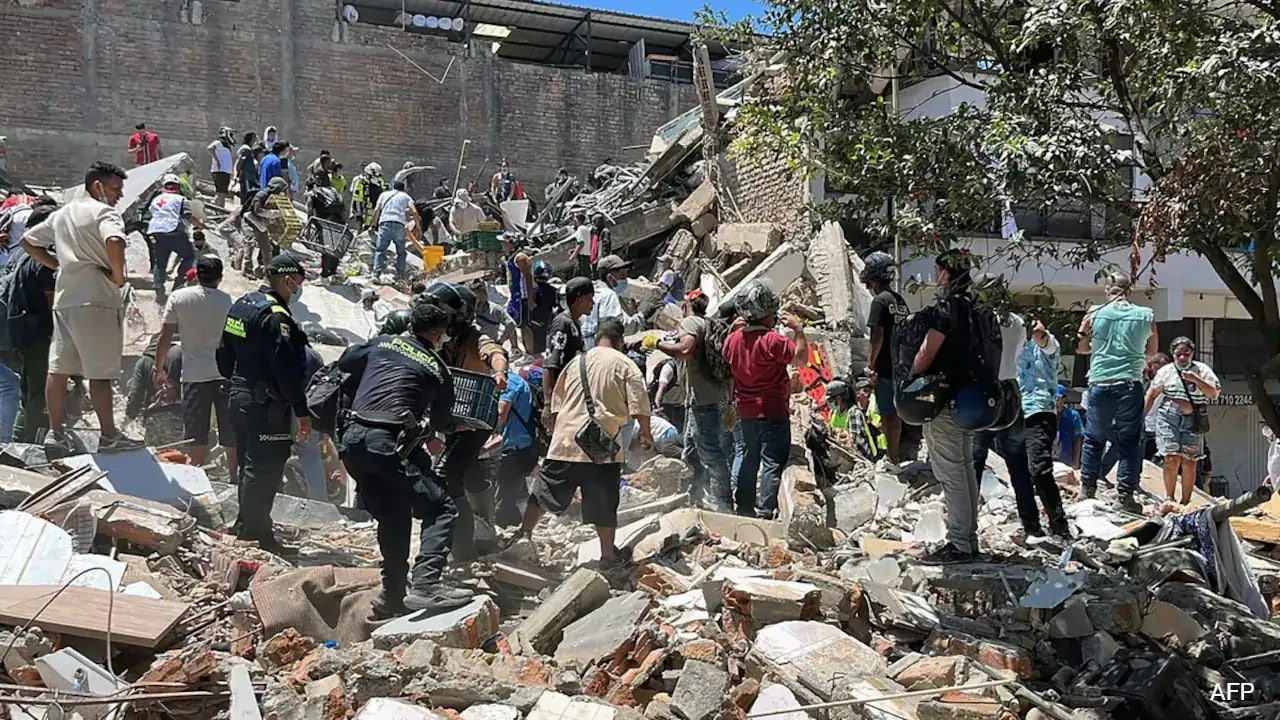
Whenever the ground shakes violently and lives are upended, social media feeds instantly fill with wild claims. A devastating earthquake hits Colombia, and within hours, internet sleuths crawl out of the woodwork to point fingers at an obscure scientific station thousands of miles away in Alaska. You've probably seen these posts. They're loud, confident, and completely wrong.
Let's look at what actually happened and why this particular conspiracy theory refuses to die.
The Core Claim Behind the Alaska Earthquake Myth
Every single time a major seismic disaster strikes, a familiar target gets blamed. This time, viral posts across TikTok and X claimed that the recent deadly earthquake in Colombia was manufactured by the High-Frequency Active Auroral Research Program, known widely as HAARP.
The logic behind these claims usually involves secret government weather weapons, tectonic warfare, or hidden energy beams shooting through the earth's crust. It sounds like a sci-fi movie script because it basically is one.
The reality is far more mundane and rooted in actual physics. HAARP is a scientific research facility located in Gakona, Alaska, operated by the University of Alaska Fairbanks. It consists of a large field of radio transmitters designed to study the ionosphere—a layer of Earth's upper atmosphere sitting roughly 37 to 600 miles above the surface.
Scientists use these radio waves to analyze natural phenomena like the northern lights and solar flares to improve communication and navigation systems. That is it. The facility does not have a giant button that shakes continents, controls the weather, or manipulates tectonic plates.
Why Physics Completely Destroys the Theory
If you want to understand why an Alaska research program cannot cause a tectonic event in South America, you have to look at the sheer scale of energy required. Earthquakes are massive geological events driven by the movement of tectonic plates deep within the Earth's lithosphere.
When faults slip, they release unimaginable amounts of energy. A moderate earthquake releases energy equivalent to tons of TNT, while major earthquakes scale up to the equivalent of thousands or millions of atomic bombs.
HAARP simply doesn't pack that kind of punch. Its transmitters emit radio frequency energy measured in megawatts, which dissipates rapidly as it travels upward into the thin air of the ionosphere. Radio waves cannot travel thousands of miles through the Earth's atmosphere, dive deep underground across continents and oceans, penetrate the Earth's crust, and somehow trigger a fault line to slip in Colombia.
Real geologists study things like subduction zones, fault lines, and stress accumulation in the Earth's crust. They don't look at radio antennae in the Alaskan wilderness. Colombia sits in a seismically active region known as the Ring of Fire, where the Nazca Plate grinds relentlessly beneath the South American Plate. That is your actual cause. Nature doesn't need human interference to shake the ground.
The Psychology of Blaming Secret Machines
Disasters are terrifying because they remind us how fragile our lives are. When an earthquake hits, it strikes without warning, destroying homes and taking lives in seconds.
Human brains hate randomness. We desperately want someone to blame because a villain feels easier to cope with than cold, unfeeling geology.
Blaming a secret government machine gives people a false sense of control. If a human enemy caused the disaster, you can fight them, protest them, or expose them. If the disaster is just a random, uncontrollable consequence of living on a dynamic, restless planet, you have to accept your own vulnerability. That frightens people far more than a conspiracy theory ever could.
How to Spot Seismic Misinformation Online
You're going to see these claims again. The next time a natural disaster happens anywhere in the world, someone will blame HAARP, secret lasers, or underground nuclear tests. Protect your feed and your sanity by keeping a few practical steps in mind.
- Check the source before you share. If a viral video features grainy footage, dramatic music, and no links to peer-reviewed scientific institutions, close the tab.
- Look for consensus from real agencies. Organizations like the United States Geological Survey or local geological institutes track seismic activity instantly. They publish data on epicenter depths, magnitudes, and fault mechanics.
- Ignore accounts that treat every natural disaster as a government plot. Conspiracy content drives engagement, and social media algorithms reward outrage, not accuracy.
Stop buying into sensationalized nonsense designed to exploit tragedy for clicks. Real science is fascinating enough without needing villains in a remote Alaskan forest. Look at the data, trust the geologists, and focus your energy on supporting relief efforts for communities actually affected by these disasters.