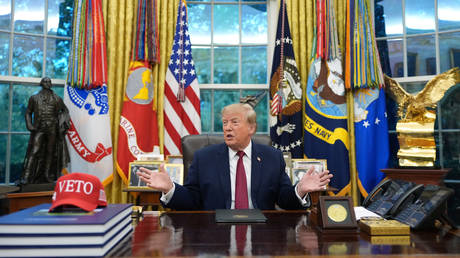
Everyone loves a headline about a secret backchannel handshake that could end a major war overnight. When Donald Trump teased a "sweeping deal" right after meeting with a Russian envoy, the internet immediately split into two predictable camps. One side claimed world peace was practically signed and sealed, while the other screamed that Washington was preparing to sell out its allies before dinner.
Both reactions completely miss how high-stakes diplomatic signaling actually works.
If you've spent any time watching international negotiations up close, you know that vague promises of massive breakthroughs are rarely about the actual paperwork sitting on the table. They're leverage plays. Trump has built an entire political brand around projecting the image of the ultimate closer, and floating the idea of a grand bargain with Moscow does something very specific for him right now. It forces European capitals, Kyiv, and critics in Washington to scramble and react to his framing rather than setting their own agenda.
Why Diplomatic Teasers Rarely Equal Actual Treaties
Let's strip away the cable news noise for a second.
In traditional statecraft, leaders keep their mouths shut until the ugly, granular details are locked down. You don't announce a historic agreement when you haven't even settled basic verification mechanisms or territorial lines. Trump operates on the exact opposite playbook. He announces the victory lap before the race is half over because public momentum creates pressure on everyone else in the room to fall in line.
When a Russian envoy walks out of a meeting and Trump immediately hints at a broad, sweeping arrangement, he isn't giving you a status update on treaty ratification. He's testing the political waters. He wants to see who panics first in Brussels, who pushes back on Capitol Hill, and how Vladimir Putin's inner circle responds to the sudden spotlight.
Honestly, it's a classic real estate negotiation tactic scaled up to nuclear geopolitics. You float a massive number or a sweeping concept just to anchor the conversation around your terms. Once people start arguing about what might be in the sweeping deal, they've already accepted the premise that a deal is happening on your timeline.
The Problem With Ambiguity in Moscow
Here is where things get tricky. While strategic ambiguity works great when you're negotiating a commercial lease in Manhattan, it carries massive risks when you're dealing with the Kremlin.
Russian diplomats don't view vague warmth as an invitation to compromise. Decades of historical precedent—from the Cold War arms control talks to the Minsk agreements—show that Moscow treats ambiguity as a vacuum to be filled with its own maximalist demands. If Washington signals it wants a fast, sweeping settlement, Russian negotiators immediately raise their asking price because they assume the American side is impatient.
That's the fundamental tension nobody talks about when these headlines drop. Speed favors the side willing to walk away, and right now, the Kremlin believes it can outlast Western political cycles.
What a Real Deal Would Actually Require
Forget the soundbites for a moment and look at the cold, hard math on the ground. Any agreement worthy of the word "sweeping" wouldn't just be a bilateral handshake between Washington and Moscow. It would have to resolve four massive roadblocks that have stalled diplomats for years.
First, there's the question of security guarantees. Ukraine isn't going to sign a piece of paper that leaves its borders defenseless against another invasion three years down the road, and European leaders in Warsaw, Berlin, and Paris won't foot the bill for a ceasefire that collapses the moment ink hits paper. Without enforceable military backing—whether through NATO mechanisms or bilateral defense pacts—any "deal" is just a temporary pause button.
Second, you have the sanctions architecture. The United States and the European Union have layered thousands of financial, energy, and technology restrictions onto the Russian economy since 2022. Trump can sign executive orders lifting certain American penalties, sure. He can't force the European Union to unfreeze hundreds of billions of dollars in Russian central bank assets held in European clearinghouses like Euroclear, nor can he compel European energy companies to start buying Russian pipeline gas again.
Third, territorial reality remains an immovable object. Neither Kyiv nor Moscow has shown any willingness to legally recognize border changes that contradict their core constitutional claims. Diplomats sometimes try to get around this by creating "frozen conflict" zones where territorial disputes are deferred indefinitely, similar to the Korean Peninsula model. Getting both sides to accept that in practice—even without formal recognition—requires immense coercive leverage that neither side has surrendered yet.
Fourth, sanctions relief has to be tied to verifiable compliance. If sanctions are lifted upfront in exchange for promises, Washington loses its primary non-military leverage overnight. Re-imposing global financial restrictions once businesses have already started flowing back into a market is nearly impossible.
The Domestic Angle You Need to Watch
Whenever Trump makes news regarding Russia, people immediately look overseas, when half the answer is sitting right inside the Beltway.
Congress still holds massive statutory authority over Russia sanctions, particularly under laws like the Countering America's Adversaries Through Sanctions Act (CAATSA). Even a president determined to overhaul foreign policy can't simply erase congressional oversight with a single tweet or press conference teaser. Lawmakers from both parties—including plenty of defense hawks inside Trump's own party—have made it clear they won't rubber-stamp an agreement that looks like capitulation.
By teasing a sweeping deal early, Trump is also flushing out his domestic opposition. He gets to see which senators immediately jump in front of cameras to complain and which ones stay quiet. It's a loyalty test and a political barometer rolled into one.
How European Allies Read These Signals
If you talk to officials in European foreign ministries right now, you won't hear panic—you'll hear exhaustion mixed with frantic contingency planning. Europe has spent the last few years slowly ramping up its own defense industrial base precisely because leaders there realized they couldn't rely entirely on Washington's political mood swings.
When Trump hints at a bilateral breakthrough with a Russian envoy without European leaders in the room, it triggers deep historical anxieties in Eastern and Central Europe. Countries like Poland and the Baltic states view unilateral U.S.-Russia deals through the lens of 20th-century history, where larger powers carved up spheres of influence over the heads of smaller nations.
Expect European capitals to respond not by waiting passively for Trump's next announcement, but by accelerating their own bilateral defense agreements and funding mechanisms so they can't be sidelined entirely if Washington pivots.
Separating Signal From Noise in Foreign Policy News
So how should you actually read these stories without getting pulled into partisan hype cycles? Stop reacting to the adjectives and start tracking the institutional actions.
Adjectives are cheap. Words like "sweeping," "historic," "productive," and "tremendous" show up after almost every diplomatic meeting, even when the two sides spent three hours screaming at each other through translators. What actually matters is what happens in the 72 hours after the cameras turn off.
Watch the personnel. Are career diplomats, Treasury Department sanctions experts, and Pentagon officials suddenly being pulled into working groups? Serious deals require hundreds of bureaucrats grinding through technical annexes. If the meeting was just two envoys talking in broad strokes with zero follow-up task forces assigned, it wasn't a breakthrough—it was a photo op and a message-testing exercise.
Watch the money and the hardware. Governments reveal their true intentions through budgets and logistics, not press releases. Keep an eye on whether weapons deliveries accelerate or slow down, and whether Treasury officials issue new enforcement waivers or tighten existing loopholes. Actions on the ground always tell the truth long before diplomatic readouts do.
You don't need a security clearance to see through political theater. Next time a headline claims a sweeping geopolitical deal is right around the corner after a single meeting, look past the rhetoric, check whether any allied capitals were actually consulted, and wait to see if concrete policy changes follow within the week. Until ink hits paper and enforcement mechanisms are verified, a teased deal is just another opening bid in a very long game.


