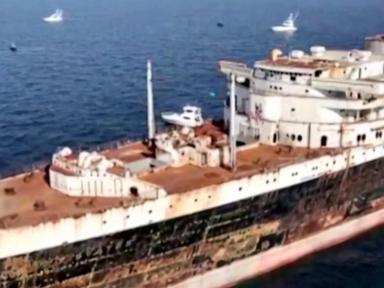
They didn't blow it up.
If you watched the viral clips of the SS United States slipping beneath the Gulf of Mexico off the Florida coast in November 2026, you probably expected Hollywood-style explosions. Most artificial reef deployments rely on scuttling charges to blast holes in the hull and force a rapid descent. Not this time. Okaloosa County and the marine engineering firm Coleen Marine skipped the explosives entirely. Instead, crews spent more than 18 months cutting precise openings in watertight compartments and pumping seawater into the hull so America's fastest ocean liner would settle straight down onto the seafloor.
It worked. On November 11, 2026—a day ahead of the originally scheduled Veterans Day sendoff—the 990-foot vessel sank upright in roughly 180 feet of water about 22 nautical miles southwest of Destin-Fort Walton Beach. That controlled descent turned a 74-year-old maritime icon into the world's largest artificial reef, eclipsing the 888-foot aircraft carrier USS Oriskany resting just 12 nautical miles away off Pensacola.
Why Sinking the SS United States Took Over Two Years of Prep
People hear "sink a ship" and assume you just tow it offshore and open the valves. Honestly, sinking a vessel engineered specifically to never go down is harder than keeping one afloat.
When naval architect William Francis Gibbs designed the SS United States in the late 1940s, the U.S. government funded much of the $71.8 million build with a strict Cold War requirement. The liner had to convert rapidly into a troop transport capable of carrying 14,000 soldiers across 10,000 miles without refueling. Gibbs obsessed over safety, compartmentalization, and fireproofing. He banned wood almost entirely from the interior—legend says even the butcher blocks and the grand piano were specially treated or made of aluminum—and divided the hull into tightly sealed watertight sections.
After Okaloosa County bought the vessel from the SS United States Conservancy for $1 million in late 2024 following a bitter pier eviction dispute in Philadelphia, marine engineers faced a massive structural puzzle. If air gets trapped inside a 990-foot hull during flooding, the ship rolls or capsizes. A sideways wreck ruins diver access and alters how currents interact with the steel.
Coleen Marine towed the liner from Philadelphia to Mobile, Alabama, in early 2025 to strip it down. According to project president Coleen O'Malley, crews actually had to repair existing hull irregularities before cutting new, calculated openings so water would enter evenly and air could escape cleanly.
The Environmental Cleanup Behind the $13 Million Project
Before a single drop of Gulf water entered the hull, inspectors had to prove the ship wouldn't poison the surrounding ecosystem. Older vessels from the 1950s are notorious for toxic materials, and federal permitting agencies don't rubber-stamp a 53,000-gross-ton sink.
Here is what the remediation team had to clear out in Mobile before the U.S. Environmental Protection Agency and other federal regulators signed off on the deployment:
- Fuel and lubricants: Crews emptied, cleaned, and obtained marine chemist certifications for all 128 fuel and lubricant tanks aboard the liner.
- PCBs and hazardous coatings: Technicians collected more than 200 samples across the ship to test for polychlorinated biphenyls. They stripped away every square inch of the green exterior deck covering, which contained high concentrations of PCBs.
- Historic artifacts: Workers removed the iconic red, white, and blue winged smokestacks, the radar mast, propellers, anchors, and thousands of interior fittings. Okaloosa County funded the roughly $13 million project using tourist tax revenue and plans to display these salvaged relics in a dedicated land-based museum in Destin-Fort Walton Beach.
Cleanup wrapped up in April 2026, though additional federal reviews pushed the final tow out of Mobile to November 9.
What the Wreck Looks Like Underwater Right Now
Because the SS United States landed upright at GPS coordinates 30° 07.148′ N, 86° 46.755′ W, its sheer vertical scale creates distinct depth zones for different types of divers and marine life.
The seafloor sits at roughly 180 feet. Because the ship stands so tall from keel to superstructure—even with its massive funnels removed—the uppermost decks sit around 55 to 60 feet below the surface. That depth profile is a massive win for Florida's dive charter industry. Recreational open-water divers can explore the top decks without exceeding standard recreational depth limits. Meanwhile, technical divers running mixed gas and decompression schedules can drop down along the sheer steel sides to examine the hull and lower decks near 180 feet.
Inside the vessel, the experience is completely different from a typical accidental shipwreck. Warren Jones, a board member of the SS United States Conservancy who sailed on the ship as an 8-year-old boy, noted that workers cut wide swim-through openings between decks. Trained wreck divers will eventually be able to navigate through the bridge, first-class public rooms, theaters, the ballroom, and passenger cabins without hitting dead-end bulkheads.
Artificial Reef Reality vs. Ecological Hype
Let's be honest about what happens when a giant steel ship hits a sandy bottom. News coverage loves calling the SS United States an instant marine oasis, and Okaloosa County officials naturally emphasize the tourism boom for anglers and divers. Both things can be true, yet marine biologists look at artificial reefs with much more nuance.
The National Oceanic and Atmospheric Administration (NOAA) defines an artificial reef as a human-made structure that mimics some characteristics of a natural reef. On the flat, sandy plains of the northern Gulf of Mexico, a 990-foot steel structure acts like a magnet. Within days, baitfish gather around the hull for shelter from currents and predators. Larger pelagics like amberjack, snapper, and grouper follow quickly behind. Over the next few years, barnacles, sponges, hydroids, and soft corals will encrust the bare metal.
The real scientific debate isn't whether fish show up—they always do. The debate is attraction versus production. Does a massive artificial reef actually increase the overall regional fish population by creating new habitat and food webs, or does it simply concentrate existing fish into one convenient spot where fishing charters can catch them faster?
To actually answer that question instead of guessing, Okaloosa County partnered with researchers—including teams from the Woods Hole Oceanographic Institution—to launch a 10-year biological, chemical, and physical monitoring program starting from day one. Scientists are tracking acoustic soundscapes and tagged fish around the hull to measure how the ecosystem matures over the next decade.
From Blue Riband Record Holder to Gulf Floor
It's hard not to feel a sting of nostalgia watching America's flagship vanish underwater, even if reefing beat cutting her up for razor blades in a scrapyard.
When the SS United States left New York on her maiden voyage in July 1952, she shattered the transatlantic speed record in both directions, averaging over 35 knots (roughly 40 mph) and peaking at 38.32 knots during sea trials. She captured the coveted Blue Riband—the first American liner to hold it in a century—and still holds the transatlantic speed record for passenger liners today. Across 17 years of service, she carried more than a million passengers, including four U.S. presidents, Marilyn Monroe, Walt Disney, and Salvador Dalí.
Jet airliners killed ocean liner travel in the 1960s. Pulled from service in 1969, the ship spent decades bouncing between owners before sitting idle along the Delaware River in South Philadelphia for nearly 30 years. Preservationists tried everything from floating casinos to waterfront hotels, yet the restoration costs—often estimated in the hundreds of millions of dollars—killed every single proposal. Sinking her off Florida wasn't anyone's first dream in 1996, yet by 2026 it was the only realistic way to keep the hull intact.
How to Plan a Dive or Fishing Trip to the Wreck
If you're a diver or angler looking to visit the SS United States off Destin-Fort Walton Beach, don't just grab a boat and drop an anchor on the GPS numbers tomorrow. You need to follow a few practical steps first:
- Check official county clearance updates. Newly deployed wrecks undergo post-sinking sonar surveys and safety inspections by Okaloosa County Natural Resources before opening to public dive boats. Verify open-access status through the Destin-Fort Walton Beach artificial reef portal before booking travel.
- Match your certification to the depth. The upper superstructure sits around 55 to 60 feet, which fits standard Open Water or Advanced Open Water certifications. If you want to swim inside the cut passageways or drop below 130 feet toward the 180-foot sand line, book specialized Wreck Diver or technical decompression training first.
- Never drop a traditional anchor into the wreck. Use public mooring buoys once installed or drift-fish above the structure. Grappling hooks damage both the ship's metal and newly settling marine organisms, and snagging an anchor in 180 feet of Gulf current is a fast way to lose gear or swamp a small boat.
- Pair the trip with the USS Oriskany. Because the USS Oriskany sits just 12 nautical miles away off Pensacola, serious wreck divers can knock out the two largest artificial reefs on Earth during a single Emerald Coast charter weekend.