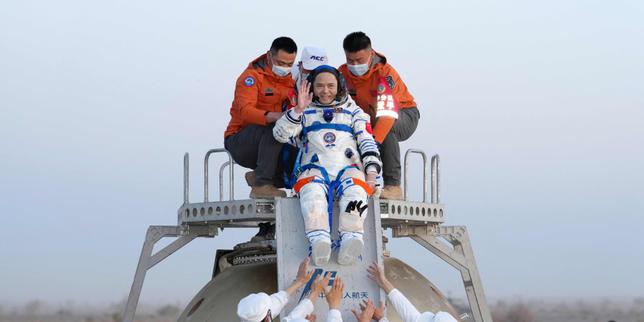
The headlines covering the safe touchdown of China's Shenzhou-21 mission are predictably uniform. They focus on the numbers: three astronauts, seven months in orbit, a smooth evening landing at the Dongfeng site in Inner Mongolia. But if you're only looking at the picture-perfect photos of the crew smiling in their lawn chairs post-landing, you're missing the real story.
This wasn't just another routine crew rotation for Beijing. The return of Senior Colonel Zhang Lu, Major Wu Fei, and Zhang Hongzhang on May 29, 2026, wraps up the most logistically chaotic, high-stakes, and genuinely historic mission in the history of the Tiangong space station.
Most coverage treats spaceflight like a clockwork train schedule. It isn't. The 210 days these taikonauts spent in space tested China's emergency backup systems to the absolute limit. Here is what actually happened while the world wasn't looking.
The Secret Space Debris Crisis
To understand why this seven-month mission is a big deal, you have to look back to November 2025. The Shenzhou-21 crew had just arrived at the station, ready for a standard handover with the departing Shenzhou-20 crew. Hours before the old crew was supposed to pack up and fly home, astronauts noticed a tiny, triangular crack on the outer pane of their capsule's viewport window.
Space debris had struck the vehicle.
Suddenly, China Manned Space Agency (CMSA) engineers faced a nightmare scenario. The Shenzhou-20 capsule was compromised. Bringing a crew back through the blistering heat of atmospheric reentry with a cracked window was an unacceptable risk.
What did they do? They gave up the Shenzhou-21 spacecraft.
The Shenzhou-20 crew piled into the brand-new Shenzhou-21 capsule and blasted back to Earth, leaving Zhang Lu and his team stranded on the Tiangong station without a lifeboat. For nearly two weeks, if anything had gone catastrophically wrong with the space station, the Shenzhou-21 crew had zero ways to get home.
How to Fix a Spacecraft in Orbit
People often underestimate the "rolling backup" system China established at the Jiuquan Satellite Launch Center. They permanently keep a Long March 2F rocket and a backup capsule ready to roll out in days. On November 25, 2025, they launched Shenzhou-22 completely uncrewed to act as the new rescue ship for the stranded crew.
But the work didn't stop there. Instead of just letting the damaged Shenzhou-20 capsule sit there as trash, the crew got to work.
In December, Zhang Lu and Wu Fei stepped outside the station for an exhausting eight-hour spacewalk. They inspected the impact zone, photographed the micro-damage, and applied a custom-developed "window crack treatment" delivered by the rescue ship. It was a wild, highly experimental orbital repair job. It worked so well that the empty, patched-up Shenzhou-20 capsule successfully reentered the atmosphere on its own in January 2026, landing safely with its interior cargo completely intact.
Breaking Spacewalk Records
This mission cemented commander Zhang Lu as China's undisputed king of extravehicular activities. By completing three more intensive spacewalks during this deployment, Zhang has now logged seven total spacewalks across his career. That is more than any other Chinese astronaut in history.
The tasks weren't just for show. The crew was processing experimental data, transferring heavy logistics, and installing new shielding to ensure future modules don't suffer the same debris damage that triggered this whole ordeal. They also tended to a crew of four mice, managing China's first-ever study of rodent mammals in microgravity to see how long-term confined living impacts mammalian biology.
The Changing Face of Tiangong
While the Shenzhou-21 crew was breaking endurance records, the station itself underwent a massive symbolic shift. Before heading home, Zhang Lu's crew welcomed their replacements, the Shenzhou-23 crew.
Among the new arrivals currently sitting in orbit is Lai Ka-ying (also known as Li Jiaying). She is a payload specialist born and raised in Hong Kong, making her the very first astronaut from the city to join a Chinese space mission. It is a massive political and cultural milestone for Beijing's space program, showing a deliberate effort to integrate specialized scientists from outside the traditional military test pilot pipeline. One of these new crew members is slated to stay up there for an entire year.
Realities of the 2030 Moon Race
It's easy to look at the International Space Station—which has been continuously occupied for over a quarter of a century—and think China is simply playing catch-up. Don't make that mistake.
The International Space Station is aging out, facing a forced retirement and deorbit plan over the coming years. Meanwhile, China's Tiangong is young, modular, and expanding. The operational flexibility CMSA demonstrated by managing a orbital debris emergency, launching an uncrewed emergency rescue vehicle within three weeks, and executing an on-orbit hull repair shows a mature, highly capable space program.
This entire seven-month marathon was a stress test for China's ultimate goal: landing astronauts on the moon by 2030. The ability to handle unexpected hardware failures in low Earth orbit is exactly the kind of grit they'll need when things go wrong a quarter-million miles away from home.
If you want to understand where the space race is heading, stop looking at the polished press release photos. Look at how a crew handles a cracked window when there's no ground crew around to fix it.
Keep an eye on the upcoming Tianzhou cargo resupply launches later this year. Those missions will give us the clearest look at the heavy-shielding modifications China is sending up next to protect its new sandbox from the worsening reality of orbital debris.
China Space Station Crew Returns to Earth
This broadcast offers a direct look at the recovery operations, showcasing the physical state of the capsule and the crew immediately after their record-setting stay in microgravity.