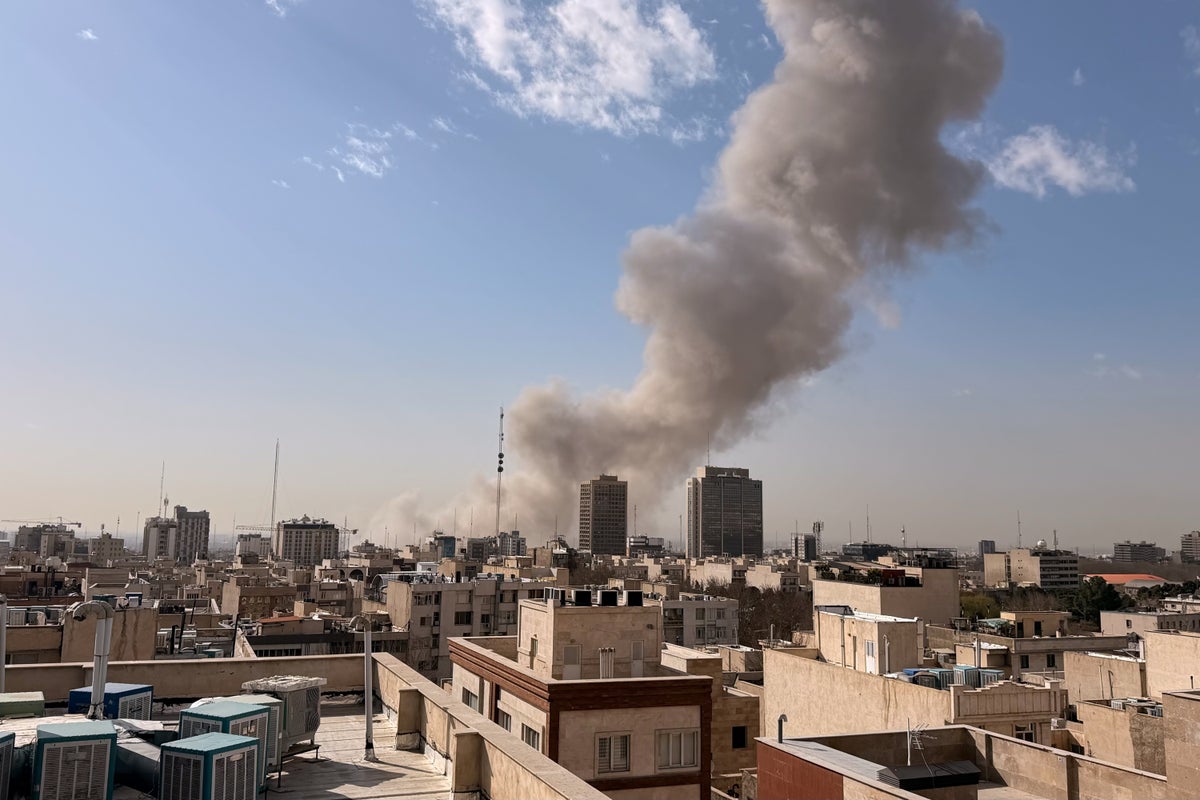
The explosions that rocked Tehran early Saturday morning did more than shatter the windows of the Mehrabad airport; they signaled the definitive collapse of a forty-seven-year geopolitical status quo. By the time the first plumes of smoke rose over the capital, President Donald Trump had already taken to social media to confirm what the world feared but few expected so soon. The United States and Israel have moved beyond the "maximum pressure" of economic sanctions into a full-scale "major combat operation" aimed at nothing less than the total dismantling of the Iranian regime.
This is not a surgical strike or a warning shot. Operation Epic Fury, as the Pentagon has dubbed it, is an existential roll of the dice. By Saturday evening, the news that Ayatollah Ali Khamenei was killed in the opening salvo had transformed the operation from a high-stakes military maneuver into a catalyst for potential state-level collapse. The Iranian government’s subsequent confirmation of his death on Sunday morning effectively ended an era of clerical rule that has defined the Middle East since 1979.
The Strategy of Decapitation
For decades, the United States and Israel operated under a tacit understanding that direct strikes on the Iranian leadership were a "red line" that would trigger a global catastrophe. That line was erased at 3:00 AM local time. The coordination between Washington and Jerusalem was total, targeting not just nuclear facilities at Fordow and Natanz, but the very nervous system of the Islamic Republic.
The primary objective appears to be a total "decapitation" of the Iranian military and political apparatus. Alongside Khamenei, reports have confirmed the deaths of the Secretary of the Supreme National Security Council, Ali Shamkhani, and the commander of the Revolutionary Guard Corps. Israel Defense Minister Israel Katz confirmed a "preemptive strike" on Iranian soil, while Trump’s message on Truth Social was even more blunt: "We're going to destroy their missiles and raze their missile industry to the ground."
This is a stark departure from the 2025 twelve-day war. That conflict focused on curbing nuclear enrichment. Today’s operation is about regime change. By striking the heart of Tehran and eliminating the Supreme Leader, the U.S. and Israel have created a power vacuum that they are actively encouraging the Iranian people to fill. Trump’s appeal for the Iranian public to “seize control of your destiny” is a gamble that the internal dissent which has simmered for years will finally boil over into a nationwide uprising.
The Retaliation and the Rising Cost
The immediate aftermath has been a cascade of violence across the region. Iran did not wait for the smoke to clear before launching its own response. Within hours, dozens of ballistic missiles and drones were launched from Iranian soil, targeting not only Israel but also U.S. military bases in Jordan, Kuwait, Qatar, and the United Arab Emirates.
The United Arab Emirates government issued a rare emergency alert to millions of residents, advising them to seek immediate shelter as air defenses intercepted incoming threats over Abu Dhabi and Dubai. This is the "uncontainable shock" that analysts warned of for years. The impact on global markets was instantaneous, with Muscat’s stock market tumbling over 3% and concerns growing over the safety of the Strait of Hormuz. More than 14 million barrels of oil pass through that narrow waterway every day, and any disruption could send global energy prices into an unprecedented spiral.
While the U.S. administration has acknowledged the risk of American casualties, calling it a "noble mission" for the sake of future security, the domestic fallout is only beginning. Lawmakers in Washington are already preparing a war powers resolution to challenge the legality of these unauthorized strikes. The lack of Congressional approval has fueled accusations of "fascism" and "impatience" from critics, who argue that the president has bypassed the democratic process to launch a war of choice.
The Fractures Within
One of the most critical aspects of this conflict is the internal struggle within the Iranian security apparatus itself. The regime’s survival has always relied on the delicate balance between the regular military, the Artesh, and the paramilitary Islamic Revolutionary Guard Corps (IRGC). As the IRGC’s leadership is systematically targeted and its command structure degraded, the Artesh may be forced to choose between loyalty to a dying regime and the preservation of the Iranian state.
The U.S. and Israel are betting that the IRGC will be too crippled to suppress the inevitable street protests. However, history shows that mass uprisings alone rarely topple entrenched regimes without significant elite defection. If the regular military does not side with the protesters, the result could be a protracted and bloody civil war rather than a swift transition to a new government.
The Iranian people, for their part, are caught in the crossfire. Reports from Tehran describe scenes of both celebration and terror. While some civilians were seen celebrating the news of Khamenei’s death, others are hunkered down as bombs continue to drop. The humanitarian toll is already mounting, with the Human Rights Activists News Agency investigating thousands of reported deaths in the opening hours of the conflict.
A New Regional Reality
The old rules of engagement in the Middle East have been set on fire. The "shadow war" that has played out through proxies for decades has finally come into the light. This is a direct, state-on-state conflict that threatens to redraw the map of the region.
The international community is largely paralyzed. The United Nations Security Council has scheduled an emergency meeting, but with Russia and China likely to condemn the strikes, any meaningful collective action is improbable. European allies, including the UK, France, and Germany, have called for a return to dialogue, but those calls ring hollow in the face of ongoing "major combat operations."
The question now is not whether the regime will fall, but what will rise from the ashes. A collapsed Iran is not necessarily a stable Iran. The risk of a "systemic shock" that leads to uncontrolled institutional breakdown is high. Kurdish and Baloch separatist groups could seize this moment to advance their own agendas, further fragmenting a country already under immense strain.
The U.S. and Israel have achieved their immediate military objectives: the nuclear program is in ruins, the top leadership is gone, and the Iranian navy is being "annihilated." But the long-term consequences of this "Epic Fury" are only beginning to be understood. This is a leap into the unknown, and the landing will determine the security of the world for generations to come.
Stay sheltered. The air is thick with more than just smoke.