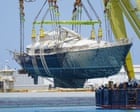
Fifteen seconds. That's all it took for a 56-meter luxury sailing yacht to go from floating peacefully at anchor to lying flat on its side in the Mediterranean.
When the Bayesian sank off the coast of Sicily in August 2024, killing seven people—including British tech billionaire Mike Lynch and his daughter Hannah—the maritime world immediately started pointing fingers. Executives from the boat's builder quickly blamed human error. Pundits questioned why a modern vessel built to cross oceans couldn't survive a summer squall.
Now we have the actual answers. The UK’s Marine Accident Investigation Branch (MAIB) has released its final report on the sinking, and it flips the early blame game upside down. Investigators found that the Bayesian suffered from an unidentified stability vulnerability to extreme winds while motoring or anchored with its sails down—a specific flaw that had never been assessed and wasn't documented in the vessel's stability information.
The crew didn't ignore a warning. They didn't even know the risk existed.
Why Nobody Saw the Stability Flaw Coming
If you've ever spent time around large sailing vessels, you know that stability booklets are treated like scripture. Every captain relies on them to understand how their boat will behave in rough weather.
Here's the catch with the Bayesian. Regulatory stability assessments for large sailing yachts traditionally focus on sailing conditions—when the boat has canvas up and is actively under sail. Nobody had ever properly modeled or calculated the wind heeling moments for the Bayesian while in its motoring condition at anchor with bare poles.
Think about that for a second. A 56-meter Perini Navi yacht sits high out of the water, carrying an enormous aluminum mast that acts like a giant lever even when every single sail is furled away. When wind slams into that rigging from the side, it creates massive rotational force.
Investigators commissioned specialized hydrodynamic and wind-tunnel research to figure out what happened that night. Their findings were sobering:
- The Vanishing Stability Point: Researchers calculated that once the Bayesian heeled past 73 degrees, it reached its angle of vanishing stability. Beyond that tilt, gravity could no longer pull the hull back upright.
- The Raised Centreboard Factor: The yacht featured a retractable centreboard designed to improve sailing performance. When lowered, it adds deep keel ballast and lateral resistance. When raised, the boat's resistance to rolling drops significantly.
- Incomplete Mariner Guidance: While the vessel's stability booklet contained general precautions against downflooding—water pouring into open hatches or vents—it failed to specify exact wind thresholds or operational triggers telling the crew when those steps had to be taken.
Honestly, this exposes a massive blind spot in superyacht design and regulation. Builders and classification societies assumed that if a boat was safe under full sail, it was automatically safe sitting at anchor with the sails down. Physics proved them dead wrong.
The Night the Wind Exploded Off Porticello
To understand why the crew couldn't react in time, you have to look at the timeline from the night of August 18 into the early hours of August 19, 2024.
The Bayesian was anchored roughly half a nautical mile southeast of Porticello, near Palermo. Nearby sat another vessel, the Sir Robert Baden-Powell. Weather forecasts for the area predicted thunderstorms, with maximum gusts topping out around 27 knots (31 mph). For a 56-meter superyacht, 27 knots is barely a stiff breeze.
At 01:00, winds were calm at roughly 8 knots. By 03:00, the deckhand on watch noted lightning and thunderclouds moving closer, though the wind still hovered around 8 knots.
Then the sky fell in.
Satellite and meteorological studies later analyzed by the UK Met Office revealed that a mesocyclonic storm front had spawned a localized supercell. Within minutes, localized downbursts—violent columns of sinking air that slam into the sea and spread outward—hit the anchorage. Wind speeds surged from 8 knots to roughly 70 knots (80 mph), with localized supercell downdrafts capable of generating even higher gusts.
None of the standard marine forecasts warned of downbursts.
At 03:57, both the Bayesian and the Sir Robert Baden-Powell began dragging their anchors as the squall hit. The deckhand ran below to wake Skipper James Cutfield, while Chief Engineer Tim Parker Eaton also woke up to check the situation. At that moment, the crew's actions were focused on standard heavy-weather procedures—dealing with torrential rain and stopping the anchor from dragging.
At 04:06, the overhead awning on the flying bridge ripped apart. Seconds later, the Bayesian violently heeled 90 degrees onto its starboard side.
It took less than 15 seconds.
Why the Centreboard Was Up
One of the biggest armchair-sailor criticisms after the sinking was simple: Why didn't they have the centreboard down?
On paper, dropping the centreboard lowers the yacht's center of gravity and increases stability. In practice, anchoring a massive sailing yacht with a deep centreboard deployed causes real operational headaches.
The MAIB report directly addressed this. Investigators noted that the Bayesian had a strong tendency to yaw—swinging wildly back and forth from side to side—whenever it sat at anchor with the centreboard lowered. That constant fishtailing puts violent snatch loads on the anchor chain, dramatically increasing the odds that the anchor will break free from the seabed and drag. It also makes the motion onboard miserable for sleeping guests.
Because of those handling issues, the centreboard was almost never lowered at anchor. And because the yacht's stability documentation never warned the crew that raising the board made the vessel vulnerable to knockdown in 70-knot winds, leaving it up wasn't a reckless shortcut. It was standard operating procedure.
Inside the 18 Minutes Before the Yacht Sank
Once the Bayesian slammed onto its side at 04:06, chaos took over.
Furniture, heavy gear, and people tumbled across what used to be walls. The main generators died instantly, plunging the interior into darkness before battery-powered emergency lights flickered on. Contrary to early speculation that open doors or hatches caused the boat to tip over, MAIB investigators concluded that water ingress did not trigger the initial knockdown. Downflooding happened after the yacht was already pinned on its side, as seawater poured through openings now submerged beneath the waves.
From the moment of the knockdown, the Bayesian stayed afloat for roughly 18 minutes before slipping beneath the surface and settling on the seabed 50 meters down.
Survival during those 18 minutes came down to sheer grit and quick thinking:
- Improvised Escapes: Trapped inside tilting cabins as water rose, guests had to climb vertical bulkheads. One couple stacked and used loose furniture drawers as a makeshift ladder to reach an exit.
- Crew Coordination: Chief Inspector Rob Loder and the MAIB report specifically credited the training and initiative of individual crew members for saving lives. Crew on the flying bridge guided escaping guests into the water and shouted warnings to swim clear of the massive mast and boom rigging as the hull went under.
- Liferaft Failures: In a troubling equipment finding, none of the Bayesian’s liferafts automatically deployed or inflated during the capsize. Crew members had to manually wrestle one raft free.
Fifteen of the 22 people aboard made it out alive—nine crew and six guests. Captain Karsten Borner and his crew on the neighboring Sir Robert Baden-Powell immediately launched their tender into the storm, pulling survivors from the water and alerting the Italian coastguard.
Where the Legal and Safety Fallout Stands
The release of the MAIB findings lands right in the middle of complicated international legal battles.
In Italy, prosecutors in Termini Imerese have placed skipper James Cutfield, chief engineer Tim Parker Eaton, and watch deckhand Matthew Griffith under formal investigation. While no criminal charges have been filed yet, Italian media reports suggest experts advising local prosecutors have leaned toward blaming crew actions. The UK report offers a sharp counterpoint to that narrative, showing how designers and regulators left the crew blind to the boat's physical limits.
Meanwhile, UK inquest proceedings continue into the deaths of British nationals Mike and Hannah Lynch alongside Jonathan and Judy Bloomer. In the UK High Court, the yacht's registered owning company, Revtom, and yacht brokerage Camper & Nicholsons have also filed legal actions seeking to limit financial liability for survivor personal injury claims.
More importantly, the MAIB isn't letting the superyacht industry sweep this under the rug. Chief Inspector Rob Loder issued direct safety recommendations urging yacht owners, managers, and captains across the fleet to audit their vessels immediately.
What Superyacht Captains and Owners Must Do Right Now
You don't need to own a 56-meter Perini Navi to take hard lessons from the Bayesian tragedy. Modern yachts—both sail and motor—have grown taller, heavier, and far more complex than the stability rules written decades ago.
If you manage, captain, or own a large yacht, stop assuming your stability booklet covers every real-world scenario. Take these steps before your next offshore passage or coastal anchorage:
- Audit Bare-Pole and Motoring Stability: Ask your naval architect or classification society to calculate wind heeling curves specifically for anchored and motoring configurations, not just sailing profiles. Know your exact angle of vanishing stability when the keel or centreboard is raised.
- Define Clear Weather Triggers: Vague warnings in a stability manual don't help at 04:00 in a squall. Establish hard operational rules for your crew—specify exact wind speeds or approaching radar signatures that require closing all watertight doors, securing hatches, lowering retractable keels, and starting main engines.
- Inspect Hydrostatic Liferaft Releases: Don't trust annual service certificates blindly. Verify that hydrostatic release units on every liferaft are clear of rigging, awnings, or superstructure overhangs that could trap them if a vessel rolls onto its beam ends.
- Watch for Convective Downbursts: Standard marine area forecasts often miss localized thunderstorm microbursts. Monitor live weather radar and barometer drops actively during anchor watches whenever convective cells build nearby, and treat any approaching squall line as capable of producing hurricane-force gusts.
For further details on the official findings and visual breakdown of the investigation, watch New report reveals what sank the Bayesian superyacht, which summarizes the MAIB's conclusions regarding the vessel's stability risks and weather conditions.