The air over the Black Sea usually tastes of salt and heavy, humid summer. But on a Tuesday night, just before the dawn could break the horizon, the air tasted of lithium batteries and low-grade aviation fuel.
You do not hear a single drone until it is already too late. You hear a lawnmower engine, high and tinny, vibrating through the floorboards of your home. Now, multiply that sound by four hundred.
For months, the war in Ukraine has been viewed through the lens of stalemates and muddy trenches. It felt static. It felt locked in a tragic, predictable loop. Then came the night the sky swarmed. By launching more than 400 long-range strike drones simultaneously across the Russian border, Ukraine did not just launch a military operation. They altered the psychology of modern warfare. They proved that distance is a luxury of the past.
The Mechanic at the Workbench
To understand how four hundred machines ended up screaming through the Russian airspace, you have to look away from the front lines. Walk instead into an abandoned tractor factory somewhere outside of Kyiv.
Let us imagine a woman named Olena. She is a composite of the dozens of software engineers and garage mechanics currently driving this asymmetric war. Olena does not wear a uniform. She wears a grease-stained hoodie and stays awake on a diet of cheap energy drinks and raw nerves. Before the war, she designed agricultural tech—automated systems to help tractors harvest wheat. Tonight, she is soldering a motherboard onto a piece of molded fiberglass that costs less than a cheap smartphone.
Her hands shake slightly, not from fear, but from exhaustion.
The strategy behind a 400-drone raid is not about brute explosive power. A single drone carries a payload that might blow up a garage or punch a hole in a fuel tank. It is nothing compared to a cruise missile. But a cruise missile costs millions of dollars. Olena’s drones cost a few thousand. When you send four hundred of them, you are not trying to out-shoot the enemy's air defense. You are trying to bankrupt it. You are trying to overwhelm the mathematics of their radar.
Consider the cold arithmetic of modern air defense. A Russian Pantsir-S1 surface-to-air missile system is a marvel of engineering. It can track and destroy incoming targets with terrifying precision. But each system only carries twelve missiles. Each missile costs hundreds of thousands of dollars to manufacture.
When a swarm of cheap, fiberglass drones appears on the radar screen, the system cannot tell the difference between a decoy and a lethal strike. It fires. It hits. One drone down. Two drones down.
Then, the missile launcher is empty.
And forty more drones are still coming.
The Black Horizon of Novorossiysk
The targets were not chosen at random. They were selected to hit where it hurts most: the wallet and the fuel tank.
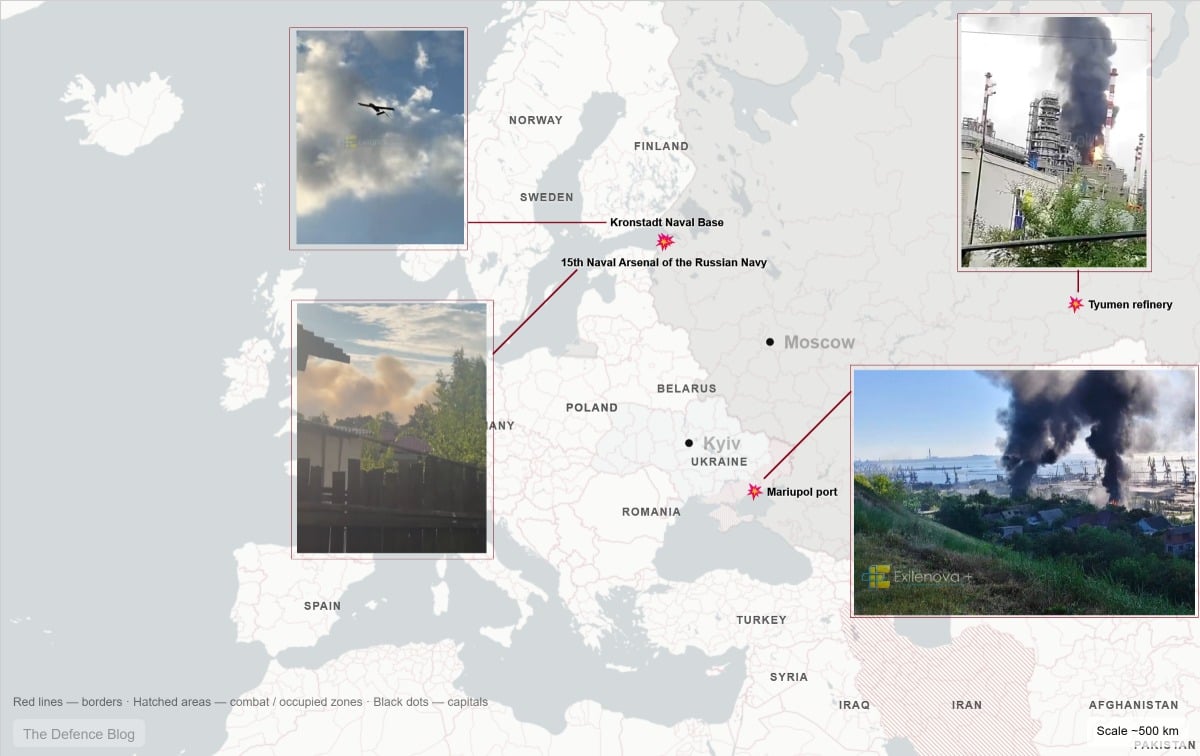
Down in the port city of Novorossiysk, the night was shattered by the sound of sirens that have become all too familiar to civilians on the other side of the border. Novorossiysk is a vital artery for the Russian economy. It houses a massive naval base and an oil refinery complex that processes hundreds of thousands of barrels of crude every single day. It is the place where energy meets the sea.
Imagine standing on the docks. The water is black, reflecting the distant lights of warships docked at the piers. Suddenly, the sky erupts.
Searchlights cut through the dark, hunting for tiny silhouettes. Anti-aircraft guns chatter blindly into the clouds, throwing red tracers across the sky. The sheer volume of the attack creates a chaotic symphony. Even if air defense systems successfully intercept ninety percent of the swarm, the remaining ten percent is more than enough to cause catastrophe.
A drone slams into a refinery distillation column. A fireball rises, turning the midnight sky into a bruised orange.
This is the invisible stake of the conflict. By striking Novorossiysk, the operation struck at the illusion of security. For over two years, the citizens of major Russian port cities could look out at the sea and feel insulated from the violence happening in the Donbas. Not anymore. The war came riding on cheap plastic wings, delivered directly to the infrastructure that funds the conflict.
The economic shockwaves of a burning refinery travel much faster than the smoke. When a refinery goes offline, gas prices tick upward. Supply chains stutter. Insurance companies look at shipping lanes in the Black Sea and rewrite their risk assessments. Suddenly, sending a container ship into these waters becomes an existential gamble.
The Evolution of the Swarm
We often think of technology as something that evolves in clean, well-funded laboratories. We think of Silicon Valley or defense mega-corporations spending a decade to develop a new stealth fighter.
The reality of drone warfare is messy, chaotic, and terrifyingly fast. It is a hyper-evolution born of desperation.
Six months ago, a long-range drone attack consisted of five or ten aircraft. They were easily spotted, easily jammed by electronic warfare, and easily shot down. The Ukrainian tech sector responded not by making the drones more complex, but by making them more autonomous and more numerosas.
They began using machine vision. When a drone gets close to its target, Russian electronic warfare units will often jam its GPS signal. The drone goes blind. It loses its connection to the satellite. In the early days of the war, that drone would simply lose control and crash harmlessly into a field.
Now, the software onboard takes over. It compares the live video feed from its camera to pre-loaded satellite imagery stored on its tiny hard drive. It looks at the shapes of the buildings below. It recognizes the curve of a coastline or the silhouette of an oil tank. It guides itself to the target without needing a single satellite signal.
It becomes an autonomous hunter.
This shifts the moral and psychological weight of the war entirely. We are no longer talking about soldiers looking through crosshairs. We are talking about algorithms executing commands miles away from the humans who wrote them. It is a cold, detached form of violence that feels profoundly unsettling.
The Ripple in the Water
While the fires burned at the refinery, another part of the swarm was hunting larger prey at the naval base.
The Russian Black Sea Fleet was once considered untouchable. It was the symbol of regional dominance. Yet, over the past twenty-four months, a navy without a functional fleet of warships has managed to systematically push that entire armada back. Ukraine has used a combination of exploding sea drones and aerial swarms to turn the western Black Sea into a no-go zone for Russian hulls.
The raid on the naval base was a declaration. It told the commanders of those warships that even their home ports, hundreds of miles from the frontline, are no longer safe harbors. Ships must now be anchored behind massive floating booms. They must be shrouded in netting. They must spend their nights waiting for the low hum of an approaching engine.
The psychological toll on the crews is immense. Sleep becomes a rare commodity when the enemy can strike from any direction, at any hour, using weapons that are smaller than a paddleboard.
Beyond the Fact Sheet
When you read the official news reports, you see numbers. You see "400 drones." You see "air defenses intercepted 102 targets." You see bureaucratic language designed to flatten the reality of what occurred into a neat, digestible statistic.
But statistics do not capture the smell of burning oil that hangs over a city for days. They do not capture the look on an engineer's face when they realize the factory they spent twenty years building has been reduced to twisted scrap metal in forty seconds. They do not capture the quiet triumph in a Kyiv basement where a team realizes their code actually worked.
This attack represents a threshold. The democratization of destruction means that small, economically strained nations can now project power across vast distances without needing an industrial superpower's budget. The sky is no longer a shield. It is a corridor.
As the sun rose over Novorossiysk, the black smoke from the refinery columns began to mingle with the morning mist. The sirens finally fell silent. On the ground, workers began the grim, quiet task of clearing debris, while far away, in hidden workshops and anonymous apartments, the batteries were already being plugged in for the next wave.