Midnight in the city smells like damp asphalt, cooling exhaust, and the sharp, chemical tang of ozone clinging to subway grates. For most of human history, this hour belonged to the ghosts. It belonged to the insomniacs pacing hardwood floors, the bakers dusting flour into silent troughs, the skeleton-crew dispatchers drinking bitter coffee from styrofoam cups.
Now, something else shares the dark.
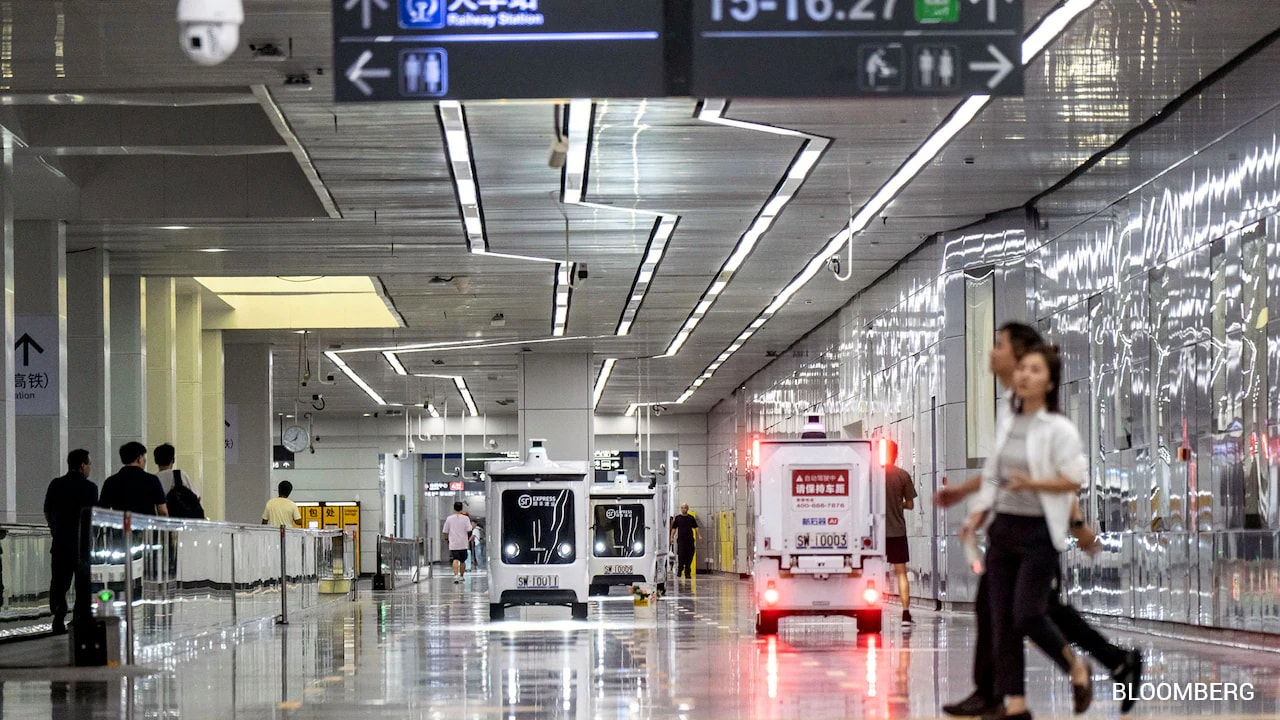
Low to the ground, humming with the faint, electric whir of brushless motors, a six-wheeled cooler on chassis rolls past a row of shuttered storefronts. It wears no coat against the chill. It breathes no frost into the amber glare of streetlights. It pauses at the curb, its LiDAR sensors sweeping the empty intersection in quiet crimson pulses, calculating the precise friction of wet autumn leaves against rubber.
It is waiting for the light to change. There are no cars. There are no pedestrians. But rules are rules, written in silicon lines by engineers sitting thousands of miles away in brightly lit offices who decided that caution does not sleep just because the city does.
Consider what happens next: the robot crosses the empty avenue, climbs a cracked concrete ramp, and stops outside an apartment complex. Inside, a tired software developer sits hunched over a laptop, fueled by caffeine and deadline panic, waiting for a bowl of lukewarm noodles delivered by a machine that costs less per hour than human labor ever could.
We talk about automation as if it arrived in a single violent shock, like a tidal wave crashing over the breakwater. We wait for the dramatic turning point, the cinematic moment of replacement. But the truth is much quieter. It slips in on little rubber wheels during the hours when humanity is too exhausted to care.
The Physics of the Dark
To understand why these delivery robots are migrating into the graveyard shift, you have to understand the tyranny of daytime traffic.
Daytime is an absolute mess for a machine trying to make a living. A sidewalk at noon is a chaotic gauntlet of strollers, distracted joggers wearing noise-canceling headphones, aggressive pigeons, errant dogs, and impatient humans who treat autonomous couriers like moving obstacles in a video game. Every five seconds, a pedestrian steps abruptly into a blind spot. Every block requires a hesitant yielding, a cautious stutter-step of software trying to guess human psychology.
Daytime is expensive for delivery algorithms because hesitation burns battery life.
Night changes the equation entirely. At 3:00 AM, the sidewalk opens up like an empty canvas. The variables drop away. The noise floor of the city lowers, allowing acoustic sensors to pick up the distant rumble of an emergency vehicle long before it enters visual range. The thermal cameras stop battling the blinding glare of a low afternoon sun bouncing off windshields.
(Note: This is a strictly controlled environment of algorithms and sensors, modeled after behavioral patterns observed in urban logistics testing grounds across major metropolitan areas.)
Engineers discovered something fascinating during early trials. When left to navigate the quiet hours, the neural networks operating these delivery bots stopped making conservative, jittery corrections. They accelerated. They smoothed out their trajectories. They learned the subtle geometry of nighttime shadows—how a cast-iron streetlight transforms a pile of trash into an apparent wall, or how black ice on a granite step looks identical to dry pavement to an optical camera.
They are learning to read the dark.
The Weight of an Empty Street
Meet Marcus. Marcus is a hypothetical night-shift dispatcher whose real-world counterpart exists in dozens of logistics control rooms from Shenzhen to San Francisco. He sits in a swivel chair under flickering fluorescent tubes, staring at a wall of monitors displaying glowing green breadcrumbs across a digital map of the city.
He is the ghost in the machine.
At 2:15 AM, monitor four flashes amber. Unit 409 has stalled in an alleyway behind a row of late-night bars.
Marcus sighs, rubbing eyes that feel like they’ve been rolled in sand. He clicks into the feed. The robot’s front-facing camera shows a wall of damp cardboard boxes discarded from a loading dock. The local raccoons have knocked over a crate of overripe produce. To a human, it’s a minor nuisance. To Unit 409’s navigation software, it is an existential paradox: an unmapped physical barrier blocking the designated corridor.
Marcus takes the controls. With a flick of his wrist, he jogs the robot backward, pivots it forty-five degrees to the left, and plots a manual workaround. The machine obeys instantly, rolling smoothly around the debris and re-entering its autonomous loop.
"Goodnight, little trash can," Marcus mutters to the empty room, though he has said it a hundred times before.
This is the hidden partnership of the night shift. We romanticize total autonomy—the gleaming myth of artificial intelligence operating in a pure vacuum, untethered from human hands. But the reality on the ground is a patchwork. The machines handle the heavy lifting, the monotonous rolling, the grueling physical endurance of traversing ten miles of freezing pavement at four in the morning. Humans provide the empathy, the intuition, the crisis intervention when the world throws an unpredictable curveball like a pile of rotting produce or a drunken reveler trying to ride the cargo lid.
Why We Built the Night Watch
Why push delivery fleets into the dark at all? Why not let the streets rest?
The answer lies in the shifting metabolism of modern consumption. We have built an economy that expects instant gratification wrapped in a brown paper bag, available twenty-four hours a day. When a nurse finishing a grueling fourteen-hour shift in the ICU wants a hot meal at midnight, human couriers are scarce, expensive, and increasingly reluctant to brave unsafe urban corridors at odd hours.
The robots do not mind the cold. They do not feel fear when a stranger approaches them on a dark corner. They do not require hazard pay.
Yet, as these fleets expand their operating hours, they change the texture of the city itself. They normalize the presence of non-human entities in public spaces during hours traditionally reserved for human vulnerability. When you walk home alone late at night and hear that low, rhythmic electric hum creeping up behind you, it triggers an ancient, primal pulse of caution. What is that? Who is watching?
Nobody is watching. Or rather, a camera is watching, recording every footstep, storing every pixel in a cloud database to improve next week's pathfinding algorithm.
The transition is invisible until you look closely. Look down at the curb next time you are out late. Notice the subtle scuff marks on the concrete where a steel-rimmed wheel corrected its course. Notice the absence of tire tracks because these vehicles weigh a fraction of a delivery van, leaving the asphalt pristine while humans sleep indoors.
They are learning our streets better than we know them ourselves. Every pothole cataloged, every dark alley mapped, every shifting shadow anticipated.
The night belongs to them now, too. And as the motors hum softly in the dark, weaving through the empty city toward a waiting porch, we are left to wonder what else we might quietly surrender to the efficiency of the machine while the rest of the world closes its eyes.