The rain in Manchester doesn't fall; it hovers. It coats the skin in a cold, permanent dampness that seeps into the bones of anyone standing pitchside. On nights like these, the Etihad Stadium feels less like a sporting venue and more like a glowing, modern colosseum cut out of the dark.
I watched Erling Haaland warm up under those lights.
There is a strange, mechanical rhythm to him. He does not glide. He stalks. At 6-foot-4, with a stride that looks less like running and more like a controlled demolition of space, he strikes the ball with a terrifying, violent precision. Every thud of his boot against the leather echoes through the empty stands before the crowd pours in. It is pure, unadulterated efficiency. A goal-scoring machine built in a Norwegian laboratory to solve the problem of modern defense.
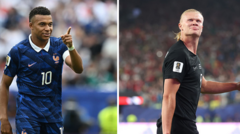
A thousand miles away, beneath the golden, opulent lights of the Parc des Princes, a different kind of lightning strikes.
Kylian Mbappé takes a pass on the flank. He doesn't just run; he hovers above the grass. His acceleration defies the laws of physics, a sudden blur of motion that leaves elite defenders looking like they are stuck in wet cement. If Haaland is a thunderstorm, Mbappé is a wildfire. One is a force of gravity; the other is a defiance of it.
For fifteen years, football fans lived in a comfortable, luxurious duopoly. Cristiano Ronaldo and Lionel Messi defined the boundaries of human excellence. We knew their storylines by heart. The tireless, manufactured perfectionist versus the natural, god-given genius. But time is an undefeated opponent. As their twilight faded, a terrifying vacuum opened at the summit of the world's most popular sport.
We wondered if we would ever see a rivalry like that again. We were looking at it all wrong.
The next decade of football will not be a repetition of the past. It is a fundamental philosophical war over the very soul of the game.
The Architect and the Avalanche
To understand what is happening to football, you have to look at the numbers, but you must read them like poetry, not a spreadsheet.
Consider the sheer absurdity of their output. By the time he turned 23, Haaland was averaging roughly a goal per game across the Champions League and domestic play—a metric that used to be considered impossible over a sustained period in the modern era. Mbappé, by the same age, had already scored in a World Cup final, won the tournament, and accumulated a trophy cabinet that looked like the hoard of a medieval king.
But their brilliance is expressed through entirely opposing dialects.
Haaland is the ultimate expression of spatial minimalism. Watch him during a match. For seventy minutes, he might do absolutely nothing. He will touch the ball fewer times than the goalkeeper. He wanders in offside positions, hands on hips, looking almost bored. Defenders relax. The crowd grows quiet.
Then, a microscopic fracture appears in the defensive line.
A midfielder looks up. In that precise millisecond, Haaland transforms. The heavy, lumbering posture vanishes. He explodes into the empty space with the velocity of a sprinting grizzly bear. By the time the center-back realizes the danger, Haaland has already used his massive frame to shield the ball, swung his left foot, and nearly torn the netting off the goals.
It is brutalist architecture in human form. It is the elimination of waste.
Mbappé, conversely, demands the spotlight. He wants the ball at his feet. He wants the defender to look him in the eyes. The Frenchman thrives in the chaos of one-on-one confrontation. He uses a dizzying array of stepovers, body feints, and sudden stops that rewrite the rules of human biomechanics. When he cuts inside from the left wing, everyone in the stadium knows exactly what he wants to do.
They still cannot stop him.
Where Haaland seeks the shortest distance between two points, Mbappé seeks the most dramatic. He is a cinematic footballer, creating narratives within ninety minutes that belong on a theater stage. He carries the weight of a nation’s expectations, the political pressure of European super-clubs, and the legacy of French football on his shoulders. And he walks through it all with a smirk.
The Ghost of the Collective
There is a quiet anxiety that haunts modern football fans, a feeling that the sport is becoming too systematized, too cold. Super-computers calculate expected goals ($xG$). Managers treat players like chess pieces, demanding rigid adherence to tactical structures.
In this new world, Haaland is the perfect weapon.
He joined a Manchester City team that was already a finely tuned, possession-obsessed machine. For years, Pep Guardiola’s side played a beautiful, intricate style of football that sometimes lacked a cutting edge. They would pass opponents to death but occasionally forgot to shoot. Haaland was the missing gear. He did not ask City to change their identity; he simply sat at the end of the assembly line, converting raw materials into goals with terrifying regularity.
But this perfection carries a hidden cost.
When you watch Haaland, you are watching the triumph of the system. If the midfield behind him is suffocated, if the supply lines are cut, he can become a ghost. We saw this in high-stakes matches where elite defensive units managed to isolate him. Without the ball, his impact shrinks. He relies on the collective to feed his hunger.
Mbappé does not wait for a system. He is the system.
Whether playing for Paris, Madrid, or the French national team, Mbappé dictates the gravity of the match. He drops deep into midfield to spark attacks. He drifts out wide to drag entire defensive blocks with him. When his team is playing poorly, he possesses the rare, transcendent ability to simply decide that they are going to win anyway. Think of the 2022 World Cup Final in Qatar. France was dead in the water, outplayed and outclassed by Argentina for eighty minutes.
Then, Mbappé happened.
Two goals in ninety seconds. A hat-trick before the final whistle. He dragged an entire country back from the edge of sporting irrelevance through sheer force of will. You cannot quantify that with a data model. You cannot coach it. It is the raw, unpredictable magic of individual genius.
The Invisible Stakes
We love rivalries because they simplify the universe. They give us sides to choose, flags to wave, and arguments to have in crowded pubs on rainy Tuesday nights. But the battle between the Norwegian and the Frenchman is about more than who wins the next Ballon d'Or.
It is a proxy war for the future of global culture.
Haaland represents the Nordic ideal—stoic, hyper-focused, fiercely private, and entirely dedicated to the craft of physical execution. His interviews are notoriously short, almost comedic in their refusal to provide media narratives. He eats a specialized diet of heart and liver, sleeps with blue-light-blocking glasses, and views his body as a high-performance engine that requires meticulous maintenance. He is the ultimate professional for an era obsessed with optimization.
Mbappé is a cultural icon of a globalized world. Born in Bondy, the Parisian suburb defined by working-class struggle and vibrant diversity, he is deeply aware of his cultural currency. He speaks multiple languages fluently. He negotiates his own image rights. He converses with presidents and world leaders. He understands that a modern superstar cannot just exist on the pitch; they must occupy the cultural zeitgeist.
When you choose to admire one over the other, you are choosing what you value more in human achievement.
Do you value the flawless execution of a single, specialized skill to a degree the world has never seen? Or do you value the multifaceted, chaotic brilliance of an individual who carries the cultural and emotional weight of millions?
The rain finally stopped at the Etihad, leaving the pitch glistening like shattered glass under the floodlights. The game had ended, the goals had been scored, and the thousands of fans were filtering out into the cold Manchester night, their breath misting in the air.
We will spend the next ten years debating who is better. We will argue over trophies, compare goal tallies, and dissect every poor performance on social media. But as I watched the groundskeepers replace the turf, I realized the true joy of this coming era isn't finding an answer.
It is the privilege of watching two entirely different gods attempt to rule the same heaven.