The rain in Devon does not fall; it targets. It sweeps off the Atlantic and batters the stone walls of Dunchideock, turning the steep lanes into miniature rivers. On a damp weekend, you would expect a village hall in this corner of England to host a quiet flower show or a poorly attended parish council meeting about potholes.
Instead, a man in a filthy trench coat is screaming about a frying pan.
The room is packed to the suffocating gills. The air smells of wet wool, damp tweed, and cheap beer. Someone near the front is wearing a neon yellow blazer that looks like it was stolen from a BBC wardrobe department in 1986. They are laughing so hard they aren't actually making sound anymore—just a rhythmic, silent gasping for oxygen.
This is not a standard memorial service. There are no black ties. There are no solemn, whispered reassurances over lukewarm tea. This is the Festival of Rik, a chaotic, loud, and unashamedly vulgar celebration of Rik Mayall, a man who spent his life proving that elegance is overrated and that a well-timed kick to the groin is the highest form of art.
It has been over a decade since Mayall’s heart stopped after a morning jog in 2014. He was 56. When the news broke back then, a specific kind of silence fell over a generation of British comedy fans. It felt wrong. Rik Mayall was many things—dangerous, poetic, grotesque, magnificent—but he was never silent.
Now, in this crowded room, the noise is back.
The Gravity of Pure Nonsense
To understand why people have traveled from across the country to a tiny village in Devon just to watch old clips of The Young Ones and Bottom, you have to understand what British television looked like before Rik arrived.
Comedy in the late 1970s was polite. It was structured. It featured men in beige cardigans delivering well-rehearsed punchlines to a polite studio audience that clapped on cue. It was safe. It assumed the world was a rational place where everything would turn out fine in the end.
Then came Rick with a 'K'.
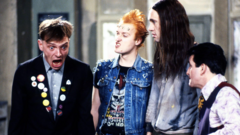
When Mayall burst onto the screen in 1982 as the self-proclaimed anarchist poet in The Young Ones, he didn't just break the rules; he acted as if the rules had never existed. He was a human cartoon. His eyes bulged like hard-boiled eggs. His mouth contorted into shapes that seemed biologically impossible. He was a whirlwind of violent slapstick, a theatrical force who treated a living room set like a gladiatorial arena.
Consider the sheer physicality of what he did. In Bottom, the sitcom he co-wrote and starred in alongside his long-time creative partner Adrian Edmondson, the violence was operatic. They hit each other with cricket bats. They set fire to each other’s legs. They used frying pans as blunt instruments of philosophy.
On paper, it sounds crude. In reality, it was balletic.
A hypothetical observer—let's call him Arthur, a traditionalist who prefers the gentle wit of Dad's Army—might look at Mayall’s work and see nothing but mindless cruelty and shouting. But Arthur would be missing the magic. The secret of Mayall’s comedy was not the violence; it was the vulnerability.
Every monster he played was utterly, desperately pathetic. Rick the poet wanted so badly to be cool, but he was just a middle-class boy throwing a tantrum. Richie Rich in Bottom was a lonely, sexually frustrated fraud living in a squalid flat, terrified of the world outside. Mayall understood a fundamental truth about human nature: our anxieties, our vanities, and our deepest insecurities are hilarious if you magnify them by a factor of ten and hit them with a toaster.
The Ghost in the Room
At the back of the festival hall stands Sarah. She is fifty-two, wears a faded Filthy Rich & Catflap t-shirt, and has driven four hours through a storm to be here. She isn't a collector or a superfan who hunts for autographs. She is just someone who remembers what it felt like to be fifteen years old, trapped in a dreary suburban town, waiting for the clock to strike 9:00 PM on a BBC Two night.
"My parents hated him," Sarah says, her voice barely carrying over the roar of the crowd watching a clip of Lord Flashheart from Blackadder. "They thought he was vulgar. They thought he was everything wrong with modern youth. And that made me love him more. When Rik was on television, you felt like you were part of a secret club that your parents couldn't join."
That is the invisible stake of this weekend. It isn't about nostalgia in the traditional sense. It isn't about looking back at a golden age with a sigh. It is about reclaiming a feeling of absolute freedom.
Mayall’s characters didn't care about decorum. They didn't care about what was appropriate. In a world that constantly demands we behave ourselves, sit up straight, and follow the script, Mayall offered a glorious, screaming alternative. He was the id of Great Britain, let off its leash and allowed to smash the crockery.
The festival organizers, a group of local enthusiasts who launched this event to raise money for charity, didn't want a museum piece. They wanted a riot. They set up lookalike competitions where contestants didn't just dress like Mayall’s characters; they had to embody the sneer, the swagger, and the manic energy.
A man on stage is currently attempting to recreate the famous dance sequence from the Bottom live show. He is not young. His knees are clearly protesting. But for three minutes, as he flails his arms and gurns at the front row, twenty years disappear from his face. The room erupts.
The Poetry of the Punch
It is easy to forget that beneath the slapstick, Mayall was a classically trained actor. He studied drama at the University of Manchester, where he met Edmondson. He knew his Shakespeare. He understood the mechanics of the stage.
When you watch him closely, you see the precision. The way he could hold a pause for five seconds, allowing the tension in the room to build until the audience was begging for the release of a punchline. The way he used his fingers, stretching them out like claws, or the sudden, terrifying drops in his voice from a high-pitched whine to a theatrical baritone.
He brought the energy of rock and roll to the comedy circuit. Before the alternative comedy boom of the early 1980s, comedians performed in smoke-filled working men's clubs or grand variety theatres. Mayall and his contemporaries performed in strip clubs, rock venues, and sweaty basement rooms. They had to be loud. They had to be fast. If they weren't, the audience would throw pint glasses at them.
That edge never left him. Even when he became a massive television star, even when he played Alan B'Stard in The New Statesman—a character that savagely lampooned the greed and cynicism of the political elite—he retained the air of a man who might suddenly jump off the screen and bite you.
But the real magic was the partnership. The bond between Mayall and Ade Edmondson was the spine of British comedy for three decades. They were the modern Laurel and Hardy, but with more blood. Their onstage chemistry was built on an absolute, unwavering trust. You cannot hit a man in the face with a real wooden chair night after night unless you love him completely.
When Edmondson chose not to attend the festival, nobody was offended. They understood. How do you mourn a man who was half of your creative soul in a public village hall? You don't. You let the fans do the shouting for you.
The Legacy of the Louder
The rain outside has settled into a steady, gray drizzle, but inside, the temperature has risen to something resembling a sauna. The festival is reaching its climax. A video montage plays on the projector screen, cutting together moments from across Mayall’s career.
There he is as Kevin Turvey, the investigative journalist who never investigated anything. There he is as Flashheart, stealing every scene of Blackadder with a single "Woof!" There he is as the voice of the prince in Grimm Tales, making children's stories sound like a threat.
The room goes quiet for a moment. It is the first time all evening that the noise has subsided. On screen, a clip plays from an interview Mayall gave later in his life. He looks older, his hair flecked with gray, but those eyes are still bright, still dancing with mischief.
"I don't have fans," he says to the interviewer, his voice dropping to that familiar, conspiratorial whisper. "I have worshippers."
The line is delivered with a smirk, but the village hall in Devon proves he wasn't entirely wrong. The people here aren't just remembering a performer. They are keeping a specific type of English eccentricity alive.
In an era where comedy is often consumed in isolation on tiny phone screens, edited into sterile ten-second clips for algorithms, this damp room offers something different. It offers communal joy. It offers the chance to laugh at the absurd, the grotesque, and the brilliant alongside two hundred strangers who all know the words to the Young Ones theme song.
The lights come up. The applause is deafening, feet stamping against the wooden floorboards until the foundations of the hall vibrate. People wipe sweat from their foreheads and tears from their eyes.
Outside, the Devon lanes are dark and empty. The world remains complicated, serious, and frequently unkind. But for a few hours, in a small corner of the countryside, the panics of ordinary life were beaten back by the memory of a man who looked at the seriousness of existence, stuck his fingers up his nose, and blew a loud, triumphant raspberry.