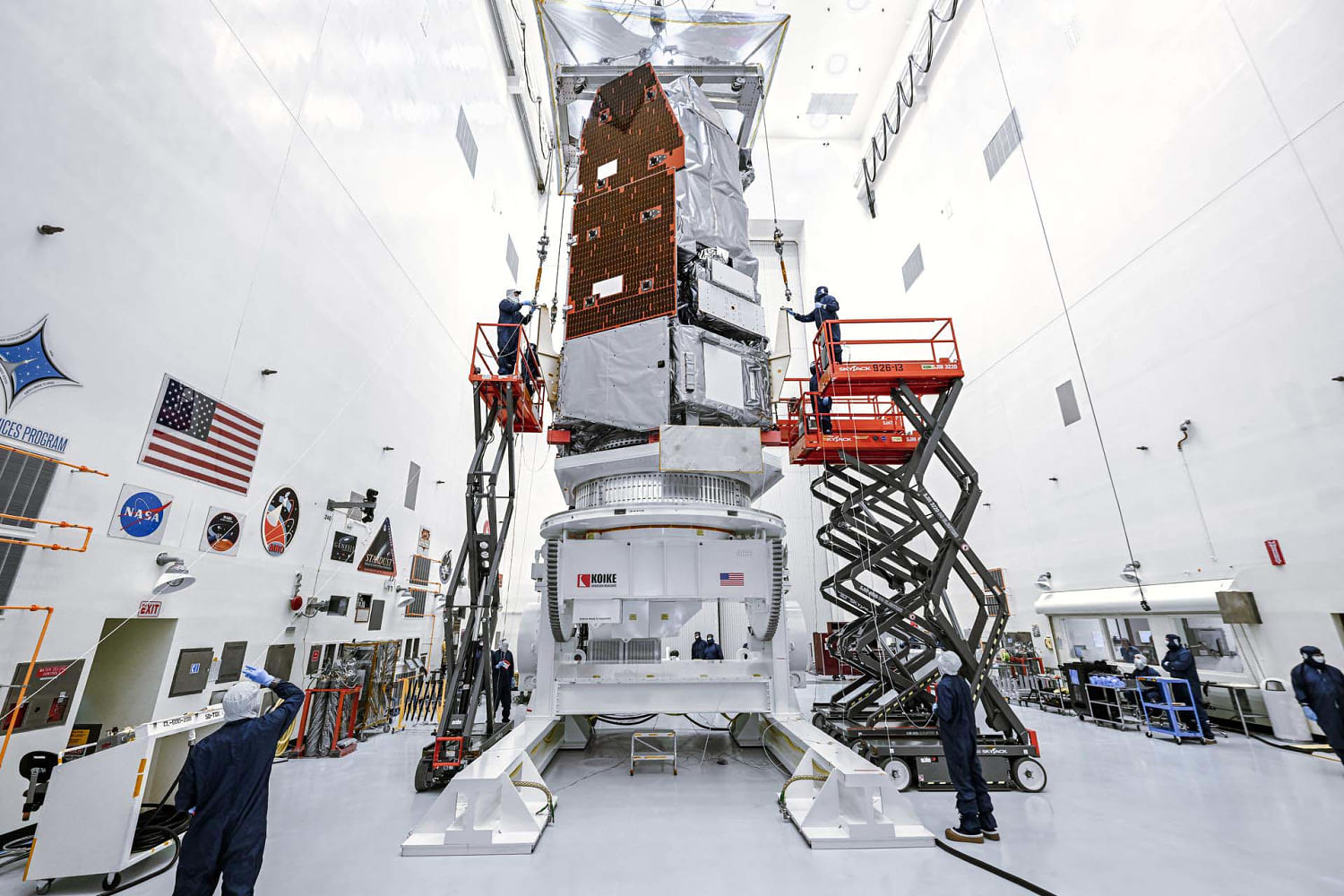
Space telescopes usually get famous for staring at tiny patches of the sky for months, digging up deep, ancient light from the edge of time. But NASA is taking a radically different approach with its newest observatory. The Nancy Grace Roman Space Telescope isn't built to peek through a narrow keyhole. It is engineered to swallow the cosmos in wide, sweeping panoramic views.
Liftoff is targeted for 7:26 a.m. EDT on Sunday, August 30, from Launch Complex 39A at NASA's Kennedy Space Center in Florida. Strapped atop a SpaceX Falcon Heavy rocket, the observatory will travel nearly one million miles away to the second Lagrange point ($L_2$). If you've been following space exploration, you know this destination well. It's the same gravitational sweet spot where the James Webb Space Telescope currently sits, keeping a stable position relative to Earth and the Sun.
Forget everything you think you know about how space observatories map the universe. Roman changes the math completely.
Why a Wide Field Changes Everything
Most people assume that building a better telescope just means making the mirror bigger or the resolution sharper. Hubble gave us breathtaking depth. Webb unlocked the infrared universe with astonishing clarity. Yet both instruments suffer from a very specific limitation: tunnel vision. They look at minuscule fractions of the sky at any given moment.
Roman carries a primary mirror that measures 2.4 meters across, matching Hubble's physical diameter. But its primary instrument, the Wide Field Instrument, features a 300.8-megapixel camera array that captures a field of view 100 times larger than Hubble's cameras.
Think of it like upgrading from a high-end microscope to an ultra-wide aerial camera. Instead of spending weeks imaging a single distant galaxy cluster, Roman will map millions of galaxies in a fraction of the time. Over its planned five-year primary mission, it will survey vast cosmic territories that scientists previously considered too expansive to chart efficiently.
Hunting Invisible Forces
You cannot talk about Roman without addressing the main targets of the mission: dark energy and dark matter. These two mysterious components make up roughly 95 percent of the universe, yet physicists still cannot touch, see, or directly measure them.
Dark matter acts as an invisible cosmic glue, holding galaxies together with its gravity. Dark energy acts as the opposite force, driving the accelerated expansion of the universe outward. Because these phenomena operate on a cosmic scale, studying them requires massive datasets rather than isolated snapshots.
Roman will use three independent techniques to track how dark energy has evolved over billions of years: measuring baryon acoustic oscillations, analyzing distant supernovae, and mapping weak gravitational lensing. By observing how the gravity of unseen matter bends light from hundreds of millions of galaxies, the telescope will generate a three-dimensional map of the cosmos that dwarfs any previous effort.
Finding Worlds Beyond Our Solar System
Mapping the invisible backbone of the universe is only half the job. Roman also carries a specialized Coronagraph Instrument designed to block blinding starlight so astronomers can spot actual planets orbiting nearby stars.
Directly imaging an exoplanet is notoriously difficult. Stars are billions of times brighter than the planets orbiting them, making the latter look like a tiny firefly sitting next to a massive searchlight. Roman's coronagraph uses advanced masks and filters to suppress that glare. This technology serves as a critical pathfinder for future missions like the proposed Habitable Worlds Observatory, laying the groundwork for finding actual signs of life on other worlds.
Getting this observatory off the ground requires serious heavy lifting. SpaceX's Falcon Heavy will roar off pad 39A, utilizing three first-stage boosters that will separate and attempt precision landings back at Cape Canaveral. Weather forecasts currently show favorable conditions for Sunday morning, with a backup launch window locked in for Monday if anything stalls the countdown.
Check NASA's live broadcast feeds starting early Sunday morning if you want to watch the launch. Once Roman deploys its solar arrays and reaches its station at $L_2$, science operations are expected to kick off in early 2027. Prepare for a massive shift in our understanding of space.