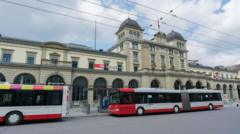
A man pulls a knife on a train platform in St. Gallen. Three people end up in the hospital. The international media immediately activates its copy-paste machinery. The narrative is always identical: a shocking anomaly in a peaceful alpine paradise, a sudden rupture in the fabric of a pristine society.
This reaction is lazy, naive, and fundamentally misdiagnoses the state of modern transit security.
For decades, the public has bought into the myth of Swiss exceptionalism. We treat Switzerland like a geopolitical bubble wrapped in bubble wrap. When violence spills onto a Swiss Federal Railways (SBB) platform, it gets framed as a freak occurrence.
It isn't. It is the predictable result of an outdated security philosophy that prioritizes frictionless commuting over basic physical defense.
The media focuses on the attacker's motive, his nationality, or his mental state. They ask the wrong questions because the wrong questions generate easy clicks. The real issue isn't the individual with the blade. The real issue is the structural vulnerability of the open-transit model in a continent where the threat profile has radically shifted over the past twenty years.
The Illusion of Open Borders and Open Platforms
I have spent years analyzing risk management and infrastructure vulnerability. If you look at the architecture of European rail, it is designed for a world that no longer exists. It is built on trust, efficiency, and speed.
You walk off the street. You buy a ticket at a kiosk or swipe an app. You walk directly onto the platform. There are no turnstiles. There are no metal detectors. There is no baggage screening.
In the industry, we call this a soft target. Actually, that is an understatement. It is a completely defenseless target.
Whenever a tragedy like the St. Gallen stabbing happens, security theater advocates crawl out of the woodwork demanding more CCTV cameras. Let's be completely honest: cameras do absolutely nothing to stop a blade. A camera merely records your victimization in high definition for a courtroom trial that happens two years too late.
The standard defense of the current system is economic. Critics of tighter security argue that implementing airport-style checkpoints would destroy the efficiency of commuter rail. They claim the financial cost would collapse the network.
This argument is a logical fallacy. It assumes the only options are total exposure or total lockdown.
[Open Access Platform] ---> Zero Friction / Maximum Vulnerability
[Airport-Style Security] -> Maximum Friction / High Economic Cost
[Behavioral Detection] ---> Low Friction / Proactive Mitigation
The data shows we don't need to turn Zurich Hauptbahnhof into Heathrow Airport. We need to stop pretending that passive policing works.
Why More Transit Police Won't Save You
The immediate political knee-jerk reaction to a train station stabbing is always the same: put more boots on the ground. Politicians promise a higher visibility of transport police.
It is a comforting lie.
Consider the mathematics of a stabbing incident. A knife attack is a close-quarters, high-velocity event. It usually concludes in less than sixty seconds. Unless a police officer is standing exactly three meters from the assailant at the precise moment the weapon is drawn, their response time is irrelevant. They are not preventing a crime; they are managing a crime scene.
Furthermore, relying on uniform visibility creates a false sense of security while teaching bad actors exactly how to avoid detection. If an attacker sees two officers patrolling Platform 3, they simply walk over to Platform 9.
We must shift from a model of reactive policing to one of proactive behavioral interception.
The Israeli Model vs. The European Model
Look at how high-risk transit hubs operate globally. Ben Gurion International Airport and Israeli rail stations do not rely solely on heavy machinery and long lines. They rely heavily on behavioral profiling and spot indicators.
- European Approach: Monitor the crowds via cameras; intervene after an anomaly or violent act is reported.
- Contrarian Alternative: Deploy plainclothes asset protection specialists trained in micro-expressions, pacing anomalies, and physiological stress indicators to intercept suspects before they board.
Is this method perfect? No. It introduces human bias variables, and it requires intense, expensive training for staff. But it addresses the threat at the point of origin rather than the point of impact.
Dismantling the "Lone Wolf" Cop-Out
Every time an incident like this occurs, officials use the phrase "lone wolf" to absolve the system of responsibility.
"There is no broader threat to the public. It was an isolated incident by a single actor."
This language is a corporate shield. Calling an attacker a lone wolf implies that their actions were entirely unpredictable, a random lightning strike that no amount of planning could prevent.
This is intellectually dishonest. Violence follows patterns. Weapon procurement, reconnaissance of the location, and behavioral escalation prior to the attack leave digital and physical footprints. The failure to detect these footprints is an intelligence and operational failure, not an act of God.
When we accept the "isolated incident" narrative, we give transit operators a free pass to do nothing until the next tragedy occurs.
The Hard Truth About Passenger Self-Defense
Let's address the most uncomfortable aspect of rail security: the total dependence of the passenger on a system that cannot protect them in real-time.
In Switzerland and much of Western Europe, the state maintains a strict monopoly on force. Citizens and commuters are actively discouraged—and often legally barred—from carrying any meaningful tools for self-defense. You are expected to sit passively, comply, and wait for the authorities to arrive.
But as the St. Gallen attack demonstrated, when a crisis hits, you are entirely on your own for those critical first minutes.
The public needs to stop viewing transit security as a service delivered by the state. Security is a shared reality. If the infrastructure architecture prevents physical screening, then the population must be educated in active threat response, spatial awareness, and bleeding control.
Instead of hiding behind pristine public relations campaigns about train punctuality, transit authorities need to start talking to the public like adults. They need to admit that the open-border, open-platform model comes with a bloody tax.
Stop Funding the Wrong Solutions
If we want to actually secure public transit, we have to stop burning money on useless measures that make bureaucrats look good while leaving commuters exposed.
- Abolish Passive CCTV Budgets: Stop buying more screens for people to watch after the blood has been spilled. Redirect those millions into tactical training for roaming, un-uniformed security teams.
- Redesign Platform Chokepoints: Modify station architecture to create natural bottlenecks where human behavior can be evaluated naturally by trained personnel, rather than allowing completely chaotic crowd flows.
- End the Culture of Denial: Accept that Switzerland is not an island. It is connected to the reality of European security dynamics. The same threats that exist in Paris, Brussels, or London exist in Geneva and St. Gallen.
The Swiss rail system is magnificent for its efficiency. But efficiency without security is just a faster ride to tragedy. Stop clapping for trains that run on time when the platforms are left entirely undefended.


