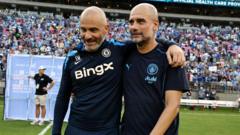
Football media loves a lineage. When a dominant manager nears the end of an era, the immediate reflex is to look for the clone. We saw it with Sir Alex Ferguson and David Moyes. We saw it with Arsene Wenger and Unai Emery. Now, as Manchester City prepares for the eventual departure of Pep Guardiola, the consensus has coalesced around Enzo Maresca. He worked under Pep. He plays positional football. He inverts his full-backs. Therefore, the logic goes, he is the natural heir to the throne.
This is lazy, copy-paste analysis. It mistakes cosmetic similarity for operational excellence. If you enjoyed this post, you might want to check out: this related article.
The idea that hiring a Guardiola assistant guarantees a continuation of Guardiola’s success is an illusion. It ignores the fundamental structural realities of managing elite football clubs and fundamentally misunderstands what makes Pep successful. Maresca is not the next Guardiola; he is a rigid idealist whose tactical dogmatism risks tearing down the very house Guardiola built.
The Fallacy of the Systematic Clone
The core argument for Maresca rests on stylistic continuity. Pundits point to his usage of a 3-2-4-1 build-up shape, his obsession with artificial transitions, and his demands on the goalkeeper to act as a third center-back. They look at these tactical markers and see a direct continuation of Manchester City’s identity. For another perspective on this development, see the recent coverage from Bleacher Report.
They are looking at the wrong things.
Guardiola’s genius does not lie in his adherence to a specific formation. If you look closely at Pep’s career, his defining characteristic is radical pragmatism disguised as idealism. He abandoned the pure tiki-taka of Barcelona when he went to Bayern Munich, opting for more direct, physical wing play with Arjen Robben and Franck Ribéry. At Manchester City, he evolved from using overlapping full-backs to inverted ones, to playing four central defenders across the backline, to building an entire system around a traditional, physical number nine in Erling Haaland.
Pep adapts. Maresca enforces.
During his tenures at Leicester City and Chelsea, Maresca showed a stark refusal to compromise on his structural principles, even when the profile of his players screamed for flexibility. His build-up structure is highly scripted. Players are instructed to occupy precise zones and wait for the opposition to press before triggering predefined passing sequences.
When it works, it looks beautiful. When an opponent refuses to press and sits in a compact mid-block, Maresca's teams frequently look stagnant, turning possession into a sterile exercise. I have watched hours of his teams circulating the ball between center-backs for minutes at a time, generating high possession statistics but zero actual threat. Elite football is not solved by automated scripts; it is won by creating structures that maximize individual brilliance. Maresca prioritizes the structure over the individual. Pep uses the structure to liberate the individual.
The Assistant Coach Trap
There is a massive operational chasm between being a brilliant tactical sounding board and being the man who carries the weight of a multi-billion-dollar football operation.
As an assistant, your job is micro-analysis. You study the training data, refine the pressing triggers, and give the manager data-driven options. You do not deal with the toxic egos of international superstars who are unhappy about sitting on the bench. You do not deal with the unrelenting pressure of the British press after three consecutive losses. You do not manage upward to a board of directors demanding immediate trophies to justify sovereign-wealth investment.
History is littered with elite assistants who flubbed the audition when handed the top job. Look at Carlos Queiroz at Real Madrid. Look at Brian Kidd. Even Mikel Arteta—the poster child for the "Pep Disciple" narrative—needed three years of painful, expensive rebuilding, a massive cultural purge, and hundreds of millions in backing before Arsenal became a functional title contender. Manchester City does not have the luxury of a three-year grace period. The moment Guardiola leaves, the vultures will be at the gates.
Furthermore, the assumption that working under a genius transfers that genius via osmosis is flawed. Intelligence does not replicate linearly.
Imagine a scenario where a brilliant hedge fund manager creates a proprietary algorithm that dominates Wall Street for a decade. The junior analyst who helped input the data does not automatically inherit the market intuition required to steer the fund through a global financial crisis. They know how the machine operates under normal conditions, but they do not know how to build a new machine from scratch when the old one breaks down.
Managing the Post-Pep Financial and Psychological Vacuum
Whoever replaces Guardiola will not just inherit a squad of players; they will inherit a squad that has won everything, multiple times over. The psychological fatigue that accompanies sustained success is the hardest thing to manage in professional sports.
Guardiola maintains intensity through an almost pathological level of personal charisma and volatile emotional management. He rotates players ruthlessly, challenges them publicly, and constantly invents new tactical crises to keep them from becoming complacent. He can do this because he has the cultural capital of being Pep Guardiola. If Rodri or Kevin De Bruyne disagree with his tactics, they look at his trophy cabinet and fall in line.
What happens when Enzo Maresca walks into that dressing room and tells a squad of five-time Premier League champions that they are standing two yards out of position during a routine build-up sequence?
Without the historical authority of a legendary playing or managerial career, a young coach who relies heavily on rigid tactical compliance will quickly lose the dressing room if results turn sour. Elite players smell dogmatism from a mile away. If the automated passing patterns do not break down an stubborn opposition defense, the players will start solving problems on their own, completely undermining the manager's authority.
The Tactical Rigidity Problem
Let us look at the actual data of how Maresca's teams operate under pressure.
In his championship-winning season with Leicester, despite having by far the most expensive and talented squad in the division, his team suffered a massive mid-season collapse. Opposing managers figured out that if you drop into a 5-4-1 low block, block the central passing lanes to the attacking midfielders, and allow Leicester's center-backs to pass the ball laterally, Maresca had no Plan B. They conceded goals on the counter-attack because their inverted full-back system left massive space in the wide channels—space that elite Premier League transitions will exploit ruthlessly.
Maresca's Standard 3-2-4-1 Build-up:

        [GK]
    [CB]  [CB]  [CB]
       [DM]  [DM]  <-- Inverted Full-back joins Midfield
  [AM]   [AM]   [AM]   [AM]
           [CF]
This structure is highly vulnerable to teams that can defend narrow and transition quickly into the vacated wide spaces. In the Championship, Leicester’s sheer talent advantage bailed them out. In the Premier League, against elite transitional sides like Liverpool, Arsenal, or Aston Villa, this predictability is a death sentence.
Guardiola’s response to teams figuring out his inverted full-back system was to abandon it. He started playing central defenders like Manuel Akanji and Nathan Aké as wide center-backs who stayed wide during possession, completely changing the defensive coverage against transitions. This is the difference between a tactical master and a tactical disciple. The master adapts the system to neutralize the opponent's counter-weapon; the disciple simply demands that his players execute the flawed system harder.
The Real Post-Guardiola Strategy
If Manchester City wants to avoid the post-Ferguson collapse, they must reject the temptation to hire a mini-Pep. They need a manager who brings their own distinct footballing philosophy, someone with a proven track record of managing elite talent and handling immense pressure.
The right question is not "Who can play most like Pep?" The right question is "Who can win after Pep?"
The club should look toward managers who excel at tournament football, structural adaptability, and high-stakes man-management. Think of coaches who have demonstrated the ability to win with different styles across different leagues. Hiring Maresca would be a decision made out of fear—the fear of losing an identity. But identity in football is transient. Winning is the only metric that endures.
Hiring a clone is an admission that you believe the system is bigger than the individuals operating it. It is a corporate solution to a sporting problem. When Guardiola walks out the door, the system goes with him. Trying to sustain it with an assistant coach is not continuity; it is a slow, expensive regression. Turn the page completely, or get ready to watch the empire crumble.