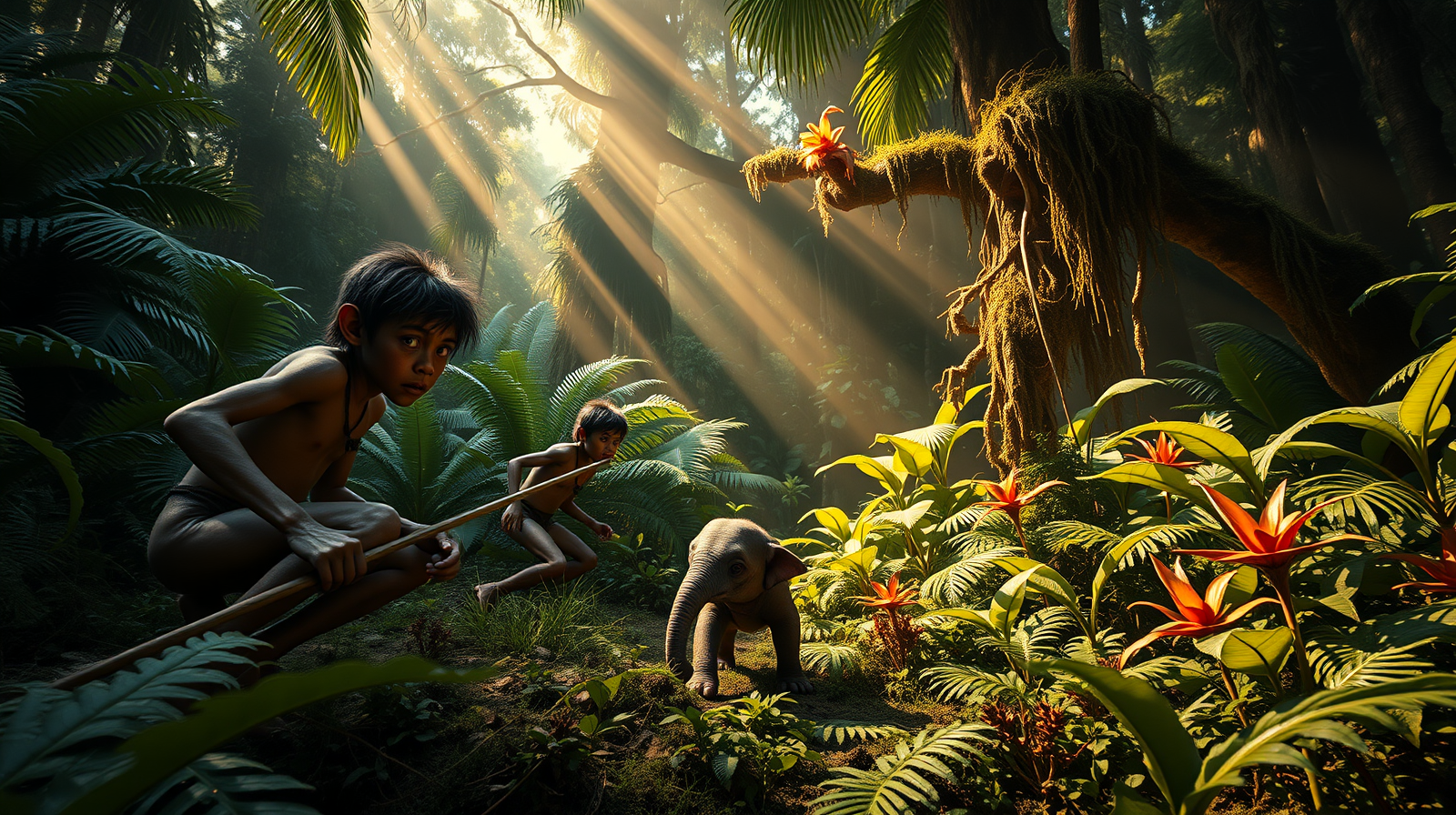
Mainstream paleoanthropology loves a clean, tragic ending. The moment a new hominin species vanishes from the fossil record, the default intellectual reflex is to blame a shifting climate. We see it with Neanderthals, we see it with Megafauna, and we are seeing it again with Homo floresiensis—the so-called "Hobbits" of Liang Bua cave on Flores, Indonesia.
The lazy consensus dominating recent headlines insists that these diminutive humans survived for thousands of years until a sudden, prolonged regional drought drove them to extinction roughly 50,000 years ago. It is a neat, tidy narrative. It fits perfectly into modern anxieties about environmental collapse.
It is also almost certainly wrong.
Blaming a routine climate fluctuation for the erasure of a highly adaptable, long-surviving hominin lineage ignores the brutal, fundamental realities of island biogeography. It mistakes a correlation in the sediment layers for causation. The reality is far more uncomfortable, and it points to a much more aggressive catalyst.
The Overlooked Masters of Island Adaptation
To understand why the drought hypothesis falls apart, look at the sheer timeline of survival. Homo floresiensis did not just arrive on Flores yesterday. Evolutionary biologists and geochronologists like Thomas Sutikna and Chris Stringer have mapped their presence on the island back hundreds of thousands of years, with ancestral lineages like Homo erectus potentially reaching the region nearly a million years ago.
During that massive stretch of time, Southeast Asia went through extreme environmental volatility. The Pleistocene epoch was not a stable paradise; it was a chaotic cycle of glacial maximums, fluctuating sea levels, volcanic eruptions, and, yes, severe droughts.
The Island Paradox: If a species survives multiple geographic upheavals over a 500,000-year period, claiming a single dry spell suddenly wiped them out requires an absurd level of cognitive dissonance.
Insular dwarfism is not an evolutionary weakness; it is a specialized survival strategy. Animals shrink on islands precisely because resources are scarce and unpredictable. By reducing their caloric requirements, Homo floresiensis became exceptionally resilient to resource scarcity. They survived alongside pygmy Stegodon (extinct elephants) and giant Komodo dragons by being the ultimate low-energy survivors. They were built for lean times.
The Real Smoking Gun at 50,000 Years Ago
If climate did not do them in, what changed 50,000 years ago? The answer is hiding in plain sight within the stratigraphic layers of Liang Bua cave, and it has nothing to do with rainfall metrics.
It has to do with the arrival of a new apex predator.
Around 50,000 to 60,000 years ago, anatomically modern humans (Homo sapiens) arrived in the Indonesian archipelago during our great migration toward Australia.
Let us look at the stark chronological alignment:
| Fossil/Artifact Evidence | Appearance/Disappearance Date |
|---|---|
| Homo floresiensis remains | Disappear approx. 50,000 years ago |
| Giant Stegodon remains | Disappear approx. 50,000 years ago |
| Giant Marabou Storks | Disappear approx. 50,000 years ago |
| Homo sapiens fire pits & tools | Appear approx. 46,000 years ago |
The "drought" narrative asks us to believe that a minor shift in monsoon patterns perfectly coincided with the arrival of Homo sapiens, and that the climate, acting alone, selectively targeted the endemic species while leaving the newly arrived modern humans completely unscathed.
That is not science; it is an exercise in shifting blame.
Direct Competition vs. Ecological Displacement
When Homo sapiens stepped onto Flores, they brought an entirely different cognitive and technological toolkit. We did not need to hunt the Hobbits to extinction in a series of prehistoric tribal wars. The destruction was likely far more mundane, driven by resource monopolization.
Imagine a scenario where two species occupy the same ecological niche, but one requires vastly fewer resources while the other possesses long-range projectile weapons, complex social organization, and advanced fire-starting capabilities. The moment Homo sapiens began clearing forests, harvesting the limited freshwater sources, and systematically overhunting the Stegodon, the carrying capacity of the island for Homo floresiensis plummeted to zero.
We did not just outcompete them; we pushed them off the ecological ledge.
Admitting this means confronting the reality of our own species' historical footprint. It is far more comforting to write a public relations piece about how "nature" took out the Hobbits than it is to acknowledge that Homo sapiens has been an ecological wrecking ball for over 50,000 years.
Dismantling the Sediment Argument
Proponents of the climate theory point directly to the changing nature of the dirt inside Liang Bua. They note a shift from moist, muddy deposits to dry, calcified dust around the time the Hobbit bones vanish.
This is a classic misinterpretation of localized cave taphonomy. A change in the microclimate of a single cave system does not equal an island-wide eco-catastrophe. Caves are dynamic environments. Openings clog, underground streams divert, and localized vegetation shifts can alter the internal humidity of a cavern entirely independent of macro-climatic trends.
Using the dust in Liang Bua to explain the extinction of a species across an entire island is the equivalent of looking at a dried-up puddle in a suburban driveway and concluding the entire state is suffering from a catastrophic water crisis.
The Hard Truth of Paleoanthropology
Field research is brutal, expensive, and agonizingly slow. I have argued with researchers who spent decades uncovering a single grid square of dirt, and the intense pressure to publish a clean, sensational headline often overrides the messier, more complex biological reality. A headline screaming "Climate Change Killed the Real-Life Hobbits" secures grants and clicks. A headline stating "We Lack the Genetic and Archeological Resolution to Prove Exactly How Modern Humans Outcompeted an Endemic Hominin" does not.
If we want to understand the loss of biodiversity on islands, we must stop using paleoclimate data as a universal scapegoat. Stop looking at the clouds for answers when the real disruptive force was walking on two feet, carrying a spear, and looking exactly like us.