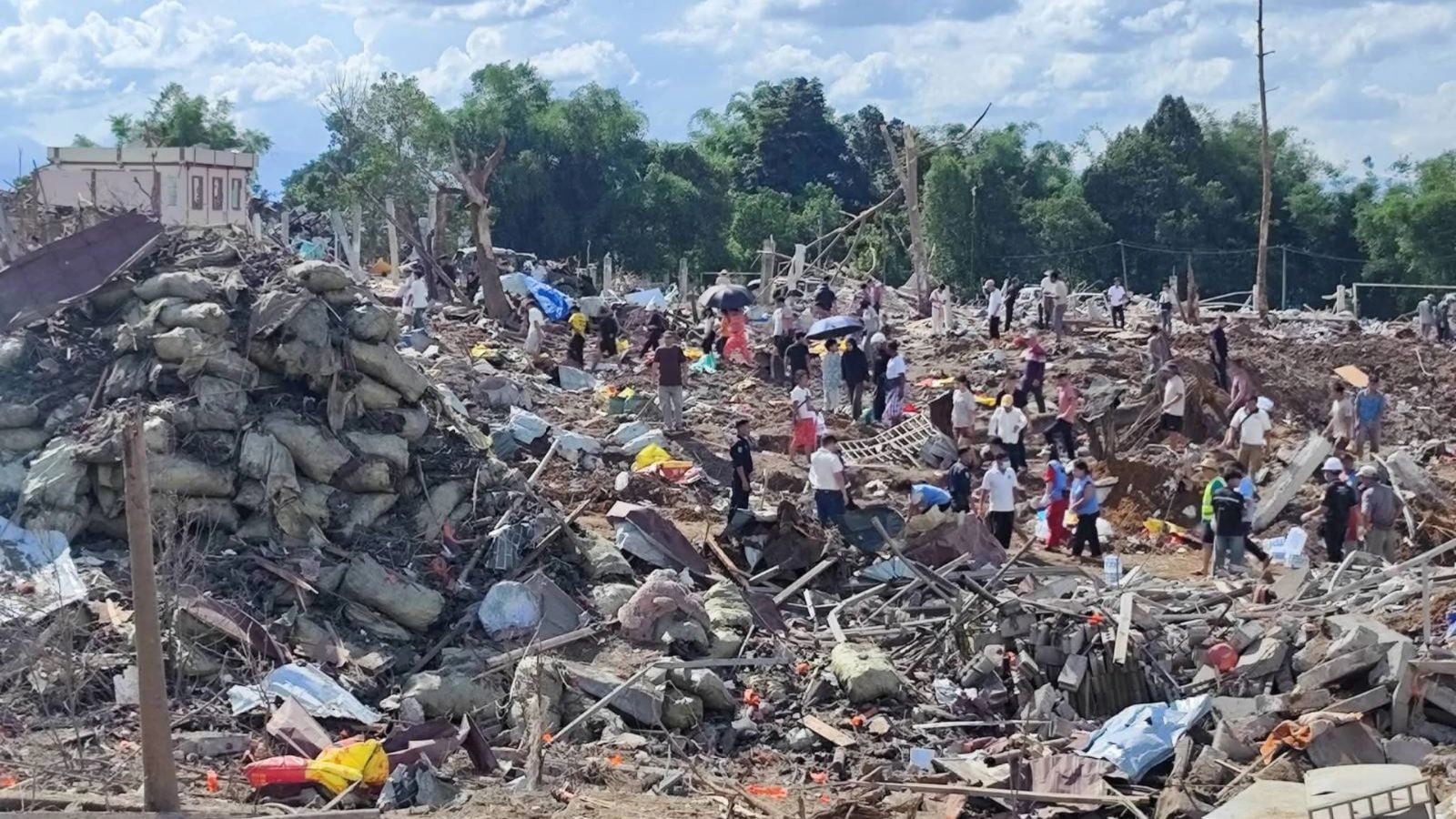
A massive mushroom cloud rose over Kaung Tat village on Sunday, turning a quiet valley near the Chinese border into a scene of complete devastation. The numbers trickling out of northern Shan State are horrific. Local sources, including the BBC and the Shwe Phee Myay News Agency, report that at least 55 people are dead. Among the victims are 25 women and 30 men. Dozens more are currently fighting for their lives in local hospitals.
When an ammunition or commercial explosives depot goes up in a conflict zone, your mind immediately goes to an airstrike or a drone attack. But the group controlling the area, the Ta'ang National Liberation Army (TNLA), says otherwise. They claim this wasn't an act of war. It was a massive, tragic accident involving industrial mining explosives.
The Reality on the Ground in Kaung Tat
If you look at the raw geography, Kaung Tat sits in a volatile, highly strategic pocket of northeast Myanmar. This isn't a place where independent journalists can just hop on a flight to verify facts. We rely on people who were there.
A local resident named Moe Z was traveling on a road roughly a mile and a half away when the detonation occurred. He described seeing a massive cloud billow into the sky. When he got closer, the scene was unrecognizable. The force of the blast ripped houses clean off their foundations.
"Everything was completely destroyed beyond recognition," Moe Z told reporters. He described a massive crater where the storage facility used to stand, with human remains scattered across the debris field.
Local journalists on the scene report that backhoes and heavy machinery are digging through mounds of rubble to find bodies. Over half the village's housing stock is just gone. For the homes closest to the epicenter of the blast, the destruction was so absolute that not even the wooden house posts remain.
Why a Rebel Army Is Storing Industrial Explosives
To understand why a powerful ethnic armed organization is sitting on tons of commercial explosives, you have to look at the war economy of Myanmar.
Since the 2021 military coup that ousted Aung San Suu Kyi's elected government, Myanmar has been locked in a brutal civil war. The military junta, currently led by Min Aung Hlaing, who recently took over as president following a parliamentary vote in April 2026, has been fighting on dozens of fronts against a coalition of ethnic armed groups and People's Defence Forces.
The TNLA is one of the most powerful rebel armies in the country. Right now, they hold a fragile ceasefire with the military junta in this specific northern region. Because they control the territory, they also control the economy.
Northern Shan State is incredibly rich in minerals, particularly rubies and rare earth elements. Mining isn't just a side business here. It's the primary lifeblood for both the rebel armies and the military-backed government. You need explosives to run a mining operation. When a rebel faction administers an entire region, they act as the government, the military, and the commercial logistics provider all at once. They import, store, and distribute the heavy-duty blasting material needed to keep the ruby mines running.
Unanswered Questions and the Official Narrative
The Palaung State Liberation Front, which is the political wing of the TNLA, took to Telegram to issue a formal apology and offer condolences to the victims. They promised a full investigation, stating that anyone found responsible for negligence would face accountability. They also committed to providing healthcare, emergency relief, and long-term rehabilitation for the displaced families.
Even though the TNLA insists this was an accidental detonation of mining supplies, local skepticism remains high. In a civil war defined by sudden shifts, surprise offensives, and heavy junta airstrikes, stockpiling massive amounts of explosives right in the middle of a civilian population center is an immense gamble.
Al Jazeera reported a slightly lower initial hospital tally of 39 dead and 75 injured, highlighting how chaotic the information flow is right now. When a blast is violent enough to obliterate entire structures and leave a deep crater, establishing an accurate headcount takes days. Rescue workers are literally piecing together what happened from the debris.
If you are following the crisis in Southeast Asia, keep your eyes on how this incident impacts the current ceasefire. Accidental or not, a disaster of this scale puts immense pressure on local administrative rebel groups. It exposes the hidden dangers civilians face when living in weaponized, resource-rich borderlands where industrial mining and active military operations share the exact same backyard.
For those looking to understand the broader context, monitor the local independent outlets like the Democratic Voice of Burma (DVB) or The Irrawaddy. They consistently track the shifting territorial control in Shan State and provide updates on whether this disaster disrupts the regional mining trade or triggers a breakdown in the local truce.