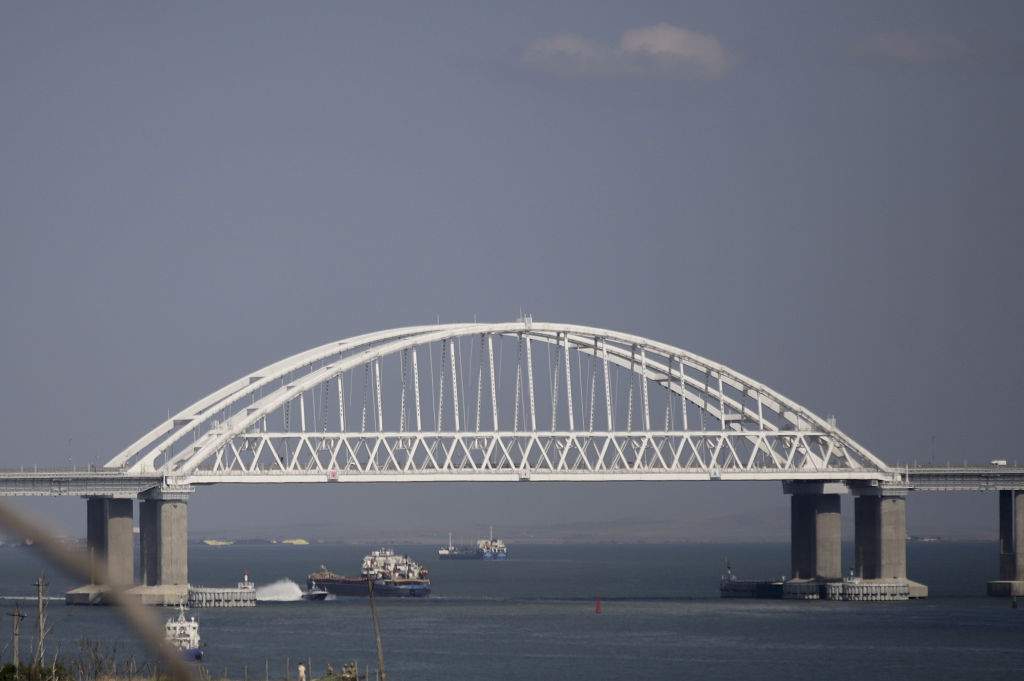
When Ukrainian forces hit the Kerch Strait Bridge and Russian officials immediately label the aftermath "minor damage," they are telling a half-truth designed to calm domestic nerves while masking a severe logistical headache. Even superficial strikes on the 12-mile span connecting mainland Russia to occupied Crimea force immediate traffic halts, trigger hours-long security inspections, and choke the primary artery feeding Moscow’s southern front. You do not need to drop a reinforced concrete span into the Black Sea to break a supply chain. You only need to make the people driving the fuel trucks wonder if the next explosion will happen while they are midway across the water.
For years, military coverage of the Crimean Bridge has suffered from an all-or-nothing fixation. Headlines routinely measure success by whether a roadway section collapses into the strait or a rail line buckles in flames, as happened during the massive truck bomb blast in October 2022 and the sea-drone attack in July 2023. When an attack leaves the asphalt scorched or damages a protective barrier without severing the deck, casual observers tend to shrug. That reading misses the entire mechanics of modern logistics and asymmetric warfare. If you found value in this article, you should read: this related article.
The Illusion of Minor Damage
Concrete and steel do not heal on their own, and saltwater is unforgiving. When Ukrainian missiles, aerial drones, or unmanned surface vessels strike near the bridge's support piers or detonate against its roadbed, the visible scorch marks are rarely the primary concern for structural engineers. The real threat lies in micro-fractures, compromised rebar, and thermal stress on pre-stressed concrete girders that already carry weight far beyond their original civilian design parameters.
Consider what happens the moment an air raid siren sounds over Kerch or an explosion echoes across the strait. Russian authorities immediately close both the road and rail spans. Traffic backs up for miles on the Taman Peninsula and outside Kerch. Bomb disposal units, structural inspectors, and divers must sweep the area before a single civilian car or military flatbed is permitted to roll again. For another angle on this event, refer to the recent update from USA Today.
A closure lasting six to twelve hours might sound trivial on paper. In wartime logistics, it creates a compounding traffic jam that ripples backward through railway marshaling yards hundreds of miles away. Trains carrying artillery shells, spare tank engines, and diesel fuel cannot simply pull over onto a shoulder. They sit stationary on vulnerable tracks, waiting for clearance, turning into clustered targets for long-range reconnaissance and strike teams.
The Psychology of the Chokepoint
Logistics is ultimately run by human beings, not spreadsheets. Every time Kyiv demonstrates that Russian air defenses—whether S-400 batteries, Pantsir systems, or moored decoy barges—can be penetrated, the risk calculation changes for everyone using the crossing.
- Civilian Bottlenecks: Crimea relies heavily on tourism and civilian commerce to maintain the illusion of normalcy that the Kremlin desperately wants to project. Repeated alerts and minor strikes turn a routine drive into a nerve-wracking gamble, prompting civilian drivers to clog secondary routes.
- Inspection Delays: Following past attacks, Moscow instituted grueling physical inspections for every vehicle approaching the bridge. X-ray scanners and manual searches already add hours to transit times; any new strike forces security services to tighten those protocols even further, strangling throughput.
- Maintenance Debt: Continuous patching under wartime conditions prevents engineers from conducting deep, systemic overhauls. A bridge hit repeatedly with "minor" strikes accumulates structural fatigue that eventually requires prolonged shutdowns just to keep it from failing under heavy freight loads.
Anatomy of a Strategic Artery
To understand why every dent in the Kerch Bridge matters, you have to look at a map of the northern Black Sea coast and strip away political rhetoric. Before 2014, Crimea was connected to the Ukrainian mainland by road and rail across the Isthmus of Perekop and the Chongar Strait. Russia’s 2014 annexation severed those land ties, turning the peninsula into an operational island.
Moscow spent roughly $3.7 billion rushing the Kerch Strait Bridge into service, opening the road section in 2018 and the rail line in 2019. It was built not merely as a vanity project for Vladimir Putin, though it certainly served that purpose, but as an umbilical cord. Without it, sustaining over two million residents and a massive military garrison requires ferry fleets that are slow, vulnerable to winter storms, and ridiculously easy to track from satellites.
When Russia launched its full-scale invasion in February 2022, its forces quickly seized a land corridor stretching from Rostov-on-Don through Mariupol and Melitopol to Crimea. On paper, that land bridge reduced Moscow’s total dependence on the Kerch crossing. In practice, the Kerch Bridge remained indispensable for heavy rail transport.
Railways are the backbone of the Russian military. Unlike Western armies that rely heavily on palletized truck transport, Russian doctrine depends on dedicated railway troops and massive trainloads of bulk ammunition and fuel. The coastal railway running through occupied southern Ukraine sits dangerously close to the front lines, well within range of Ukrainian tube artillery, HIMARS rockets, and short-range drones. The Kerch rail span, positioned dozens of miles behind the active combat zone, offered a safer, high-capacity alternative—until Kyiv began systematically reaching it.
How Ukraine Pressures the Span Without Destroying It
Toppling a modern bridge built to withstand seismic activity and ice floes is notoriously difficult. Bridges are composed mostly of empty air and thick, reinforced concrete piers anchored deep into the seabed. Unless an explosive charge detonates directly against a critical load-bearing column or severs the main suspension arches, the structure usually survives.
Ukrainian planners know the math of structural demolition better than anyone. Rather than wasting scarce, expensive munitions trying to achieve a Hollywood-style collapse in a single afternoon, Kyiv has shifted toward persistent, multi-domain attrition.
Saturation and Air Defense Exhaustion
Every strike on the Kerch Bridge forces Russia to deploy an extraordinary concentration of high-end air defense assets around a single geographic point. Those S-300 and S-400 launchers, radar arrays, and electronic warfare stations cannot be used to protect oil refineries inside Russia, airfields in Belgorod, or troop concentrations in Donetsk.
By launching combined attacks—mixing cheap aerial decoys, naval drones skimming the waves, and precision-guided missiles—Ukraine forces Russian interceptors to fire million-dollar missiles at a fraction of the cost. Even when Russian air defenses shoot down 90 percent of an incoming wave, the remaining 10 percent that slips through to cause "minor" damage accomplishes two objectives: it inflicts physical wear on the bridge and proves that the protective umbrella has holes.
Targeting the Ferries and Approaches
A bridge is useless if you cannot reach its on-ramps or if there is no backup when it closes. Alongside direct strikes on the span, Ukrainian forces have repeatedly targeted the rail ferries operating across the Kerch Strait and the fuel depots in Port Kavkaz on the Russian side.
Suppose a hypothetical freight train carrying 3,000 tons of artillery shells approaches the Taman Peninsula just as a Ukrainian drone strike damages a section of the bridge's guardrails and power lines. Under normal circumstances, logistics officers would divert that cargo onto roll-on, roll-off rail ferries to keep the ammunition moving toward Melitopol. If those ferries are sitting at the bottom of the harbor or undergoing dry-dock repairs from an earlier strike, the cargo stops dead. The minor damage on the bridge suddenly becomes a total blockade for heavy equipment.
The Cost of Keeping the Lights On
Moscow’s insistence on downplaying every incident stems from political necessity. For the Kremlin, the Kerch Bridge is the physical manifestation of its claim that Crimea is permanently Russian. Admitting that the structure is fragile, chronically threatened, or operationally degraded undermines the core narrative sold to the Russian public since 2014.
Consequently, state media follows a predictable script after every nocturnal explosion in the strait. First comes silence and a traffic halt. Next, regional officials announce that air defenses repelled a massive attack and that falling debris caused negligible cosmetic damage. Finally, state television broadcasts footage of a handful of cars driving across the undamaged lanes at sunrise to prove the bridge is open.
What those carefully cropped morning broadcasts never show are the weight restrictions quietly imposed on heavy cargo trains. They do not show the underwater barriers, sunken barges, and boom defenses Russia has had to install along the waterway, turning the strait into an obstacle course that slows down commercial shipping in the Sea of Azov. Nor do they mention the sheer financial drain of maintaining permanent engineering crews on standby at both ends of the bridge to pour fresh asphalt and weld steel plates before the next wave arrives.
What History Tells Us About Choked Supply Lines
Military history offers plenty of reminders that you do not have to obliterate a transport link to render it strategically crippled. During the Vietnam War, American aircraft bombed the Thanh Hoa Bridge for years, dropping hundreds of tons of ordnance on it without bringing it down. Yet the constant threat of attack, the destruction of approach roads, and the relentless need for repairs drastically curtailed the volume of supplies North Vietnam could push south over that span during critical periods.
A similar dynamic played out in 2022 around the Antonivka Road Bridge near Kherson. Ukrainian HIMARS strikes did not collapse the bridge into the Dnipro River immediately. Instead, they punched neat, repetitive holes through the concrete deck. Russian engineers could patch the asphalt in a day or two, allowing light vehicles to cross, while heavy armored vehicles and loaded ammunition trucks risked plunging through weakened sections. Eventually, the cumulative structural degradation—combined with the impossibility of safely moving heavy logistics—forced Russia to abandon the entire western bank of the Dnipro.
The Kerch Bridge is vastly larger and stronger than the Antonivka crossing, but the underlying physics remain identical. Infrastructure does not have to vanish to fail its operational mission.
Moscow’s Shrinking Margin for Error
Every time a strike leaves "minor" damage on the Crimean Bridge, Russia’s margin for error shrinks a little further. Moscow is currently racing to complete a new railway line running along the Sea of Azov coast through occupied territory, explicitly designed to bypass the Kerch crossing entirely. That construction project is the loudest possible admission from the Kremlin that the bridge can no longer be trusted as a secure lifeline.
Until that alternative rail line is fully operational—and even after it opens, given its proximity to Ukrainian drone and missile range—Russia remains tethered to a 12-mile strip of concrete and steel suspended over open water. Kyiv does not need a single cinematic explosion to win the battle of the Kerch Strait; it simply needs to ensure the bridge never gets a single quiet week to recover.