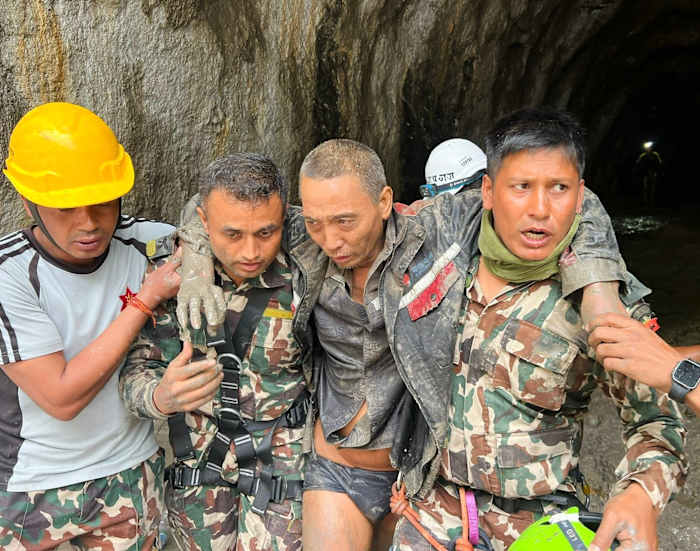
Every time a flood or an earthquake drops headlines about a miraculous survivor pulled from the ruins after ten days, the global news machine goes into raptures. Cameras roll. Anchors choke back tears. The narrative is always identical: human resilience triumphs, hope springs eternal against the odds, and miraculous survival is the standard by which we should measure emergency response.
It is a comforting lie.
I have watched emergency management systems operate from the inside for over a decade. I have stood in disaster zones in South Asia and Latin America, walking through mud-choked streets while cameras zoomed in on a single anomaly. The obsession with the ten-day miracle survivor is not just bad journalism. It is a dangerous distraction that actively kills people by sanitizing systemic failure.
When media outlets focus on the statistical outlier—the one person who defied biological limits under a crushed concrete slab or inside a flooded pocket—they hide the brutal math of disaster triage. They create an urban legend that convinces the public, and worse, poorly trained local authorities, that search windows are virtually infinite if people just pray hard enough or look long enough.
Let us look at the actual physics of survival.
Human physiology operates on strict margins. Without water, renal failure typically shuts down the body within three to four days, depending on ambient temperature and humidity. In a flood scenario, humidity is maximal, but water quality is toxic. Ingestion of raw floodwaters laced with agricultural runoff, raw sewage, and decomposing organic matter introduces pathogens that cause fatal dysentery or cholera within hours, long before dehydration finishes the job.
When a news anchor breathlessly reports that someone survived ten days trapped in debris after a flood, they are skipping the medical autopsy of that claim. In nearly every verified case of extended survival past the standard seventy-two-hour golden window, specific anomalies must align: access to an accidental freshwater drip, an airtight or temperature-regulated pocket, and a pre-existing physiological robustness that defies standard bell curves.
Treating the anomaly as the baseline is a catastrophic policy error.
The Myth Of The Infinite Golden Window
The international search and rescue community relies on the concept of the golden seventy-two hours. After three days, the probability of finding live victims drops off a fiscal and logistical cliff. Insurance companies, government budget allocators, and disaster relief logistics officers know this. Yet, political leaders bowing to public pressure—fueled by sensationalized media reports—routinely force rescue teams to keep scouring rubble long after the probability of life approaches zero.
This wastes critical resources.
Imagine a scenario where a provincial government allocates two million dollars and three hundred elite personnel to a hopeless search for a single survivor on day eight, simply because a viral video showed someone pulled from the mud the day before. Meanwhile, forty miles away, dozens of isolated communities are dying of waterborne diseases because field hospitals, antibiotics, and clean water filtration systems have not been deployed.
We are trading verifiable, mass-scale life preservation for high-profile theater.
The media loves the theater because it fits a neat emotional arc. Disaster strikes. Despair sets in. A hero emerges from the muck. Credits roll. But real emergency response is boring, statistical, and cold. It is about logistics networks, supply chain integrity, rapid water testing, and preventative evacuation.
When we romanticize the ten-day rescue, we shift the responsibility of survival away from structural engineering, zoning laws, and early-warning infrastructure, placing it squarely onto the shoulders of individual endurance. We tell citizens that if their houses wash away, it is up to their inner grit to hold out until a rescue dog sniffs them out a week later.
Dismantling The Disaster Industrial Complex
The disaster response sector suffers from a severe accountability crisis. International NGOs and local disaster management agencies often market their capabilities based on inspirational imagery rather than empirical efficacy.
Let us define the metrics that actually matter. Success in a flood zone is not measured by how many dramatic pull-out videos are generated for social media. It is measured by the epidemiological curve of post-disaster infection rates, the speed at which potable water is restored, and the reduction in secondary mortality.
More people die in the weeks after a flood from cholera, typhoid, and infected lacerations than die on the day the levees break. Yet, post-disaster health infrastructure receives a fraction of the funding and media spotlight compared to the dramatic initial extraction phase.
I have seen relief organizations deploy million-dollar urban search and rescue units to rural villages where everyone had already evacuated or drowned, while basic water purification tablets sat in a customs warehouse fifty miles away due to bureaucratic inertia. The incentives are completely misaligned. Dramatic rescues secure funding. Boring water purification does not make the evening news.
What To Do When The Waters Rise
If you want actionable advice based on reality rather than Hollywood scripts, forget about waiting ten days for a miracle extraction.
First, abandon the assumption that the state will save you within the first twenty-four hours. In a catastrophic regional flood, first responders are victims too. Their stations are flooded, their communication lines are down, and their primary mandate in the initial hours is triage, not door-to-door delivery.
Second, prep for the post-flood environment, not just the flood itself. Everyone packs a flashlight and some protein bars. Almost no one packs heavy-duty water purification systems, medical-grade disinfectants for minor cuts, and snake-or-vector bite kits. In a flood, a minor skin abrasion exposed to stagnant water can turn into necrotizing fasciitis within forty-eight hours.
Third, stop consuming disaster coverage as entertainment. When you watch a ten-day rescue story, recognize it for what it is: a statistical lottery win packaged as policy justification.
Until we stop treating structural incompetence as an inspirational human interest story, we will keep repeating the same preventable tragedies while cheering for the few who beat impossible odds.