The rapid integration of robotics into the Chinese domestic market has moved beyond the phase of novelty and entered a period of functional experimentation where hardware is being used to bridge gaps in labor safety, social emotionality, and urban convenience. While media narratives often frame these developments as "quirky," a structural analysis reveals a targeted effort to solve high-friction problems in the primary and tertiary sectors through specific mechanical interventions. The current trajectory suggests a shift toward high-utility, low-cost automation designed to operate in unscripted human environments.
The Utility of Performance in Agricultural Safety
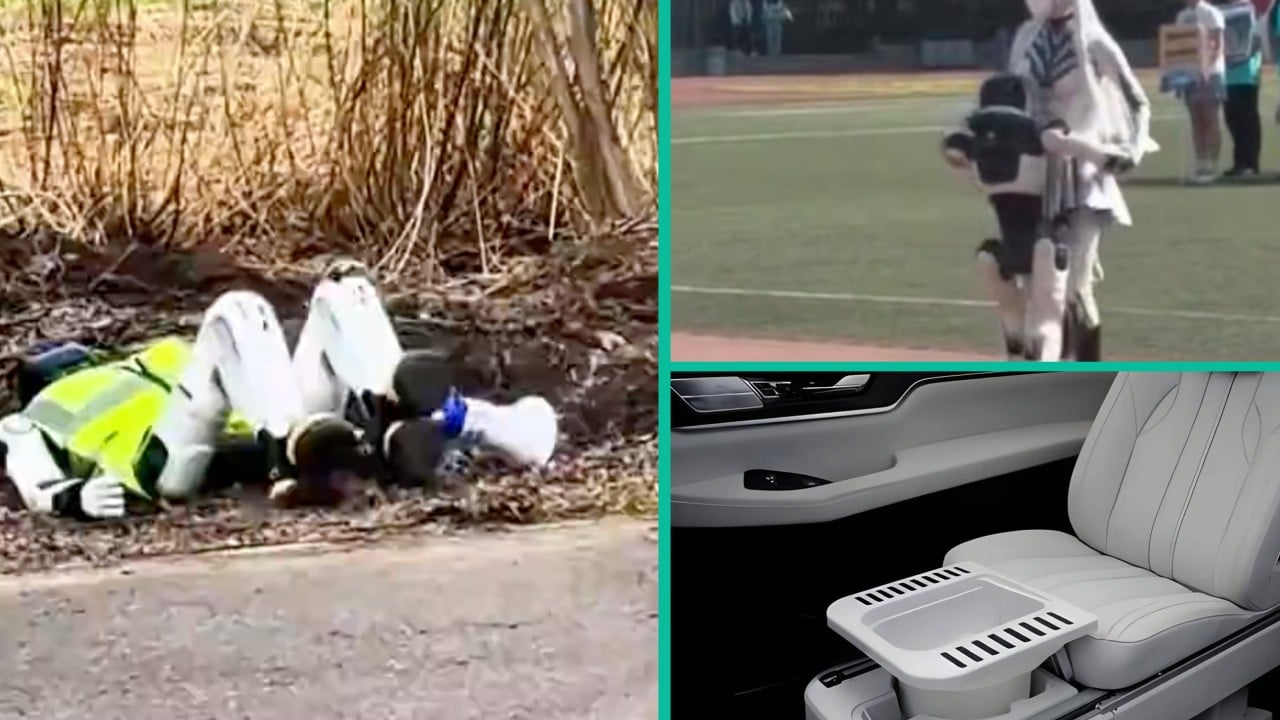
The deployment of drones and ground vehicles for pesticide application introduces a critical safety variable: human proximity to toxic chemicals. However, the technical barrier is not the spraying itself, but the communication of risk to nearby residents or livestock. The use of robots that "play dead" or perform exaggerated mechanical failures serves as a primitive but effective non-verbal signaling system.
From a behavioral economics standpoint, this utilizes a Signal-to-Noise Ratio optimization. Standard sirens or flashing lights are often ignored in rural settings due to sensory habituation. By mimicking a catastrophic failure—falling over or emitting a specific distress signal—the machine triggers a high-priority biological response in observers. This "theatrical safety" mechanism creates a physical buffer zone between the chemical dispersion area and the public, reducing the liability of autonomous operation in unregulated spaces.
The cost function of this approach is significantly lower than implementing geofencing or high-resolution LIDAR systems to detect and avoid every possible intruder. Instead of the machine being responsible for the environment, the machine manipulates the human actors within that environment to self-regulate their distance.
Emotional Hardware and the Commodification of Physicality
The emergence of "hugging robots" designed for social interaction represents a shift from information-based AI to physical-interaction AI. This transition addresses a specific bottleneck in the service economy: the labor-intensive nature of emotional support and physical comfort.
The engineering challenge here lies in Tactile Feedback Loops. For a machine to simulate a human hug, it must solve for three variables:
- Variable Pressure Sensing: The ability to apply enough force to be perceived as "firm" without exceeding the threshold of physical discomfort or injury.
- Thermal Regulation: Human-to-human comfort is heavily dependent on heat transfer. Robots in this category are increasingly incorporating internal heating elements to mimic homeostatic temperatures.
- Compliant Actuation: Moving away from rigid, gear-driven joints toward soft robotics or "series elastic actuators" that allow the machine to yield to the user's body shape.
This is not merely a social experiment; it is a prototype for the eldercare and mental health markets. As the demographic pyramid in China shifts, the ratio of caregivers to patients becomes unsustainable. Automating physical affection, while ethically complex, represents a scalability solution for a loneliness epidemic that carries quantifiable public health costs.
Urban Infrastructure Constraints and Mobile Sanitation Solutions
The approval of in-car toilet systems for autonomous or long-haul vehicles addresses a fundamental failure in urban planning: the misalignment between transit times and biological requirements. In high-density megacities where traffic congestion is a persistent variable, the vehicle is being reimagined as a self-contained life-support module.
The technical integration of sanitation systems into passenger vehicles involves a rigorous trade-off between Mass Efficiency and Occupant Volume.
- Waste Management: Implementing chemical treatment or vacuum-seal technologies similar to those found in aerospace engineering to minimize odor and leakage in a vibrating, mobile environment.
- Regulatory Hurdles: The shift from a vehicle being classified as a "transportation device" to a "habitable space" requires a complete overhaul of safety certifications, particularly regarding fluid dynamics during high-velocity impacts.
The approval of these systems by regulatory bodies signals a departure from traditional automotive design. It acknowledges that as autonomy increases, the "driver" becomes a "dweller," and the interior utility must evolve to support extended periods of occupancy. This creates a secondary market for specialized sanitation services and hardware maintenance, effectively turning the vehicle into a mobile real estate asset.
The Bottleneck of Edge Case Management
While these individual innovations solve specific problems, the systemic bottleneck remains the Unstructured Environment Paradox. Robots function efficiently in warehouses because the variables are controlled. In a rural field or a crowded city street, the number of unpredictable variables—unpredictable human behavior, weather patterns, and irregular terrain—increases exponentially.
The "theatrical" behaviors of these robots (like playing dead) are essentially "soft" solutions to hard computational problems. When the AI cannot calculate a 100% safe pathing solution through a crowd, it reverts to a state that forces the crowd to move around it. This is a tactical admission of the current limitations in computer vision and real-time processing power.
Strategic Vector: From Feature to Infrastructure
The long-term value of these disparate technologies lies in their eventual consolidation into a unified service layer. We are observing the beta-testing of a robotic ecosystem that prioritizes:
- Low-Cost Durability: Using simplified mechanical signals instead of expensive sensors.
- Niche Specialization: Solving one highly specific problem (sanitation, pesticide safety, emotional contact) rather than attempting to build a general-purpose humanoid.
- Regulatory Integration: Working within the legal frameworks of the Chinese market to set global precedents for autonomous operations.
For investors and competitors, the metric of success is not the "quirkiness" of the interaction but the Human-Intervention Reduction Rate. Every time a robot successfully manages a human interaction through a programmed behavior—without a remote operator stepping in—the marginal cost of that service drops.
The strategic play for firms in this space is to move beyond the hardware sales model and toward an Automation-as-a-Service (AaaS) framework. The agricultural robot is not a product; it is a subscription to a reduced liability and increased crop yield. The in-car toilet is not a feature; it is an expansion of the vehicle's productive uptime. Firms that fail to quantify these efficiencies will remain stuck in the novelty phase, while those that map these "quirks" to hard economic outputs will dominate the next decade of the robotics-human interface.
The logical conclusion of this trend is the total "roboticization" of the background environment. Safety, comfort, and sanitation are being offloaded to autonomous systems that don't need to be intelligent in a general sense—they only need to be effective within their specific functional silos. The most successful machines will be those that successfully manipulate their human environment to compensate for their own mechanical limitations.
Identify the specific high-friction biological or logistical bottlenecks in your target market. Do not attempt to build a robot that mimics a human; build a machine that solves the specific inefficiency, then use behavioral signaling to manage the human-machine interface. Priority should be given to "soft" robotics and non-verbal communication modules to reduce the computational load of autonomous navigation.