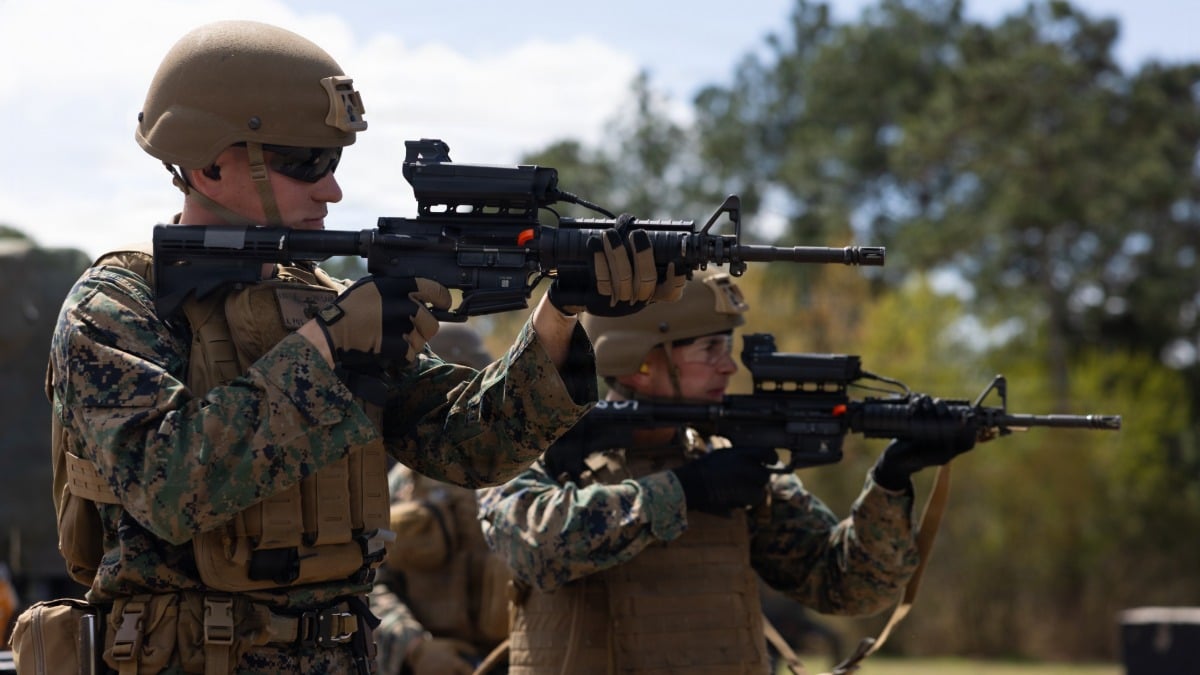
The United States Marine Corps’ selection of Smart Shooter for a $5.8 million fire control systematic integration contract signals a profound shift from traditional marksman-dependent shooting paradigms to algorithmic kinetic optimization. At its core, this procurement addresses a fundamental failure rate in battlefield ballistics: the degradation of human accuracy under cognitive load and physiological stress. By decoupling the exact moment of firing from human reflex, this technology treats the infantry rifle not merely as a mechanical tool, but as a closed-loop computational platform.
The transaction value of $5.8 million represents an initial operational capability (IOC) phase rather than a full-scale force modernization. In defense procurement, this scale typically finances low-rate initial production (LRIP), field testing across specialized units, and the baseline software adjustments required to interface proprietary fire control optics with existing Marine Corps weapons systems, specifically the M27 Infantry Automatic Rifle (IAR).
The Kinetic Bottleneck and Human Physiological Failure Modes
Traditional small arms marksmanship relies on a complex sequence of biological feedback loops. A shooter must align the weapon's bore axis with a target, calculate windage and elevation drop mentally or via manual optic adjustments, control respiratory motion, and execute a trigger press without introducing angular deviation.
Under combat conditions, elevated heart rates, sensory overload, and physical fatigue degrade fine motor skills. This introduces severe variances in accuracy, categorized by three distinct failure modes:
- Angular Deviation (Trigger Jerk): The involuntary muscular contraction of the hand during trigger activation, which pulls the muzzle off the intended point of aim immediately prior to ignition.
- Target Motion Calculation Latency: The cognitive delay in estimating the velocity, vector, and range of a moving target, leading to improper lead calculation.
- Atmospheric Miscalculation: Inability to rapidly quantify density altitude, crosswinds, and inclination angles in dynamic engagements.
The Smart Shooter system—specifically the SMASH family of fire control optics—recalculates this equation by shifting the human role from a continuous tracking system to a supervisory targeting system. The operator retains the authority to designate a target and express intent to shoot, but the system controls the exact millisecond of the kinetic release.
The Architecture of Algorithmic Fire Control
The mechanical and digital workflow of an algorithmic optic operates on a continuous feedback loop divided into three sequential phases: acquisition, calculation, and lock-out bypass.
+------------------+     +--------------------+     +---------------------+
| Target Detection | --> | Ballistic Solution | --> | Trigger Lock Bypass |
|  (Image/IR/EO)   |     | (Range/Wind/Velo)  |     | (Muzzle Alignment)  |
+------------------+     +--------------------+     +---------------------+
Electro-Optical Target Acquisition and Tracking
The optic utilizes an integrated suite containing a high-resolution daytime camera or thermal/infrared sensor, a laser rangefinder (LRF), and an internal inertial measurement unit (IMU). When the operator activates the system via a remote switch on the weapon's grip, the processing unit treats the visual field as a digital matrix.
Using computer vision algorithms optimized for edge computing, the system identifies potential targets based on contrast, motion, and structural geometry. The shooter selects a specific target bounding box within the heads-up display (HUD). Once selected, the system locks onto the target, tracking its relative movement across the X and Y axes of the frame at high frame rates.
Dynamic Ballistic Solution Calculation
Simultaneously, the internal processor runs a continuous ballistic algorithm. The laser rangefinder provides precise distance data, while the IMU measures the weapon’s pitch, roll, and yaw rates. The software calculates the required barrel elevation and lead angle based on the ammunition type’s pre-programmed ballistic coefficient and muzzle velocity.
Instead of forcing the shooter to manually align a traditional crosshair with a moving target while compensating for drop, the system projects a dynamic, floating reticle. The system knows exactly where the barrel must be pointed to ensure a hit, accounting for the target’s current velocity vector.
The Trigger Modification Mechanism
The critical differentiator of this technology is its physical integration with the weapon’s fire control group. The system requires an engineered trigger mechanism replacement.
When the operator pulls and holds the trigger down, the weapon does not immediately fire. Instead, the trigger pull sends an electronic signal to the optic, indicating "intent to fire." The system keeps the firing pin blocked or disconnected until the weapon’s physical bore axis intersects perfectly with the calculated ballistic solution. The moment the shooter naturally sweeps the weapon's reticle over the designated target box and the alignment error drops to zero, the optic sends an electronic impulse to release the sear. The shot fires instantly.
The Cost Function of Counter-Unmanned Aerial Systems
While the technology improves lethality against ground targets, the primary strategic catalyst for the U.S. Marines' procurement is the proliferation of Group 1 and Group 2 Unmanned Aerial Systems (UAS)—low-cost, commercial-off-the-shelf quadcopters and loitering munitions.
Defending against small drones presents a severe economic asymmetry. Utilizing exquisite air defense missiles costing hundreds of thousands of dollars per interception against a $1,000 drone is financially unsustainable. Conversely, relying on standard infantry small arms with traditional optics yields low probability of kill ($P_k$) metrics due to the target’s small radar/visual cross-section, erratic flight paths, and high angular velocity relative to the shooter.
The operational math shifts significantly when analyzing the probability of kill via computerized fire control:
$$P_k = 1 - (1 - P_h)^n$$
Where $P_h$ is the probability of a single-shot hit and $n$ is the number of rounds fired.
In a traditional scenario, $P_h$ against a moving quadcopter at 200 meters approaches zero for an average infantryman under stress, requiring massive ammunition expenditure ($n$) to achieve neutralization, which frequently leads to barrel overheating and supply depletion. By automating the lead and elevation calculations and restricting kinetic release to the exact moment of geometric alignment, the system significantly elevates the $P_h$ value of every single round. This achieves drone neutralization in short, controlled bursts, drastically lowering the logistical footprint of ammunition supply lines during decentralized operations.
Operational Friction Points and Technological Limitations
Deploying advanced processing units and electro-optics to frontline infantry units introduces distinct vulnerabilities that are absent in legacy mechanical systems. A rigid strategic assessment requires examining these system limitations.
Power Dependency and Thermal Management
Legacy combat optics rely on ambient light collection, tritium, or low-draw LED circuits capable of operating for tens of thousands of hours on a single battery. An algorithmic optic, by contrast, runs a high-frame-rate image sensor, a digital display, a laser rangefinder, and a ballistic processing chip.
This creates a high continuous power draw. If the power supply fails or is depleted in an austere environment, the weapon system loses its primary capability, reverting to a heavy, sub-optimal backup optical sight. Furthermore, continuous processing generates thermal signatures that must be dissipated without compromising the environmental sealing of the unit.
Latency in High-Velocity Scenarios
The processing pipeline—sensor capture, algorithmic target tracking, ballistic calculation, and electronic trigger release—introduces milliseconds of systemic latency. If a target changes direction faster than the sensor's sampling rate or the processing unit's loop frequency, the calculated solution will lag behind reality. This latency creates an performance ceiling against high-speed, close-range threats.
Digital Countermeasures and Environmental Degradation
Computer vision algorithms are susceptible to specific environmental and deliberate distortions. Heavy precipitation, dense smoke, fog, and dust obscurants degrade the optic's optical sensors, reducing target contrast and preventing lock-on.
Additionally, adversaries can deploy visual countermeasures, such as active infrared strobes or specific geometric camouflage patterns designed to spoof edge-detection algorithms, forcing the operator to override the system and return to manual aiming modes.
Institutional Trade-offs in Infantry Training
The adoption of algorithmic small arms fire control poses a fundamental institutional dilemma regarding the training pipeline of the Marine Corps, which historically prides itself on foundational marksmanship excellence.
If technology guarantees accuracy up to the physical limits of the cartridge, the requirement for intensive, time-consuming instruction in manual marksmanship fundamentals could be deprioritized. This creates an institutional vulnerability: dependency on software-defined accuracy. If systemic electronic warfare or localized power failures compromise the devices across a theater of operations, a force that has truncated its foundational marksmanship training will experience an immediate, catastrophic drop in combat effectiveness.
Therefore, the deployment of the $5.8 million contract must be structured not as a replacement for fundamental marksmanship, but as an additive capabilities layer. Training regimens must maintain rigorous manual qualifications, treating the algorithmic fire control system as an emergency force multiplier for specific high-stress mission sets—such as counter-UAS defense and urban clearing operations—rather than a baseline crutch for general infantry engagements.
Tactical Integration Blueprint
To maximize the return on investment of this procurement, the Marine Corps must avoid deploying these optics uniformly across the standard infantry squad. Instead, deployment should follow a specialized capability framework.
Optics should be integrated at the fire-team level, precisely paired with the M27 IAR to serve as a organic counter-UAS and long-range engagement asset. This tactical placement ensures that every small unit maintains an immediate defense capability against loitering munitions without encumbering every rifleman with the added weight, bulk, and power-management requirements of an electronic fire control group.
The evaluation metrics for the success of this contract must bypass subjective operator feedback and focus exclusively on hard telemetry: quantifying the reduction in rounds-per-kill against aerial targets, measuring the speed of target engagement transitions in high-stress simulations, and defining the mean time between failures (MTBF) of the electronic trigger components in harsh field environments. Only with this rigorous data can the decision for full-rate production be justified.