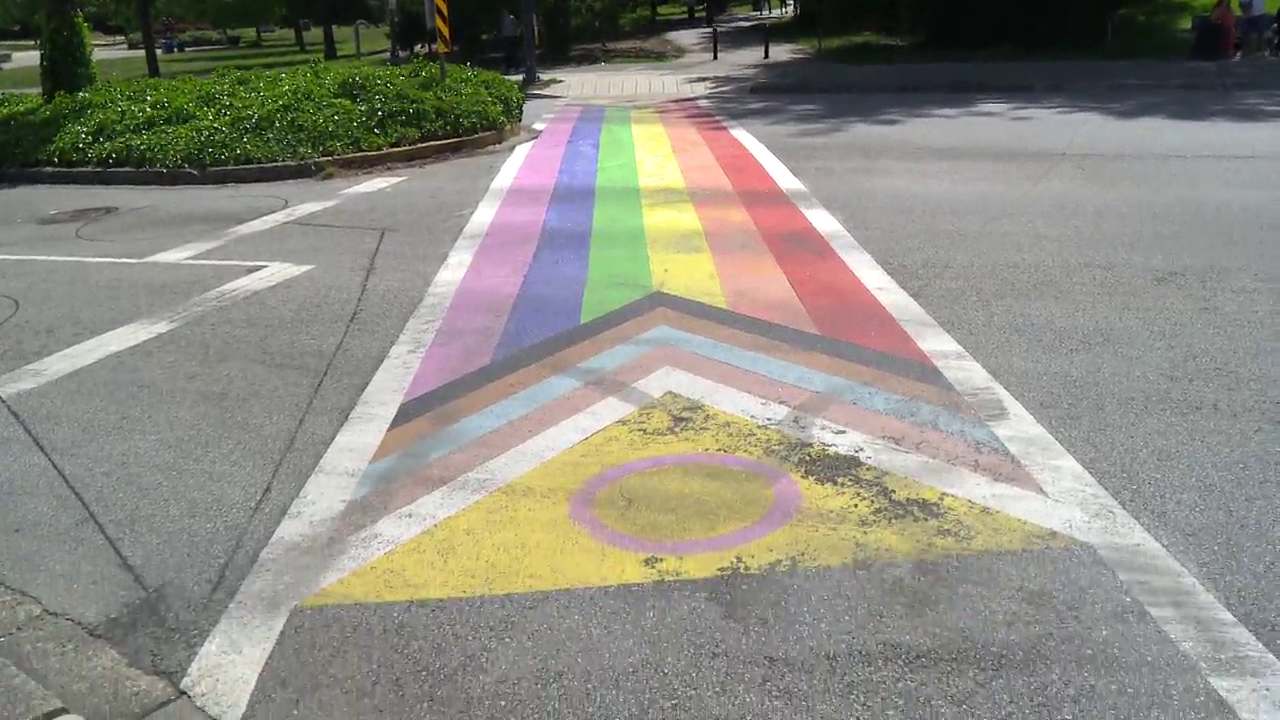
Fringe political actors operate in a high-scarcity marketplace where the primary currency is not capital or policy consensus, but decentralized attention. When Amrit Birring, leader of the marginal Freedom Party of British Columbia, filmed himself and two accomplices spray-painting black lines over the Intersex-Inclusive Progress Pride Flag crosswalk near Holland Park in Surrey, the act was not merely a localized property crime. It was a calculated application of a structural marketing playbook designed to exploit societal fracture lines for low-cost asset acquisition—specifically, digital reach and base mobilization.
To understand the lifecycle of this event, analysts must look past the immediate ideological vitriol and evaluate the incident through a strict operational framework. Political entities with near-zero electoral market share cannot compete in traditional media landscapes. They rely instead on high-variance, provocative interventions to manufacture visibility. The target selection, the timing, and the subsequent distribution mechanics reveal a deliberate strategy to force algorithmic leverage from civic friction.
The Cost-Benefit Function of Performative Vandalism
Fringe campaigns are bound by severe resource constraints. In the 2024 British Columbia provincial election, Birring secured 371 votes in the Surrey-Newton riding, representing a 2.4 percent market share. In a standard electoral framework, scaling this market share requires significant financial expenditure on staff, advertising infrastructure, and physical outreach.
Performative defacement alters this economic equation by drastically reducing the Customer Acquisition Cost (CAC) for new supporters. The cost function of this specific intervention can be broken down into three primary variables:
- Direct Capital Outlay: The nominal cost of materials (spray paint, physical placards) and transportation to the intersection of Old Yale Road and University Drive. This is effectively negligible.
- Legal Exposure and Liabilities: The calculated risk of criminal mischief charges, civil property damage fines, and investigation by the Surrey Police Service hate crime unit.
- Reputational Depreciation: The permanent alienation of the moderate electorate. For a mainstream candidate, this cost is catastrophic. For a fringe candidate whose platform relies explicitly on institutional opposition—such as dismantling the SOGI 123 educational resources—this cost shifts from a liability to a core asset.
By executing the defacement at 3:50 p.m. on a Saturday, immediately preceding the launch of Pride Month, the actors maximized the temporal relevance of the event. The return on investment is realized when the counter-response triggers a secondary wave of media amplification.
The Asymmetric Attention Loop
The structural logic of ideological vandalism relies on a predictable, two-stage transmission mechanism that exploits the baseline operations of both social media algorithms and mainstream news distribution.
[Phase 1: Direct Action] -> Localized Vandalism & Video Capture
                                    │
                                    ▼
[Phase 2: Distribution]  -> Algorithmic Amplification via Outrage
                                    │
                                    ▼
[Phase 3: Counter-Wave]  -> Mainstream Media Coverage & Institutional Condemnation
                                    │
                                    ▼
[Resulting Outcome]      -> Audience Growth & Resource Consolidation for Fringe Actor
Phase 1: Institutional Capture and Algorithmic Sorting
The perpetrator directly uploads the recorded artifact to a proprietary social media channel, framing the transgression as ideological resistance ("When tyranny becomes law resistance becomes your duty"). The explicit illegality of the act serves as a high-strength signal to the platform's optimization algorithms, which prioritize high-engagement metadata—specifically shares, comments, and prolonged watch times fueled by moral outrage.
Phase 2: The Amplification Paradox of Advocacy Groups
Advocacy organizations such as Surrey Pride B.C. and Sher Pride are forced into a structural dilemma. To maintain their institutional mandates, protect their constituents, and coordinate municipal clean-up efforts, they must publicly denounce the act. In doing so, they provide the narrative conflict that mainstream news outlets require to satisfy editorial demand.
Surrey Pride explicitly recognized this mechanism, issuing a directive to supporters stating: “The individuals involved want us to react and help spread their video so we will NOT be sharing.” However, the institutional requirement to report the incident to law enforcement and the Mayor’s office inevitably generates a public record, rendering the event visible to legacy media systems.
The Infrastructure Bottleneck: Municipal Maintenance as an Erasure Tool
Municipal infrastructure is frequently utilized as a low-cost canvas for high-conflict messaging because the physical removal of the message introduces an operational bottleneck for the city.
The physical asset in question—a specialized multi-color roadway installation—requires specific maintenance protocols when compromised. City of Surrey maintenance crews deployed high-pressure washing systems on Monday morning to reverse the defacement. While effective at removing standard aerosol pigments, repeated chemical and high-pressure interventions accelerate the degradation of the underlying thermoplastic or epoxy coatings used in municipal crosswalk treatments.
This creates a recurring fiscal externality for local governments. The municipality must absorb the labor and material costs of continuous restoration, while the vandal incurs zero maintenance overhead. The asymmetry is stark: five minutes of low-skill vandalism requires multiple hours of skilled municipal labor and specialized equipment to remediate.
Limits of the Provocation Strategy
While the attention-acquisition model provides immediate, short-term returns in visibility, it faces severe structural limitations regarding long-term political scalability.
The first limitation is the saturation ceiling. As performative acts of defacement increase in frequency—noting that this specific Surrey crosswalk was previously targeted shortly after its installation—the marginal attention yield per incident decreases. Audiences habituate to the visual stimuli of damaged public assets, forcing perpetrators to escalate the severity or nature of the provocation to achieve identical media penetration.
The second bottleneck is legal containment. The Surrey Police Service identified three persons of interest within 48 hours of the event. When an actor explicitly documents their own unlawful activity to satisfy the distribution requirements of Phase One, they simultaneously deliver an airtight evidentiary package to state prosecutors. The transition from a civil protest framework to a criminal prosecution framework introduces hard caps on the strategy:
- Financial Penalties: Restitution orders for public property restoration deplete the limited capital reserves of fringe organizations.
- Operational Disruption: Criminal proceedings and conditions of release restrict the physical mobility and organizing capacity of the leadership core.
- Platform Deplatforming: While certain alternative networks tolerate explicit recordings of illegal acts, mainstream digital infrastructure providers frequently enforce terms of service violations regarding the promotion of unlawful activity, severing the actor from broad-market distribution channels.
Strategic Mitigation for Civic Systems
To break the asymmetric economic advantage held by fringe provocateurs, municipal governments and civic organizations must alter the payoff matrix of the performative defacement model. Relying solely on retrospective law enforcement and standard media denunciation preserves the exact feedback loop the actors rely on for growth.
Municipalities must shift investment toward physical resilience. Utilizing highly durable, non-porous anti-graffiti clear coats over public art installations significantly lowers the operational friction of removal, allowing rapid remediation by non-specialized staff without accelerating the degradation of the underlying asset.
Simultaneously, institutional communication models must decouple the condemnation of the act from the profile of the actor. Media reporting that emphasizes the technical mechanics of the asset's restoration and the execution of legal penalties—rather than amplifying the ideological branding or names of fringe entities—denies the perpetrator the primary return on their logistical investment: broad-market visibility.