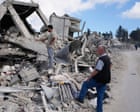
The transition from active kinetic warfare to a negotiated cessation of hostilities represents a fundamental shift in a population's risk calculus. When a truce is declared—such as the recent cessation of military operations between Israel and Hezbollah in Lebanon—media narratives typically frame the public reaction through the lens of emotional relief or simple skepticism. This framework fails to capture the underlying economic and psychological mechanisms driving human behavior in high-stakes environments.
The civilian response to a newly established truce is not an emotional state of caution; it is a rational, calculated manifestation of extreme loss aversion. Under normal economic conditions, individuals make decisions based on expected utility, weighing potential gains against potential losses. In a post-conflict environment, however, the downside risk of premature reinvestment—whether that investment is financial capital, physical reconstruction, or geographical relocation—is catastrophic.
To understand why a war-weary population greets a truce with profound hesitation, the situation must be deconstructed into a structural matrix of risk, capital preservation, and institutional trust.
The Risk Asymmetry of Regional Return
The decision of displaced populations to repatriate to conflict zones immediately following a truce can be modeled as a binary choice under radical uncertainty. The primary constraint is a steep asymmetry in payoffs. If an individual returns prematurely and hostilities resume, the loss is total: destruction of remaining assets, physical injury, or death. If they delay return, the cost is the marginal price of temporary housing and prolonged displacement.
This creates a risk-imbalanced bottleneck. The population segments into three distinct risk profiles based on their capital reserves and asset exposure.
- The Asset-Bound Segment: Individuals whose entire net worth is tied to physical property or agricultural land within the conflict zone. These actors face an immediate liquidity crisis. Their return is driven not by optimism, but by the urgent need to mitigate ongoing depreciation, secure physical boundaries, or salvage harvestable assets.
- The Liquid-Capital Segment: Displaced persons who retained cash reserves or portable assets. This group displays the highest degree of loss aversion. They utilize their capital to extend temporary residency outside the danger zone, deliberately internalizing the predictable cost of rent to hedge against the unpredictable risk of a truce collapse.
- The Zero-Reserve Segment: Vulnerable populations whose temporary displacement structures have exhausted their financial reserves. For this group, the decision to return is forced by the absolute depletion of resources. Their repatriation is an indicator of economic destitution rather than a baseline metric of trust in the ceasefire's durability.
Because of these distinct profiles, aggregate repatriation numbers are a deceptive metric. A high initial volume of returning citizens does not signal systemic confidence in a political settlement. It frequently reflects a combination of acute asset desperation and the financial exhaustion of the displaced population.
The Three Anchors of Verifiable Stability
For a truce to transition from a temporary pause in kinetic operations to a stable environment viable for capital reinvestment, it must be validated by three external verification mechanisms. A population remaining in a state of high caution indicates that these anchors have not yet achieved structural credibility.
1. Enforcement Transparency and Border Demarcation
A truce requires visible, physical enforcement mechanisms to alter the civilian risk matrix. In the Lebanese context, this depends on the deployment of state military forces and international peacekeeping bodies to fill the security vacuum left by non-state actors and withdrawing foreign forces.
Civilians do not measure stability by political communiqués; they measure it by the physical presence of official regulatory bodies on transport infrastructure and border checkpoints. Until these forces establish exclusive operational control over the geographic space, the probability of a localized flashpoint triggering a systemic collapse remains unacceptably high.
2. Information Integrity vs. Propaganda Echoes
In the early phases of a ceasefire, asymmetric information distribution creates a secondary market of panic and rumor. Non-state actors and state militaries simultaneously engage in information warfare to claim strategic victory.
This informational noise directly impacts local economic behavior. A retail merchant in a southern border town will not restock inventory if conflicting digital channels report imminent troop movements. The stabilization of local markets requires centralized, high-integrity information nodes—such as verified neutral international monitoring groups—capable of disproving false reportage in real time.
3. De-escalation Metrics and Kinetic Benchmarks
The durability of a truce is measured by the steady drawdown of specific military indicators. Populations look for explicit operational pivots:
- The cessation of low-altitude surveillance overflights, which act as a continuous psychological trigger and signal ongoing targeting workflows.
- The visible withdrawal of heavy artillery and mechanized armor beyond agreed-upon geographical thresholds.
- The transition from combat readiness to defensive or administrative posture at local military installations.
The absence of these observable pivots explains the persistent caution of the populace. If the structural architecture of war remains fully assembled, the civilian population assumes the machinery can be restarted instantly.
The Reconstruction Capital Bottleneck
The secondary phase of truce degradation occurs within the financial sector. Physical destruction creates an immediate demand for capital injection to rebuild residential and commercial infrastructure. However, international financial institutions, sovereign donors, and private investors operate under strict risk-adjusted return requirements.
A fragile truce introduces a sovereign risk premium that completely blocks private capital flows. Commercial banks refuse to underwrite mortgages or construction loans in areas where the probability of asset destruction within a twelve-month window exceeds a baseline threshold. Insurance entities classify the region under force majeure, rendering new commercial ventures uninsurable.
This systemic credit freeze forces the burden of reconstruction onto two highly problematic funding sources: informal capital networks and heavily politicized international aid.
Informal networks, while agile, are insufficient for macro-scale infrastructure deployment. Politicized aid, channeled through state bureaucracies or sectarian organizations, introduces allocative inefficiencies. Funds are distributed based on political loyalty rather than economic utility, deepening systemic fractures and creating localized dependencies that undermine long-term stability.
Strategic Forecast: The Five-Phase Stabilization Matrix
Moving forward, the normalization of a post-conflict territory can be projected through a five-phase matrix. Each phase represents an escalating commitment of civilian and financial capital, contingent on the successful execution of the preceding phase.
[Phase 1: Kinetic Cessation] -> [Phase 2: Sovereignty Assertion] -> [Phase 3: Critical Infrastructure Restoration] -> [Phase 4: Credit Market Thaw] -> [Phase 5: Sovereign Capital Inflow]
The system is currently stalled at the interface of Phase 1 and Phase 2. The kinetic cessation is functional, but the sovereignty assertion remains legally and logistically contested.
To break this deadlock and transition the population from defensive survivalism to active economic participation, the immediate strategic priority must be the decoupling of critical utility infrastructure from political negotiations. The restoration of electrical grids, water treatment facilities, and telecom networks in the affected regions must be executed under neutral administrative mandates.
By restoring basic functional utility, the daily operational cost of civilian life decreases. This structural cost reduction provides the population with the financial breathing room required to shift their time horizons from short-term survival to mid-term asset reconstruction, effectively changing the local risk calculus from the bottom up.