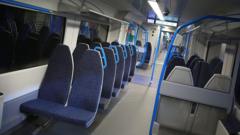
High-capacity rail networks face an immutable physical constraint: the zero-sum allocation of interior volumetric space between seated passengers, standing passengers, and aisle clearance. When Govia Thameslink Railway introduced the Class 700 fleet in 2018 under a 2.8 billion pound investment program, the procurement strategy prioritized high-density layout configurations over ergonomic comfort. The resulting thin-profile cushions—universally castigated by commuters as ironing boards—were a calculated design choice to maximize standing capacity on severely congested core routes.
The announcement that more than 60,000 seat base cushions and backrests across 115 trains will be replaced signals a strategic pivot from pure passenger throughput capacity toward ergonomic remediation. Operating under public ownership following the transition of Govia Thameslink Railway into public control, transport authorities are absorbing the political and financial cost of correcting a design optimization that ignored long-dwell passenger comfort. Analyzing this retrofit requires examining the balance sheet of ergonomic debt, the mechanics of rolling stock modifications, and the structural limitations governing passenger rail design.
The Cost Function of High-Density Fleet Design
Rail operators balancing high passenger volumes across commuter arteries like Bedford to St Pancras operate under strict yield management constraints. Every millimeter dedicated to seat padding reduces the spatial envelope available for standees, thereby lowering the theoretical maximum train capacity during peak crush hours.
The original Class 700 interior specification optimized for two primary variables:
- Aisle Width and Standee Accumulation: Minimizing seat thickness expanded the central aisle clearance, facilitating faster passenger boarding and alighting cycles at high-frequency stations.
- Mass and Energy Efficiency: Lightweight composite seat frames reduced overall train weight, lowering traction energy consumption across frequent acceleration and braking curves.
This optimization function, however, externalized the costs directly onto the commuter. Sitting on low-profile foam for journeys exceeding forty minutes generates cumulative musculoskeletal strain, turning the physical asset of the train into a source of friction between operator and passenger. The decision to retrofit over 60,000 cushion sets acknowledges that the perceived cost of passenger dissatisfaction finally surpassed the operational efficiency gained by ultra-thin padding.
The Mechanics of Fleet-Wide Ergonomic Remediation
Executing a rolling stock overhaul across 115 trains without disrupting daily timetable schedules introduces massive logistical friction. Fleet management teams cannot simply pull an entire sub-fleet out of service simultaneously without collapsing network capacity.
The two-year deployment timeline scheduled to begin next year reflects the operational velocity constraints inherent to heavy rail maintenance.
- Phased Depot Scheduling: Upgrades must be synchronized with routine heavy maintenance windows, restricting installation rates to maintain daily train diagram availability.
- Supply Chain Integration: Manufacturing, shipping, and staging more than 60,000 redesigned cushions requires precise tier-one supplier coordination, with Siemens managing the refit logistics.
- Constraint Retention: Legroom dimensions and cabin layouts remain fundamentally unchanged because structural floor anchors and bulkhead positions cannot be altered without a complete interior gutting.
First-class and standard-class sections receive asymmetrical treatments. While standard-class units gain enhanced base cushioning and modified backrests, first-class sections retain their existing backrest frameworks while receiving upgraded base pads. This tiered approach reflects capital allocation efficiency, directing heavy intervention where passenger volume and public grievance are concentrated.
The Capital and Political Arbitrage of Nationalized Operations
The timing of the seat overhaul, announced less than one hundred days after public acquisition of the operator, highlights the intersection of public sector mandates and capital expenditure visibility. Under previous franchise models, long-term interior modifications required complex contractual renegotiations between the Department for Transport and private operating companies, often stalling aesthetic and comfort upgrades in protracted commercial disputes.
Public ownership collapses this bureaucratic distance. The capital allocation for the retrofit—reportedly absorbed through manufacturer frameworks—serves an immediate signaling function. By addressing high-visibility friction points like seat comfort and rolling stock sanitation, new management secures early wins that validate the transition to state control.
Concurrently, the omission of auxiliary upgrades, such as power sockets, underscores the strict financial boundaries of the project. Ergonomic relief is delivered where it is cheapest to install via cushion replacement, while heavy electrical retrofits requiring wiring loom redesigns are excluded to contain expenditure.
Prioritize targeted depot scheduling and tier-one supply chain synchronization to compress the two-year retrofit window without compromising peak-hour timetable integrity.