The room was always dim, sealed away from the humid Washington summer, thick with the scent of old paper and stale tobacco. On the desk sat a briefcase. It wasn't fancy. It was scuffed at the corners, the leather worn smooth by decades of nervous palms. Inside it lay nothing more than a few yellow legal pads covered in dense, spidery algebra.
Yet, when that briefcase snapped shut, billions of dollars vanished from Tokyo stock tickers. When it opened, a factory worker in Ohio could suddenly afford a mortgage.
For nearly twenty years, Alan Greenspan was the closest thing the modern world had to an economic deity. He didn't command armies. He didn't write laws. He simply adjusted a single, invisible lever—the federal funds rate—and the entire global organism convulsed or sighed in relief.
Now, at one hundred years old, the maestro has gone quiet. His death marks the absolute end of an era when we believed a single human brain could perfectly calibrate human greed and ambition.
To understand the weight of his passing, you have to understand what it felt like to live in his shadow.
The Oracle of the Briefcase
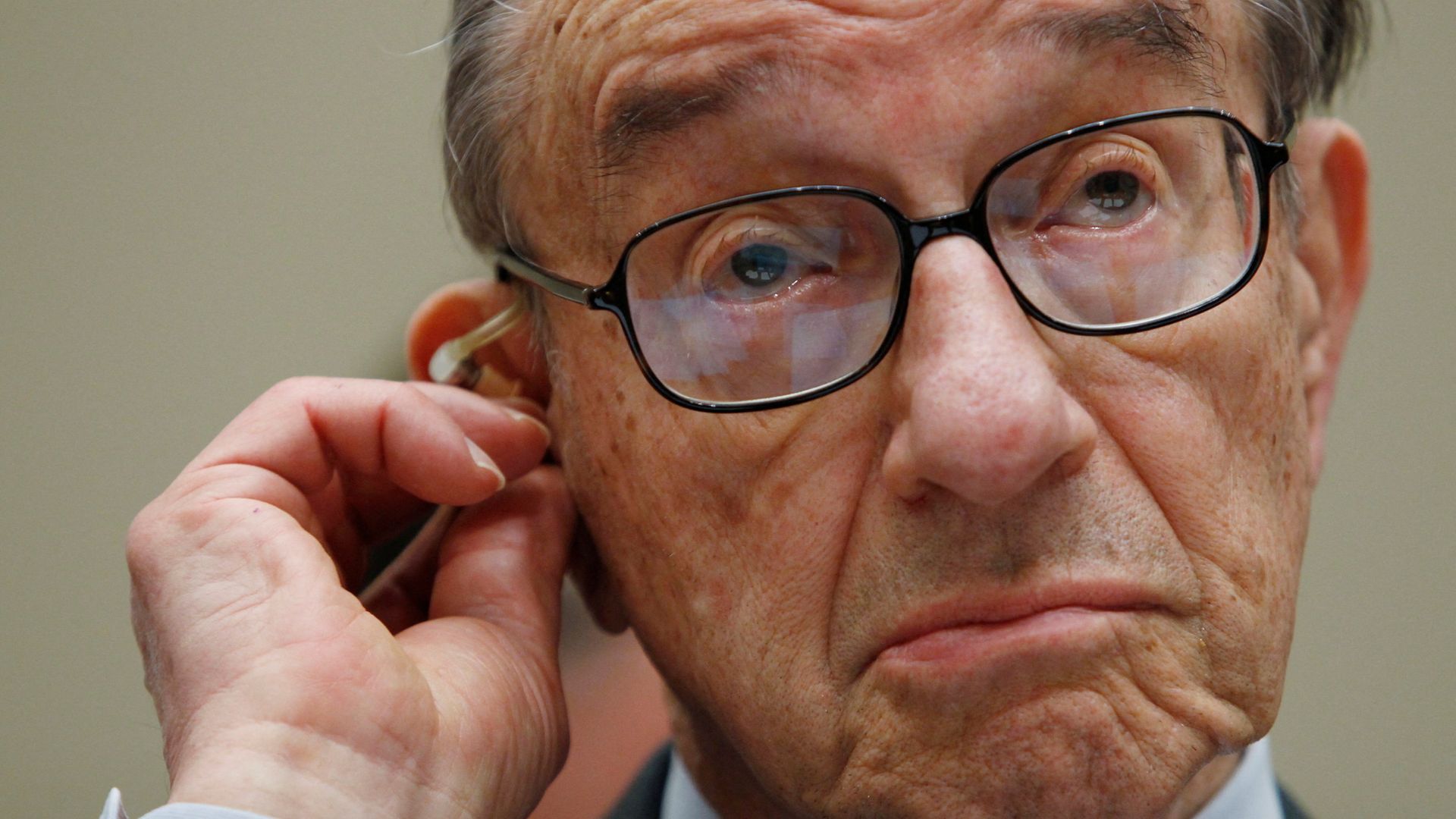
Imagine a young couple in 1996. Let’s call them Sarah and David. They are sitting at a kitchen table, staring at a stack of bank papers, trying to buy their first home. They don’t know anything about macroeconomics. They don’t care about the Federal Reserve. But their entire future hinges on a man they have never met, a man who looks like a somber owl peering through thick, black-rimmed glasses.
Every Tuesday, television networks would broadcast footage of Greenspan walking into the Federal Reserve building. Reporters didn't look at his face; they looked at his hand. Was the briefcase thick and bulging? That meant a mountain of data, suggesting economic trouble or an imminent interest rate hike. Was it thin? The markets breathed easy.
It was absurd. It was tribal. We were reading tea leaves, trying to decode a man who prided himself on being utterly inscrutable.
"If I seem unduly clear to you," Greenspan once famously quipped, "you must have misunderstood what I said."
This wasn’t just a clever line. It was a strategy. Greenspan invented a dialect that Wall Street came to call Fed-speak. It was a dense, impenetrable thicket of clauses, passive verbs, and qualifying phrases designed to calm the markets without committing to anything. He knew that a single misplaced adjective could trigger a panic, causing trillions of dollars to evaporate before lunchtime.
He bore that burden alone. He spent his mornings soaking in a hot bathtub, reading hundreds of pages of obscure economic data—railcar loadings, structural steel orders, the price of scrap metal. He didn't just look at the big picture; he looked at the microscopic gears of the American machine.
The Day the World Broke
Power is a strange thing. It feels absolute until the moment it isn't.
For a long time, Greenspan was infallible. When the stock market crashed in 1987, just weeks after he took office, he flooded the system with cash and saved the financial world from ruin. When the dot-com bubble burst, he lowered rates and kept the engine running. He was hailed as the "Maestro." Time magazine put him on the cover alongside Robert Rubin and Larry Summers, labeling them the "Committee to Save the World."
But the problem with saving the world is that the world begins to believe you can do it forever.
Consider what happened next: the dawn of the new millennium. To shield the country from the economic fallout of the September 11 attacks and the tech bust, Greenspan cut interest rates to historic lows. Money became cheap. It flowed like water, seeking the path of least resistance.
That path led straight to the American housing market.
Suddenly, everyone could buy a house. Subprime mortgages—loans given to people who had no realistic way of paying them back—were bundled together into complex financial instruments, stamped with AAA ratings by agencies that should have known better, and sold across the globe.
Greenspan watched this happen. His philosophy, rooted in the libertarian writings of Ayn Rand, whom he had known in his youth, told him that the market would correct itself. He believed that the self-interest of major banks would prevent them from doing anything truly suicidal.
He was wrong.
The Confession
The true tragedy of Alan Greenspan didn't happen during his tenure. It happened in October 2008, two years after he stepped down, when the entire global financial architecture collapsed into the dust.
He was called before a congressional committee. The room was packed, the air tight with anger. A congressman looked down from the dais and asked him the question everyone wanted answered: Did your ideology lead you to make decisions you now regret?
The old man sat there, looking fragile, stripped of his oracle-like mystique. He admitted, with a quiet, devastating honesty, that he had found a "flaw" in his model of how the world worked.
"A flaw?" the congressman pressed.
"A flaw in the model that I perceived is the critical functioning structure that defines how the world works," Greenspan replied.
It was an astonishing moment of vulnerability. The architect of the modern global economy was admitting that the foundation was built on sand. He had trusted human rationality too much. He had underestimated the sheer, blinding power of collective euphoria and collective panic.
The Silent Legacy
With Greenspan’s death, the conversation inevitably turns to his ledger. Was he the genius who steered America through its longest peacetime expansion, or was he the arsonist who left the matches near the dry wood of the housing market?
The truth is too complicated for a simple verdict.
He was a jazz clarinetist who became a statistician, a man who loved numbers because they didn't lie, only to find himself trapped in a world where numbers were manipulated by human emotion. He showed us that the economy isn't a machine. It's a psychological drama. It is driven by fear, by hope, by the desire of parents to build a better life for their children, and by the greed of traders looking for a quick payout.
Today, the Federal Reserve operates differently. Press conferences are live-streamed. Chairman Jerome Powell speaks in plain English. The era of the mysterious oracle, whispering cryptic phrases from behind a scuffed leather briefcase, is gone forever.
In his later years, Greenspan lived quietly, watching the world he helped build move faster and faster, leaving his analog methods behind. He knew better than anyone that time, like inflation, always wins in the end.
Somewhere in Washington, an old briefcase sits empty, its latches tarnished, holding nothing but the ghost of a time when the whole world stopped to listen to a whisper.


