The paradox of resource recovery manifests when ecological victories trigger economic instability. In the Western and Central Pacific, the spawning biomass of Pacific bluefin tuna (Thunnus orientalis) surged from an endangered baseline of 12,000 metric tons in 2010 to an estimated 144,000 metric tons. This represents a highly successful structural recovery overseen by the Western and Central Pacific Fisheries Commission (WCPFC). However, this population boom has induced an unintended operational crisis for coastal Japanese fishermen. The mechanism driving this crisis is a structural mismatch between dynamic ecological migrations and rigid, static regulatory frameworks.
Rather than maximizing profitability, the abundance of fish has restricted the earning capacity of coastal operators. Understanding this economic friction requires examining the structural bottlenecks across the harvesting, regulatory, and market valuation phases of the domestic supply chain.
The Economics of Fixed-Quota Friction
The core economic vulnerability for Japanese coastal fishermen stems from the design of the international quota allocation system. For the current fishing season, Japan operates under a strict Western and Central Pacific large-fish (30 kg or more) allocation cap of 8,421 metric tons. While this allocation reflects a historic 50 percent increase from previous baseline agreements, it functions as an absolute ceiling. This creates severe operational inefficiencies when confronted with changing migratory densities.
[Increased Spawning Biomass + Climate Shifting]
                       │
                       ▼
       [Abnormal Influx in Nearshore Waters]
                       │
                       ▼
        [Accelerated Quota Exhaustion]
                       │
                       ▼
[Forced Seasonal Shutdown during Peak Valuation Window]
This structural dynamic alters the traditional relationship between fishing effort and financial return through three distinct operational bottlenecks.
1. The Intertemporal Valuation Bottleneck
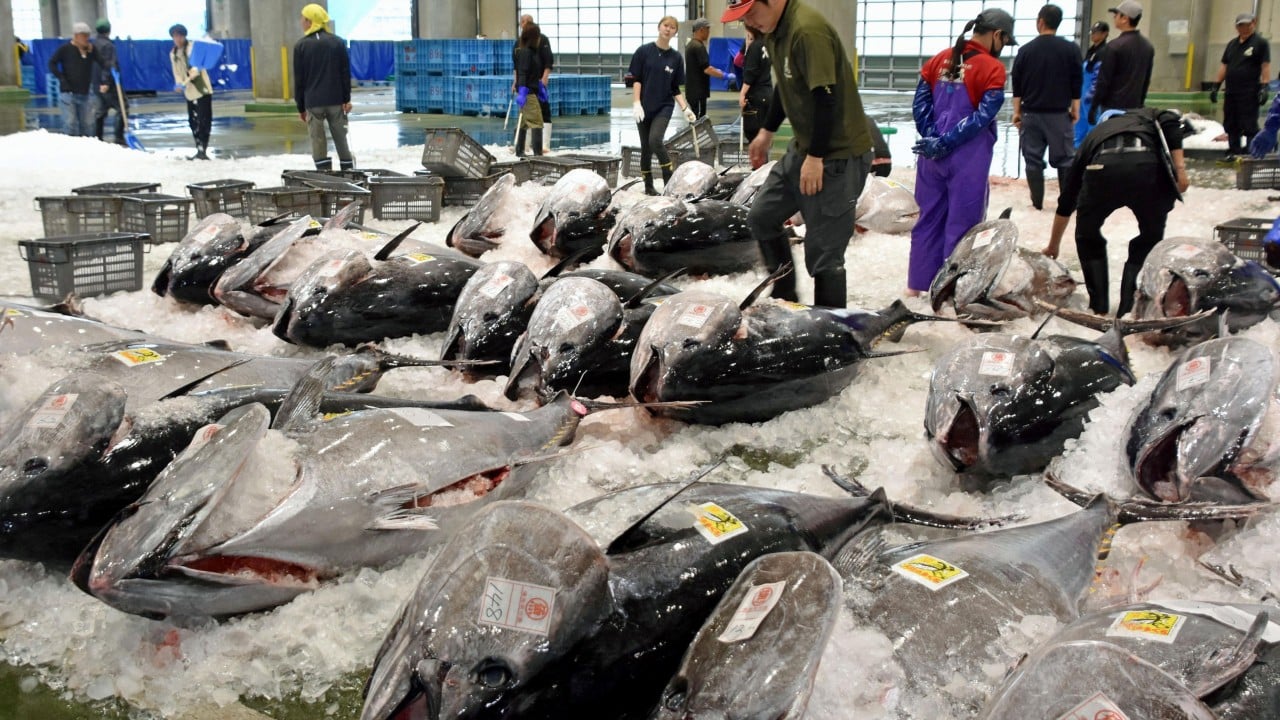
Pacific bluefin tuna exhibit significant seasonal quality variance. Fish captured during late autumn and winter possess substantially higher fat content and optimal marbling. This commands a premium price at wholesale hubs like Tokyo's Toyosu Market. Conversely, spring and summer catches yield lower fat profiles and depressed market values per kilogram.
Because the local tuna density has spiked in early-season waters—partially accelerated by shifting marine isotherms—coastal set-net and line fishermen are filling their strict localized allocations within the first few months of the cycle. By exhausting their legal quotas on low-margin summer catches, operators are systematically locked out of the high-margin winter harvest. They are forced to trade a finite volume asset for suboptimal returns.
2. The Operational Cost of Discarding
Set-net (teibi-ami) operations are inherently non-selective harvesting systems. Large coastal nets capture pelagic species indiscriminately based on migration paths. When a set-net fills with an unexpected school of bluefin tuna after local quotas are exhausted, fishermen face a compounding financial loss:
- Labor Disruption: Crews must spend hours manually sorting and releasing protected large bluefin tuna from the nets, increasing active labor hours and physical depreciation of gear.
- Target Species Displacement: The physical volume occupied by restricted tuna inside the net limits the capacity for other commercially viable, non-quota species like squid or mackerel, directly reducing the net's economic yield per deployment.
3. Domestic Market Saturation and Price Deflation
While high-end sushi bars rely on prime winter catches, the concurrent influx of early-season wild catches and steady outputs from domestic closed-loop aquaculture systems (such as Kindai University's fully farm-raised operations) has altered the domestic supply-demand equilibrium. The localized glut of early-season wild tuna has driven immediate wholesale price deflation at regional ports. Fishermen face a double loss: they are catching fewer fish during peak value windows, and receiving lower prices for the fish they are legally allowed to land early in the season.
Structural Reforms and Regulatory Adjustments
To mitigate this structural friction, Japan's Fisheries Agency has initiated a diplomatic strategy at the WCPFC Northern Committee meetings in Nagasaki to restructure the allocation framework. The proposed strategy aims to realign regulatory policy with contemporary biomass realities through a two-pronged adjustment.
The 25/6 Structural Reallocation Formula
Japan has proposed an automatic, data-driven quota adjustment formula designed to optimize economic yield while preserving reproductive biomass:
- Large Bluefin Increase: An immediate 25 percent increase in the western and central Pacific catch quota for tuna weighing 30 kg or more, expanding legal capacity during high-yield migration waves.
- Juvenile Bluefin Reduction: A simultaneous 6 percent reduction in the allowance for fish weighing less than 30 kg.
The logic behind this asymmetric adjustment relies on population cohort dynamics. By restricting the harvest of juvenile cohorts under 30 kg, the policy protects the future breeding population as they approach sexual maturity. This allows the international management body to justify expanding the immediate harvest of the current surplus of mature, high-value apex adults.
Limitations of the Proposed Framework
The proposed quota inflation is not a comprehensive solution for the coastal fishing sector. International counter-pressures, primarily from conservation-focused delegations like the United States, introduce significant friction to the adoption of these higher limits. These nations emphasize long-term resource preservation over immediate market accommodation.
Furthermore, simply raising global country quotas fails to solve internal domestic allocation issues. The domestic distribution of quota within Japan historically favors industrial purse-seine fleets over small-scale, artisanal coastal line-and-pole operations. If the newly negotiated quota is captured by industrial scale operators, regional coastal economies will continue to face localized closures and asset underutilization.
The optimal long-term strategy for the Japanese domestic fishery requires a structural shift away from volume-based optimization toward an agile, value-indexed allocation model. The Ministry of Agriculture, Forestry, and Fisheries must decentralize quota management to allow real-time, inter-prefectural quota trading and seasonal roll-overs. This adjustment would ensure that regional set-net operations can defer their catch allocations to peak winter valuation windows, successfully balancing ecological abundance with economic sustainability.