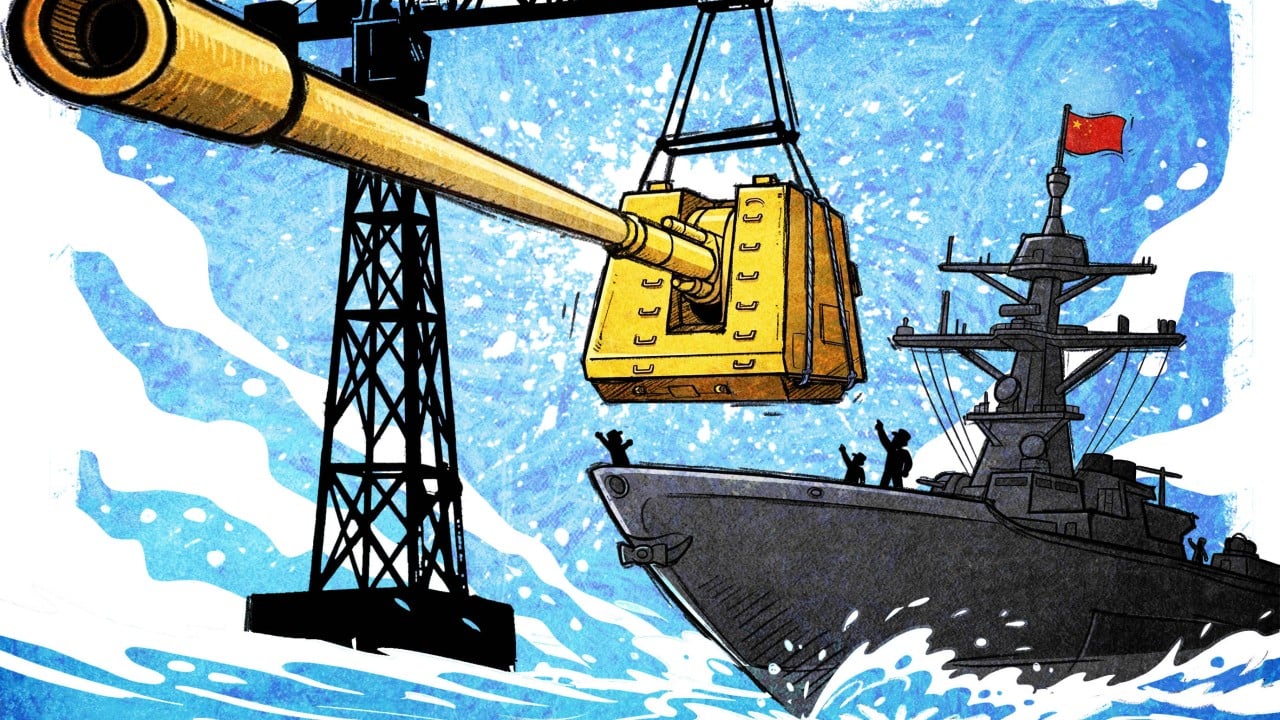
The People’s Liberation Army Navy cannot afford to fight its next war exclusively with missiles. In a high-intensity maritime conflict across the Taiwan Strait or throughout the South China Sea, the world’s largest navy by ship count faces a stark, arithmetic reality: it will run out of precision-guided munitions long before it runs out of targets.
Photographs emerging from the Liaonan shipyard in Dalian reveal China’s pragmatic solution to this structural vulnerability. A massive, previously unseen 155mm naval gun has been integrated onto a Type 910 weapons trials ship for active sea testing. Developed by a subsidiary of state-owned defense giant NORINCO, this 21.8-tonne turret represents the largest caliber main gun mounted on a modern warship today.
The defense establishment has spent decades declaring the era of big naval artillery dead, pointing to the undisputed supremacy of anti-ship cruise missiles and swarms of cheap loitering munitions. China is pointedly reversing this trajectory. This is not a nostalgic retreat into twentieth-century dreadnought tactics. It is a highly calculated, logistically driven insurance policy against the limits of industrial warfare.
The Mathematical Failure of Modern Missile Stockpiles
Modern surface combatants like China's Type 055 cruisers or America's Arleigh Burke-class destroyers are essentially floating multi-mission electronics platforms wrapped around a finite set of Vertical Launch System (VLS) cells. When those cells are empty, the ship is functionally useless.
A standard Type 052D destroyer carries 64 VLS cells. A Type 055 carries 112. In a contested peer-on-peer clash, a single multi-axis saturation attack involving anti-ship missiles and aerial drones could deplete a warship's entire defensive air-defense inventory in a matter of hours. Replacing those missiles requires pulling into a specialized, secure naval port equipped with heavy cranes. Under the threat of long-range ballistic strikes, such replenishment hubs become high-priority targets, choking the logistics chain.
A heavy naval gun offers a continuous, un-jammable alternative. The NORINCO 155mm system bridges the operational gap between lower-tier defensive weapons and high-end strategic missiles. By adapting standard, land-based 155mm artillery ammunition blueprints, the Chinese military bypasses the exorbitant production bottlenecks associated with high-tech rocketry.
Consider the raw economic disparity. A single land-attack cruise missile or advanced anti-ship weapon costs anywhere from $1.5 million to $4 million. Conversely, a standard 155mm artillery round costs between $2,000 and $5,000. Even when upgraded with base-bleed technology or GPS/Beidou satellite-guided kits, these advanced shells remain a fraction of a missile's unit cost.
The Ghosts of Failed Western Programs
Western military observers view China’s 155mm experiment with justifiable skepticism. The historical landscape is littered with failed attempts to bring heavy army artillery to the maritime environment.
Germany attempted the MONARC project, which sought to mount the turret of a PzH 2000 155mm self-propelled howitzer onto a frigate deck. The program dissolved when engineers realized land-based artillery mounts could not survive the highly corrosive, salt-heavy marine atmosphere without catastrophic structural degradation.
The United States stumbled even more spectacularly with the Zumwalt-class destroyer’s Advanced Gun System (AGS). The 155mm AGS was engineered around the Long Range Land Attack Projectile (LRLAP), a highly specialized, rocket-assisted guided shell. When the U.S. Navy slashed the Zumwalt fleet build from 32 ships down to just three, the economies of scale collapsed. The cost of a single LRLAP round skyrocketed to nearly $1 million—equivalent to the cost of a Tomahawk cruise missile. The guns were left without ammunition and are currently being stripped from the hulls to make room for hypersonic missile tubes.
China’s defense industry is attempting to avoid the Zumwalt trap through raw volume and standardization. NORINCO produces millions of 155mm shells annually for the People's Liberation Army's land forces, including the PLZ-05 self-propelled howitzer. By leveraging this pre-existing industrial base, the Chinese navy avoids the specialized ammunition curse that killed the American AGS.
Re-Engineering the Amphibious Assault Calculus
The tactical utility of this weapon becomes apparent when analyzing a potential cross-strait invasion scenario. Suppressing a deeply fortified coastline requires a relentless volume of fire that missiles simply cannot sustain.
During the initial hours of an amphibious breach, an assault force must neutralize hardened coastal artillery, hidden radar installations, anti-ship missile batteries, and reinforced concrete bunkers situated within the immediate tactical depth of the shoreline. If the navy relies solely on its VLS cells for shore bombardment, it actively disarms its own fleet against subsequent air and sub-surface counter-attacks.
A 155mm naval gun firing guided projectiles can reach inland up to 40 kilometers with conventional base-bleed shells. When utilizing rocket-assisted, extended-range smart munitions, that envelope expands past 100 kilometers.
| Weapon System | Projectile Weight | Operational Range | Primary Target Set |
|---|---|---|---|
| H/PJ-26 76mm | ~6 kg | 15 – 20 km | Air defense, light surface craft |
| H/PJ-38 130mm | ~32 kg | 23 – 35 km | General surface-to-surface, shore support |
| New 155mm Prototype | ~45+ kg | 40 – 100+ km | Fortified bunkers, coastal batteries, deep area denial |
The explosive payload of a 155mm shell creates a fragmentation pattern and concussive force vastly superior to the 130mm H/PJ-38 guns currently mounted on China's Type 055 and 052D destroyers. This ensures deep kinetic penetration against entrenched defensive networks, providing a continuous wall of fire that covers the landing craft as they cross the vulnerable littoral zone.
Pragmatism Over the Railgun Fantasy
The emergence of a conventional gunpowder-based 155mm system marks a profound shift in Beijing’s technological expectations. In 2018, international headlines focused on the Haiyangshan, a Type 072 landing ship modified to carry a massive experimental electromagnetic railgun.
The railgun promised hypersonic velocities, extreme ranges, and cheap ammunition. It also brought intractable engineering hurdles. Generating the massive electrical surges required to fire a railgun demanded advanced integrated electric propulsion systems that standard warship hulls could not support. Barrel erosion was catastrophic, with the intense friction destroying the internal rails after a limited number of salvos.
China’s military planners realized that chasing an unproven sci-fi weapon was wasting valuable modernization time. The 155mm conventional gun is the pragmatic pivot. It offers a mature, reliable, and immediately manufacturable alternative that delivers the necessary range and destructive capacity without redesigning the electrical grids of the entire surface fleet.
Where the Big Guns Will Live
It is highly unlikely that China will mount these heavy 21.8-tonne turrets across its entire destroyer fleet. The structural modification required to handle the immense recoil and deck-stress of a 155mm system would require a complete overhaul of existing destroyer hulls.
The weapon is instead destined for specialized fire-support platforms and the expanding amphibious fleet. Speculation points toward integration on future iterations of the Type 071 amphibious transport docks, or even the newly launched Type 076 amphibious assault ship, the Sichuan.
Placing these guns on massive, high-displacement amphibious platforms provides two distinct advantages. First, these large hulls naturally absorb the massive kinetic recoil of heavy artillery. Second, it keeps the fleet's primary air-defense destroyers free to focus entirely on protecting the strike group from external threats, rather than tying them down to dangerous, predictable positions near the enemy coastline.
By turning to conventional heavy artillery, Beijing is acknowledging that technology cannot completely rewrite the fundamentals of prolonged conflict. Precision missiles are excellent for opening salvos, but when the smoke clears and a protracted war of attrition begins, the side that can sustain the cheapest, heaviest volume of fire holds the definitive advantage.