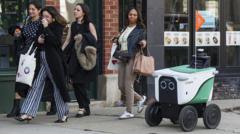
The media wants you to hate the six-wheeled cooler rolling down your sidewalk.
Every few months, a fresh wave of outrage literature hits the press, chronicling the existential dread of neighborhood activists blocks away from a university campus. They paint a picture of public spaces hijacked by silicon valley playthings. They interview a pedestrian who had to step aside, quote a local politician hunting for an easy headline, and declare that the "backlash" has arrived.
It is a comforting narrative. It pits the noble citizen against the faceless tech corporation.
It is also completely wrong.
The hyperventilating over sidewalk delivery bots is a classic displacement of anger. We are blaming automated coolers for exposing the structural, political, and economic rot that has plagued urban planning for a half-century. The robot is not the invader. The robot is the stress test that your city just failed.
The Lazy Consensus of the Robot Backlash
The standard argument against delivery bots relies on three pillars of lazy thinking:
- The Sovereignty of the Sidewalk: The claim that public walkways are sacred spaces being privatized for corporate profit.
- The Hazard Myth: The idea that autonomous rovers are erratic, dangerous obstacles mowing down pedestrians.
- The Labor Fallacy: The belief that blocking these machines protects working-class delivery drivers.
Let us dismantle these one by one, using actual logistics data and the physical realities of urban infrastructure, rather than emotional town hall testimony.
First, the idea that sidewalks are currently uncompromised zones of public utility is laughable. Walk down any major avenue in New York, San Francisco, or London. Your path is blocked by mountains of uncollected trash bags, poorly placed construction scaffolding, illegally parked scooters, and restaurant patio seating that has crept far past its permitted boundaries.
We tolerate immense physical degradation of our walking spaces from private actors every single day. Yet, when a 50-pound electric vehicle traveling at three miles per hour occupies a square yard of concrete to deliver a sandwich, it is treated as an occupying army.
Second, the safety panic is statistically illiterate. According to National Highway Traffic Safety Administration data, vehicle-pedestrian fatalities have hit historic highs over the last decade, driven overwhelmingly by the proliferation of oversized SUVs and distracted driving.
Delivery robots do not kill people. They do not even break bones. They are programmed with hyper-conservative collision avoidance algorithms. If a robot encounters an unpredictable obstacle—like a toddler or a stray dog—it does not barrel through. It stops. It waits. If it gets stuck, a remote human supervisor in an office thousands of miles away takes the sticks and maneuvers it out of the way.
The real hazard on the sidewalk isn't the machine; it's the 15-mile-per-hour electric moped being driven on the walkway by a gig worker desperately trying to beat an algorithmic delivery deadline set by a multi-billion-dollar platform. The bot is the peaceful alternative.
The Real Scapegoat: Infrastructure Blindness
I have spent years analyzing urban logistics networks and watching companies pour millions of dollars into solving the "last-mile" problem. Here is the open secret that nobody in city hall wants to admit: Delivery bots are failing because our cities are built poorly, not because the technology is flawed.
If a robot gets stuck on a curb, the headline reads: Clumsy Robot Blocks Pedestrian.
The actual headline should be: City Fails to Maintain ADA-Compliant Curb Ramps for 30 Years.
The American Society of Civil Engineers consistently gives US infrastructure mediocre grades, with roads and transit systems perpetually underfunded. The broken pavement, missing curb cuts, overgrown tree roots, and winter sidewalks left unshoveled are a daily nightmare for wheelchair users, parents with strollers, and the elderly.
When a delivery robot encounters a sidewalk that looks like a war zone, it stalls. The tech critics cheer. But they are cheering for the visibility of their own city's neglect. The robot is merely a diagnostic tool with wheels. It maps the failures of municipal maintenance in real-time. If a sidewalk is impassable for an autonomous rover, it is impassable for a person with mobility challenges.
Instead of banning the machine, we should be using its telemetry data to sue the public works department.
The Hidden Economics of the Last Mile
To understand why the anti-robot crusade is counterproductive, you have to look at the brutal math of moving goods across a city.
The last mile of delivery accounts for more than 50% of total shipping costs. In a traditional setup, that cost is paid in human exploitation and environmental degradation.
Consider the alternative to the robot. A customer orders a two-pound burrito. To deliver it, a human driver starts a 3,000-pound, gasoline-powered internal combustion engine vehicle. They drive two miles, idle double-parked in a bike lane—forcing cyclists into oncoming traffic—run inside, grab the food, drive to the destination, double-park again, and hand over the meal.
This process is a logistical catastrophe. It produces greenhouse gases, creates dangerous traffic congestion, and relies on an underpaid gig workforce operating without health benefits or job security.
Now look at the mechanical alternative. A small, electric rover draws pennies worth of electricity from a localized grid. It moves at walking speed, stays off the road, and uses zero fossil fuels.
When politicians ban robots to "protect public spaces," they are actively choosing to keep heavy, polluting delivery vans idling in their streets. They are trading an occasional minor sidewalk inconvenience for chronic air pollution and traffic fatalities. It is a terrible trade.
The Labor Fallacy: Who Are We Actually Protecting?
The most cynical angle of the anti-robot backlash is the faux-populist claim that automation is stealing good jobs.
Let’s be precise about the labor we are talking about. Courier work for app-based platforms is grueling, dangerous, and financially volatile. Workers face extreme weather, wage theft via shifting platform algorithms, and a disproportionate risk of being struck by cars.
Furthermore, the deployment of rovers does not eliminate human labor; it shifts it. These machines require fleet mechanics, localized sanitization crews, hardware engineers, and an army of remote tele-operators.
During my time auditing supply chain efficiency, I’ve watched companies realize that managing a fleet of 500 rovers requires a massive local ecosystem of support staff. The jobs do not vanish; they become safer, more stable, and shielded from the elements.
Arguing that we must ban robots to preserve bike courier jobs is identical to arguing that we should have banned washing machines to protect the livelihoods of scullery maids. It is a defense of unnecessary human drudgery.
How to Actually Fix Local Logistics
If we want to address the tension between automation and public space, we need to stop asking the wrong question. The question is not "How do we get rid of the robots?" The question is "How do we design a city that can feed itself without choking on its own transport?"
The solution requires radical, unconventional shifts in how we allocate urban space.
1. Abolish Free Street Parking for Logistics Lanes
The primary reason robots are on the sidewalk is because the street is a lethal dead zone controlled by heavy vehicles. We surrender roughly 20% of our public street space to the free storage of private metal boxes—otherwise known as parallel parking.
If cities reclaimed just one parking space per block and converted it into an "All-Vehicle Micro-Mobility Lane," we could move delivery robots, e-bikes, and motorized wheelchairs off the sidewalk entirely. The conflict vanishes the moment you stop prioritizing parked cars over moving people and goods.
2. Implement Universal Machine Access Tolls
If private companies want to use public infrastructure to move commercial goods, they should pay for the privilege. Cities should charge robot operators a fractional per-mile toll for sidewalk usage.
But here is the catch: every cent of that revenue must be legally earmarked for immediate sidewalk repair and ADA compliance within that specific zip code. If a robot cracks a piece of pavement, its own operating fees should pay to fix it by the end of the week.
3. Establish Micro-Hub Distribution Models
The current model of letting robots roam five miles from a central kitchen to a suburban home is inefficient. True automation requires micro-hubs—modular shipping containers placed in underutilized urban dead zones (like beneath overpasses or inside dead parking garages).
Heavy trucks drop goods at the hub overnight. Small, localized rovers handle the final two blocks during the day. This drastically limits the transit time and keeps the machines contained to predictable, hyper-local loops.
The Downside Nobody Talks About
To be entirely transparent, a pro-robot future is not without friction.
The immediate casualty of automated delivery is not safety or public space; it is urban spontaneity. A sidewalk populated by perfectly optimized, predictable machines is a sterile environment. Robots do not pause to chat with neighbors. They do not patronize local businesses on a whim. They do not add to the cultural fabric of a neighborhood.
If a city becomes purely a machine for the frictionless distribution of goods, it ceases to be a city and becomes an open-air warehouse. That is a legitimate aesthetic and social concern.
But let’s not pretend that a delivery van driver rushing to make 40 drops a day while dodging parking tickets is contributing to the bohemian charm of your neighborhood either. We have already industrialized our streets; we are just squeamish about letting the machines look like machines.
Stop Blaming the Machine
The next time you see a delivery robot paused at a curb, unable to navigate a lip of broken concrete, don't get angry at the company that built it. Don't write a letter to your council member demanding a ban on autonomous vehicles.
Look down at the cracked, crumbling cement beneath its wheels. Look at the gridlocked street next to it, choked with idling box trucks and oversized SUVs occupying space that belongs to the public.
The robot is not the entity destroying the livability of your city. It is simply the only thing small enough, slow enough, and honest enough to show you exactly how broken your neighborhood already is.