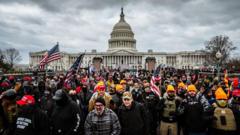
The United States Department of Justice (DOJ) is currently engaged in a forced recalibration of its prosecutorial strategy regarding the January 6 Capitol breach. This shift is not a matter of judicial leniency but a direct response to the Supreme Court’s ruling in Fischer v. United States, which narrowed the application of 18 U.S.C. § 1512(c)(2). By redefining "obstruction of an official proceeding," the Court effectively removed a cornerstone of the government’s charging framework, creating a systemic requirement to vacate or dismiss convictions that relied on an overextended interpretation of the statute.
The Mechanical Failure of the Broad Interpretation
For three years, the DOJ operated under the theory that § 1512(c)(2) served as a "catch-all" provision for any conduct that "otherwise obstructs, influences, or impedes any official proceeding." This interpretation allowed prosecutors to apply a felony charge—carrying a 20-year maximum sentence—to individuals whose primary actions were physical entry and disruption rather than document destruction or evidence tampering.
The Fischer decision corrected this by applying the principle of ejusdem generis. The Court ruled that subsection (c)(2) must be read in the context of subsection (c)(1), which focuses on the alteration or destruction of records, documents, or other objects. To sustain a conviction under (c)(2), the government must now prove that the defendant’s actions specifically targeted the integrity or availability of physical evidence used in the proceeding.
This creates a distinct "Evidence Linkage Requirement." If a defendant entered the Capitol to protest but did not attempt to seize, destroy, or manipulate the electoral ballots or specific physical records of the joint session, the (c)(2) charge becomes legally insolvent.
Categorizing the Impacted Caseload
The DOJ’s effort to throw out or revise these convictions follows a logical sorting process based on the "Purity of the Charge." Defendants fall into three primary risk tiers:
1. The Single-Charge Vulnerability
The highest priority for dismissal involves defendants convicted solely of the § 1512(c)(2) felony. Without a secondary felony to anchor the sentencing, the government has no legal standing to maintain incarceration. In these instances, the DOJ is proactively filing motions to vacate to preempt inevitable defense appeals, thereby conserving judicial resources.
2. The Multi-Charge Buffer
Many defendants face a "stack" of charges, including 18 U.S.C. § 1752 (restricted building or grounds) and 40 U.S.C. § 5104 (parade or demonstration in a Capitol building). While the (c)(2) felony might be the most severe, its removal does not vacate the entire conviction. However, it triggers a "Sentencing Decay." Because the remaining charges are often misdemeanors, the total time served may already exceed the maximum allowable sentence for the surviving counts, necessitating immediate release.
3. The Evidence-Rich Exceptions
The DOJ is not abandoning (c)(2) across the board. Prosecutors are currently auditing files for evidence of "Document-Centric Interference." Individuals who targeted the mahogany boxes carrying the electoral certificates or who attempted to delete electronic data used in the certification process remain within the narrowed scope of the Fischer ruling.
The Jurisdictional Bottleneck and Resource Allocation
The mandate to review hundreds of cases introduces a massive operational overhead. The DOJ must perform a case-by-case "Evidence Re-Evaluation," which involves:
- Transcription Audit: Reviewing trial transcripts to determine if the jury instructions relied on the now-defunct "broad" definition of obstruction.
- Plea Integrity Checks: Assessing whether defendants who pleaded guilty did so under a "Mistake of Law." If a defendant admitted to "obstructing" under the old definition, their plea may be considered involuntary or legally insufficient.
- Sentencing Re-Calculations: Adjusting the "Offense Level" under the U.S. Sentencing Guidelines. The removal of a Level 14 or higher felony significantly shifts the "Zone" in which a defendant sits, often moving them from a "Mandatory Imprisonment" category to "Probation Eligible."
This creates a "Prosecutorial Opportunity Cost." Every hour spent retroactively fixing 2021 convictions is an hour lost on active investigations or higher-priority felony cases. The decision to "throw out" convictions is a pragmatic move to stop the bleed of departmental man-hours.
The Causality of the Fischer Ripple Effect
The collapse of the broad (c)(2) interpretation has a cascading effect on the federal sentencing math. Under the Sentencing Guidelines, the "Aggregate Offense Level" is determined by the most serious count. When the (c)(2) charge—often the anchor of the prosecution's strategy—is removed, the mathematical foundation for the sentence vanishes.
This leads to "Sentencing Disparity Inflation." If the DOJ does not proactively vacate these counts, individuals with nearly identical conduct would serve vastly different sentences based solely on whether their cases were adjudicated before or after the Fischer ruling. To maintain the appearance of institutional integrity, the DOJ must normalize these sentences through mass motions to vacate.
The Collateral Consequences of Felony Reclassification
A felony conviction carries weights beyond prison time, known as "Collateral Consequences." These include the loss of voting rights, firearm ownership, and professional licensure. By downgrading these convictions to misdemeanors or dismissing them entirely, the DOJ is effectively restoring these civil rights to hundreds of individuals.
The "Legal Liability Loop":
- Vacated Conviction: The underlying felony is nullified.
- Restoration of Status: The individual is no longer a "convicted felon."
- Expungement Pressure: While federal expungement is rare, the move increases pressure on the executive branch for formal pardons or commutations to clean the administrative slate.
Structural Limitations of the Current Strategy
The DOJ's strategy is limited by the "Finality of Judgment" principle. While they are moving quickly on pending cases and those on direct appeal, individuals who have already completed their sentences and exhausted their appeals face a much higher bar for relief (typically requiring a writ of habeas corpus under 28 U.S.C. § 2255).
The government is prioritizing "Active Custody" cases. This creates a hierarchy of relief where the most "aggrieved" (those currently in prison) are serviced first, while those who have already paid the price of the overextended statute remain in a legal limbo.
Tactical Realignment for Future Prosecutions
Prosecutors are now shifting their reliance to 18 U.S.C. § 1512(k) (conspiracy to obstruct) and 18 U.S.C. § 231 (civil disorder). The "Civil Disorder" statute is becoming the new preferred felony for non-violent but disruptive entries, as it focuses on the "interference with a law enforcement officer" rather than the "obstruction of the proceeding."
This shift reveals a "Statutory Substitution" tactic. The DOJ is not reducing its intensity but is instead swapping a broken tool (the broad § 1512(c)(2)) for a more resilient one. This ensures that future cases are "Fischer-proof."
The immediate strategic requirement for the DOJ is to execute a "Clean Break" from the previous interpretation. This involves conceding all vulnerable (c)(2) counts where no physical evidence tampering occurred. By doing so, they protect the remaining convictions from being overturned on "Contamination" grounds—where an invalid charge is argued to have prejudiced the jury's view of valid charges. The goal is to isolate the failure, cauterize the legal wound, and stabilize the remaining caseload against further Supreme Court scrutiny.