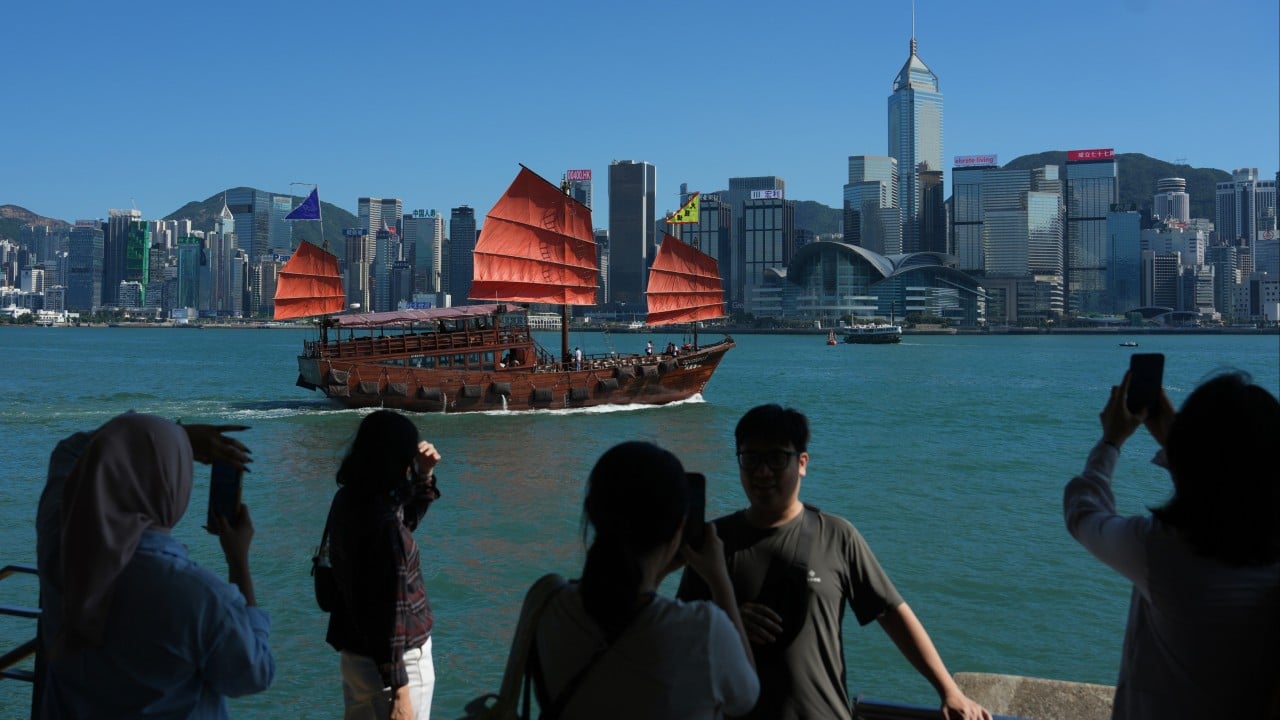
The rain over Victoria Harbour rarely falls straight down. It sweeps sideways off the South China Sea, salt-heavy and slate-grey, plastering the glass of the International Finance Centre until the view of Kowloon dissolves into a smeared watercolor.
Up on the forty-second floor, the coffee in the paper cup has gone cold. Arthur Vance does not notice. His eyes are fixed on a blinking cursor in a spreadsheet that tracks capital migration across three time zones. For twenty-five years, Arthur has advised British and American firms on where to plant their flags in Asia. He has watched capitals boom, panic, restructure, and reinvent themselves. For a closer look into this area, we recommend: this related article.
Right now, the headlines blaring from London and New York are filled with obituaries. They write about an exodus. They talk about closed doors, tightened loops of regulatory anxiety, and the quiet bleeding of talent.
Arthur takes a sip of the bitter dregs, looks out at the grey blur of the harbor, and laughs. A dry, short sound. For further background on this issue, detailed coverage is available on Forbes.
"The pundits are reading the wrong ticker," he says, gesturing to the open window where the ferry horns are sounding below. "They look at the noise. We look at the ledger."
To understand why United States and United Kingdom corporations continue to set up shop, expand desks, and pour billions into Hong Kong despite years of geopolitical friction, you have to abandon the comfort of ideological abstraction. You have to walk the ground where capital actually moves.
Money has no flag. Money has a compass. And its needle keeps spinning back toward the Pearl River Delta.
The Anatomy of an Unbreakable Habit
Consider the journey of Marcus, a thirty-eight-year-old managing director at a mid-sized London fintech specializing in cross-border supply chain financing. Six months ago, Marcus sat in a glass-walled conference room in the City of London, listening to his board express deep reservations about a proposed expansion into Hong Kong.
The air in the room was thick with caution. The board members cited the headlines. They worried about compliance nightmares, shifting legal frameworks, and the reputational optics of doubling down on a market that mainstream Western commentary had consigned to a protracted twilight.
Marcus listened, nodded, and then slid a single sheet of paper across the polished mahogany table.
On it were three columns: Friction, Velocity, and Access.
"If we set up in Singapore," Marcus told the board, "we get stability, but we fight for talent, and our access to the mainland's secondary manufacturing hubs runs through three layers of intermediaries. If we stay entirely in London, we watch our competitors lock down the Asian supply chains while we wait for overnight trading windows to clear. But if we go to Hong Kong, we inherit a common-law judicial tradition that our legal team already understands, a tax structure that rewards reinvestment, and a physical desk fifty miles from the factories that build the hardware our clients sell."
The board fell silent. They were looking at spreadsheets, but Marcus was talking about gravity.
Commerce is fundamentally lazy. It seeks the path of least resistance combined with the highest possible return. For over a century, Hong Kong engineered itself precisely to be that path. It is an operating system built for transactions. The infrastructure—the deep-water port logistics, the lightning-fast clearing houses, the network of accountants, lawyers, and arbitrators who speak fluent English, Cantonese, and Mandarin—did not vanish overnight because a treaty changed or a press release was issued.
When Algernon Yau, the city's Secretary for Commerce and Economic Development, looks out at the foreign chambers of commerce, his message is almost aggressively mundane. It can be summarized in five words: Money is money.
Bureaucrats in Washington and London can debate the weather. CFOs in Mayfair and Manhattan care about the climate control. And the climate control in Hong Kong remains remarkably hospitable to profit.
The Reality Behind the Rhetoric
To suggest that nothing has changed would be intellectually dishonest. Everything has changed, and nothing has changed.
The political architecture of the city underwent a seismic realignment over the past half-decade. National security legislation, electoral overhauls, and a tightening integration with Beijing's overarching administrative apparatus have altered the political grammar of the territory. Protest banners are gone. The old, freewheeling street life has been subsumed by a quieter, more ordered rhythm.
For Western executives raised on a steady diet of political pluralism as a prerequisite for commerce, this transition was jarring. Many packed their bags. Families who had spent generations in Repulse Bay villas relocated to the leafy suburbs of Singapore or packed for home. The expatriate community shrank in sheer headcount, leading to a narrative of total desertion.
Yet, headcount is a misleading metric. A hundred lifestyle expats leaving do not alter the balance sheet of a multinational investment bank that just deployed three hundred quantitative analysts to trade mainland equities through the Stock Connect program.
The numbers tell a story that defies the partisan talking points. According to official census and economic data, thousands of regional headquarters and offices continue to operate within the territory, with US and UK firms maintaining a formidable footprint. They are not here out of nostalgia. They are here because the math works.
Let us break down the underlying mechanics that keep Western capital anchored to these steep, neon-drenched hills:
The tax regime remains a sanctuary for corporate margins. A maximum profits tax rate of sixteen point five percent, paired with a territorial source principle of taxation, means that capital generated outside the jurisdiction largely stays untouched by local levies. For a British holding company navigating the labyrinthine tax burdens of post-Brexit Europe, Hong Kong’s fiscal simplicity is a relief valve.
The currency peg to the US dollar offers predictability. In an era of rampant macroeconomic volatility and fluctuating emerging-market currencies, the peg provides a reliable anchor for trade settlement. When a New York fund manager prices an asset in Hong Kong dollars, they know the floor will hold.
The proximity to the Greater Bay Area transforms the city from an isolated island into the gateway of a sprawling industrial engine. Shenzhen is forty minutes away by high-speed rail. Guangzhou is just beyond. Together, this urban cluster represents a combined GDP that rivals major national economies, teeming with hardware startups, biotech laboratories, and manufacturing giants hungry for Western capital and global capital markets.
The Midnight Trader
Step back down from the forty-second floor to the trading desks at midnight.
The city outside is quiet now, save for the hum of air conditioners and the occasional rumble of a tram climbing Happy Valley. Inside the room, screens glow in hues of electric blue and amber.
Elena, a twenty-six-year-old compliance analyst originally from Manchester, is running through a checklist of cross-border transactions. Her coffee is also cold. She arrived in Hong Kong eighteen months ago, having accepted a secondment that her friends back home treated almost like a deployment to a remote outpost.
"They thought I was walking into a movie about corporate espionage," Elena says, her fingers flying across the mechanical keyboard. "They asked if I was scared. I told them I was too busy updating compliance protocols to be scared."
Elena’s daily reality is not a geopolitical thriller. It is an endless exercise in logistics, data verification, and liquidity management. She helps route capital from London institutional investors into green energy projects in southern China, balancing UK regulatory standards with mainland reporting requirements.
She sees the friction points firsthand. She knows where the bureaucratic bottlenecks pinch. She has felt the chill of uncertainty when diplomatic tensions flare between Washington and Beijing.
Yet, she also sees the sheer kinetic energy of the system. Money moves through this hub with a velocity that London and New York can rarely replicate when dealing directly with Asian counterparties. The time-zone alignment with Tokyo, Singapore, Shanghai, and Sydney creates a continuous twenty-four-hour desk capability that makes Western hubs look sluggish by comparison.
"People back home want everything to be black and white," Elena reflects, pausing for a moment to watch a cargo ship maneuver through the dark waters of the harbor. "They want Hong Kong to either be a total dystopia or the exact same playground it was in nineteen-ninety-nine. It’s neither. It’s a machine. And if you know how to operate the machine, it generates results that make the boardrooms back in the UK stop asking questions about the headlines."
The Persistence of Profit
There is a profound lesson here about the nature of modern globalization.
We often make the mistake of assuming that commerce follows ideology. We want to believe that corporations vote with their values, that capital packs its bags the moment political liberties are curtailed, and that economic systems operate as moral arbiters.
History consistently disproves this comforting illusion. Capital does not have a conscience; it has an objective. It seeks return, security of contract, liquidity, and infrastructure.
When US and UK firms continue to expand their presence in Hong Kong, they are not endorsing every policy shift issued from administrative offices. They are performing a cold, rational calculation. They are weighing the noise of international politics against the unyielding reality of market access.
The skyscrapers along the waterfront are not monuments to political compliance; they are monuments to inertia and efficiency. Once an economic ecosystem reaches a certain density of talent, legal infrastructure, and capital liquidity, it becomes nearly impossible to replicate elsewhere. You can build a shiny new financial district in another coastal city, but you cannot easily transplant the centuries of institutional muscle memory that allow a billion-dollar deal to clear in seconds.
Arthur Vance turns away from the window as the first pale light of dawn begins to stain the clouds above the Peak. The rain has stopped, leaving the asphalt of Des Voeux Road gleaming like polished obsidian.
He closes his spreadsheet, shuts down his terminal, and grabs his coat. Downstairs, the morning rush is beginning. Taxis are honking. Office workers in crisp suits are pouring out of the MTR stations, carrying takeout breakfast and scrolling through their phones.
In a few hours, the markets will open. The buy orders will post. The wires will hum beneath the pavement.
The pundits will keep writing their elegies in London and New York. And the money will keep flowing through the ledger beneath the skyline.