Silence.
In Silicon Valley, silence is rarely peaceful; it is the sound of a vacuum forming right before a hurricane hits, a pressurized quiet where billion-dollar valuations either crystallize or shatter against the cold realities of physics and market sentiment. For years, the loudest sound in modern computing was the hum of Nvidia’s data center GPUs—millions of silicon engines stacked in windowless warehouses from Iowa to Dublin, burning megawatts to teach machines how to speak, code, and dream. And standing at the center of that deafening roar was a man who never seemed to take off his black leather jacket, a founder who had willed a graphics card company into a multi-trillion-dollar colossus. Discover more on a related topic: this related article.
Then came the stumbles. The rumors. The sudden, terrifying realization that even the sharpest empire in technology can bleed when the ground shifts beneath its feet.
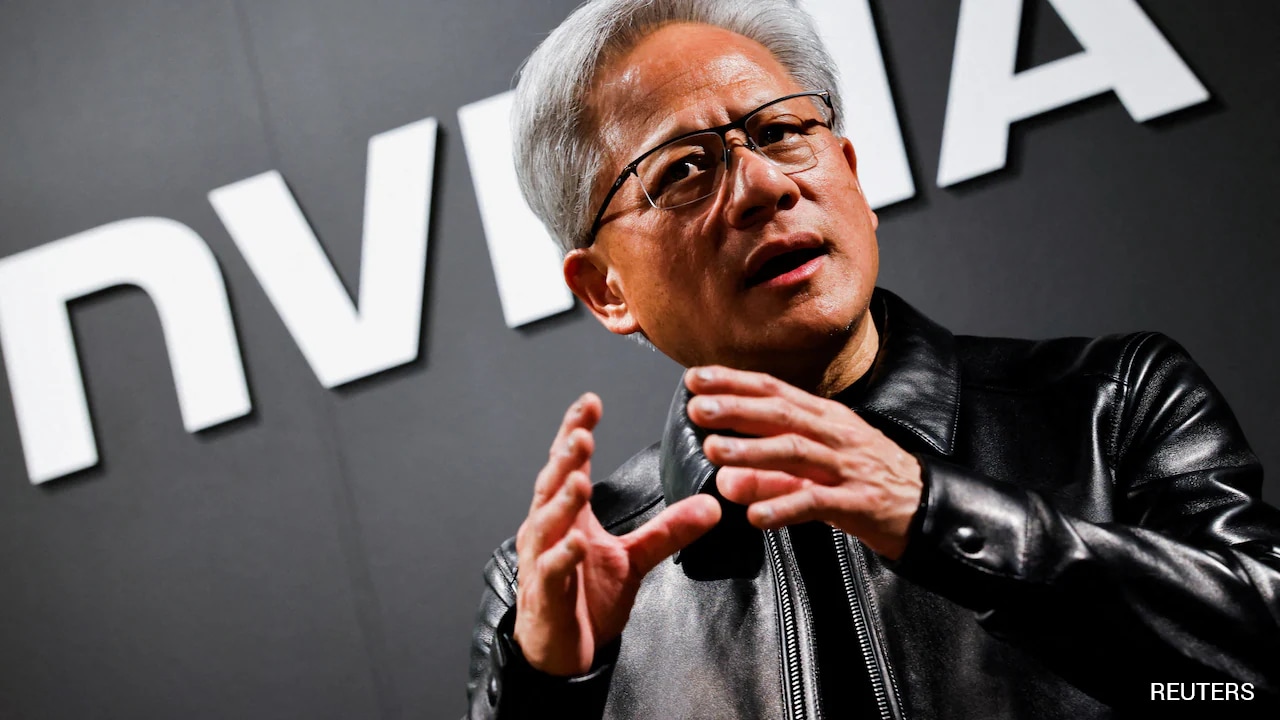
When reports began circulating recently that Jensen Huang was eyeing a fierce comeback as Nvidia’s chief executive—and that his closest inner circle had quietly assembled a high-stakes "war room" to engineer it—the financial press treated it like another boardroom chess match. They published dry bullet points. They cited anonymous sources, quarterly guidance adjustments, and supply chain bottlenecks. They wrote about stock tickers as if they were weather patterns rather than the distilled anxiety of hundreds of thousands of engineers, pensioners, and dreamers whose futures are tethered to a single company’s survival. More analysis by Financial Times delves into similar perspectives on this issue.
They missed the point entirely.
To understand why a war room is currently operating behind closed doors in Santa Clara, you have to strip away the spreadsheets and look at the human anatomy of a reckoning. You have to look at what happens when the architect of an era discovers that the building is creaking under its own weight.
The Architecture of a Fall
Nobody builds a monopoly by accident, and nobody watches it wobble without feeling the vertigo in their teeth.
Consider the hypothetical reality of an engineering lead—let’s call her Elena—sitting on the fourth floor of Nvidia’s Endeavor building at two in the morning. Elena isn't thinking about price-to-earnings ratios. She is staring at thermal dissipation telemetry on a dual-monitor setup, the blue light reflecting off cold coffee in a ceramic mug. For five years, her team had one mandate: make the next generation of silicon faster than the laws of thermodynamics seemed to allow. Every eighteen months, they delivered a miracle. Hopper. Blackwell. Rubin. Each architecture wasn't just an upgrade; it was an ambush on the competition.
Until the competition stopped playing Nvidia’s game.
Here is the unvarnished truth that business analysts bury beneath jargon: Nvidia’s dominance was never just about hardware. If it were only about chips, another billionaire could have thrown fifty billion dollars at a foundry in Taiwan and copied the blueprints. Nvidia’s real moat was CUDA, a proprietary software ecosystem that Huang bet the entire company on nearly two decades ago, long before anyone cared about neural networks. Think of CUDA like the electrical grid of a sprawling metropolis. You might be able to build a cheaper, slightly faster generator in your backyard, but every appliance, streetlight, and subway train in the city is already wired into the municipal grid. Rewiring the city isn't just expensive; it is a logistical nightmare that takes years.
Yet, by late 2025 and into 2026, the city started buying generators anyway.
Hyperscalers—the cloud giants who used to write blank checks to Santa Clara—began aggressively deploying their own custom silicon. Open-source translation layers matured to the point where code written for Nvidia’s grid could run on rival hardware with minimal friction. Meanwhile, the broader market began asking an uncomfortable, existential question that echoed through every earnings call like a gunshot in a canyon: Where is the return on investment?
Companies had spent hundreds of billions of dollars buying the shovels for the artificial intelligence gold rush, only to realize they hadn't found enough gold to pay for the hardware. Orders slowed. Deployment timelines stretched. Architectural delays on next-generation racks created rare openings for rivals to slip through the door. For the first time in a decade, the invincible aura around Nvidia cracked. The stock swung wildly, shaving hundreds of billions of dollars off its market cap in weeks, turning paper billionaires back into mere millionaires and triggering the kind of boardroom whispers that every founder dreads.
Is Jensen losing his touch? Has the company grown too bureaucratic, too slow, too drunk on its own mythology to fight like an underdog again?
Inside the War Room
I have sat in corporate crisis rooms during product recalls and hostile takeover attempts, and the air inside them always smells the same: stale espresso, dry-erase markers, and adrenaline. There is no corporate theater left when survival is on the line. The slides lose their glossy animations. People stop saying "let's circle back" and start speaking in blunt, jagged fragments.
According to the reports detailing Nvidia’s internal mobilization, the "war room" formed by Huang’s allies isn't a public relations bunker designed to spin bad news to Wall Street. If it were, it would fail before the first press release hit the wire. You cannot sweet-talk a data center operator who is looking at power consumption metrics, and you cannot charm an institutional investor who is watching gross margins compress.
Instead, this gathering of veteran lieutenants, chief architects, and battle-hardened strategists represents a deliberate, psychological rewiring of the entire organization.
For years, Huang famously avoided traditional corporate hierarchies. He refused one-on-one meetings with direct reports, insisting that information flow openly in large group settings so that bad news couldn't hide in dark corners. He maintained dozens of direct reports, operating less like a ceremonial CEO and more like a relentless field commander who knew the thermal tolerances of every transistor on the floor.
Success, however, breeds its own kind of insulation. When a company swells to tens of thousands of employees and commands the attention of heads of state, layers inevitably form. Filters appear. People begin managing upward, polishing rough edges before the boss sees them, protecting their fiefdoms instead of attacking the market.
The war room is the antidote to that rot.
Its purpose is singular: to strip away three years of imperial complacency and restore the ferocious, desperate paranoia that saved Nvidia from bankruptcy in the 1990s. Remember—and it is astonishing how quickly people forget this—Nvidia came within thirty days of running out of cash in 1996. Its early graphics chips were architectural dead ends. Huang had to beg Sega’s executives to let him keep a five-million-dollar investment even while admitting that Nvidia’s technology couldn't fulfill their contract. That brush with corporate death seared a permanent motto into the company’s walls: Our company is thirty days from going out of business.
When you are worth trillions, nobody believes that motto anymore. It becomes wallpaper. The war room exists to make everyone believe it again.
The Invisible Stakes of a Comeback
Why should anyone outside of Silicon Valley or Wall Street care whether a sixty-something tech billionaire engineers a second act?
Because the modern economy has quietly placed an unprecedented wager on a single point of failure.
Look at your retirement account, your pension fund, or the broader index funds that underpin middle-class wealth across the Western world. Over the past three years, Nvidia’s trajectory became the load-bearing beam of the entire equity market. When Nvidia surged, it pulled the S&P 500 upward, masking weakness in manufacturing, commercial real estate, and consumer spending. When Nvidia stumbled, the tremors rattled currency markets in Tokyo and bond desks in London.
Beyond the financial plumbing lies something far more tangible: the physical infrastructure of the next century.
Walk past a modern AI data center today and you aren't looking at an office building; you are looking at a massive heat exchanger wrapped in concrete and barbed wire. These facilities consume as much electricity as mid-sized cities and drink millions of gallons of water to keep the silicon from melting. Nvidia’s roadmap dictates how much power grids need to expand, how nuclear reactors are recommissioned, and whether the next generation of medical research and climate modeling accelerates or stalls out under the weight of prohibitive compute costs.
If Huang’s comeback falters—if Nvidia retreats into defending its legacy turf rather than reinventing the frontier—the entire pace of technological deployment hits a wall. Rivals might gain market share, certainly, and competition is healthy in the long run. In the short term, however, a fragmented hardware ecosystem forces software developers to spend years rewriting foundational code instead of building new tools. Innovation slows to a crawl while engineers argue over compilers.
To illustrate the difference, imagine a global shipping industry where every port suddenly decided to use a different size shipping container. Eventually, cranes would adapt, and new logistics networks would emerge. For five years, though, goods would rot on the docks while the world re-engineered the boxes.
That is the invisible stake sitting on the table inside that Santa Clara war room.
How You Reinvent a Titan
So what does a genuine comeback actually look like when you are already the biggest player on the board? You cannot simply announce a faster chip. The market has grown numb to teraflops and parameter counts.
Based on the behavioral patterns of founders who have successfully pulled off second-act transformations—think of Steve Jobs returning to a bleeding Apple in 1997, or Satya Nadella dismantling Microsoft’s Windows-first dogma in 2014—Huang and his allies have to execute three brutal pivots simultaneously.
First, they must cannibalize their own cash cows.
Every dominant technology company dies the same way: it protects its highest-margin product until a cheaper, scrappier alternative renders that product obsolete. For Nvidia, the temptation is to milk massive training clusters for as long as cloud providers will buy them. The war room’s hardest task is forcing the organization to pivot aggressively toward inference—the actual day-to-day running of AI models at the edge, on smaller, radically more power-efficient architectures—even if those chips carry lower margins than the monolithic data center racks that built the empire.
Second, they must move up the stack from components to outcomes.
Selling picks and shovels works wonderfully until everyone has a shed full of shovels. To survive the inevitable commoditization of raw compute, Nvidia has to become indispensable at the software and enterprise workflow level. That means turning Nvidia NIMs, digital twins, and industry-specific AI blueprints into the default operating system for pharmaceutical companies, robotics manufacturers, and sovereign governments. If a hospital chain in Germany or an automaker in Japan can deploy an autonomous system in weeks using Nvidia’s pre-packaged software stack, they won't care if a rival chip is ten percent cheaper on paper.
Third, Huang himself has to trade ubiquity for surgical focus.
For two years, Jensen Huang was everywhere—signing autographs in night markets in Taipei, delivering two-hour keynotes in packed hockey arenas, becoming a pop-culture icon in a leather jacket. Fame is intoxicating, and it is also a massive tax on attention. A comeback requires retreating from the spotlight, shutting the door on the victory tour, and returning to the unglamorous, obsessive product reviews where great engineering is actually forged.
The Weight of the Jacket
I admit, watching this unfold carries a strange, unsettling tension. Part of us roots for the underdog—the upstart chip designer in a garage or the open-source collective trying to break a monopoly’s grip on the future of intelligence. Monopolies make us nervous, and they should. Concentrating that much computational power and market value under one roof carries systemic risks that no single executive, no matter how brilliant, can fully anticipate.
Yet there is another part of us that recognizes how rare true builder-founders actually are. Most modern corporations are run by caretakers—polished executives trained to smooth out volatility, buy back shares, and avoid any risk that might jeopardize their next bonus cycle. They preserve value until there is nothing left to preserve.
Jensen Huang is not a caretaker. He is a builder who happens to be staring down the ultimate test of a founder’s life: proving that his greatest triumph wasn't just a lucky collision with history, that he didn't merely catch a generational wave, but that he actually knows how to make the ocean move when the tide goes out.
Late at night, long after the financial commentators have signed off and the algorithmic trading bots have gone quiet, the lights in Santa Clara stay on. Inside a conference room stripped of trophies and press clippings, a group of exhausted engineers and executives are hunched over whiteboards, erasing old assumptions and drawing new architectures from scratch. Outside, the California night is cool and indifferent. Inside, the jacket is off, the sleeves are rolled up, and the clock is ticking down from thirty days all over again.